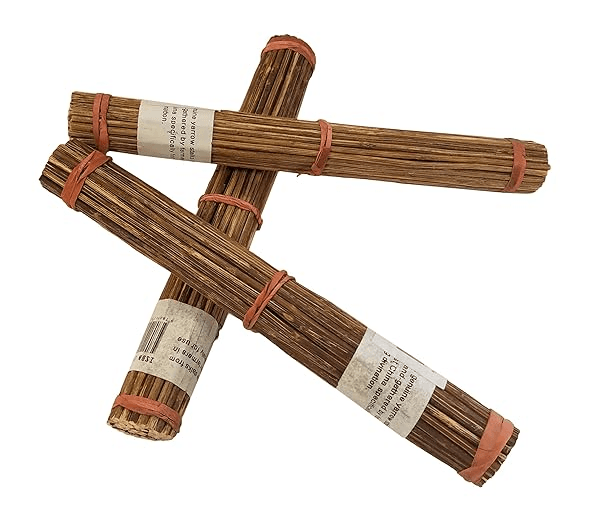
The Yarrow Stalk Method: A Conversation with the Universe
Let me tell you about one of the oldest ways humans have tried to peek into the future. It's called the yarrow stalk method, and it's been around for about three thousand years.
""The great number is fifty. Use forty-nine of them." — The Zhou Yi (Book of Changes)
What's the Deal with Yarrow?
Yarrow is just a plant. A slow-growing one that the ancient Chinese believed had a special connection to the heavens. They thought if you let yarrow grow for a hundred years, it became magical. So they used its dried stalks to ask the universe questions.
You need fifty stalks to do this right. Each one about a foot long, dried and straight. These days, most people use chopsticks or wooden sticks instead. The plant doesn't matter as much as what you do with them.
Before You Start
Here's the thing about divination — it's not just a trick. It's a ritual. The old texts say you should wash up, burn some incense, and clear your mind. Think of it like meditation meets fortune-telling.
You have one question in mind. Not vague stuff like "Will I be happy?" but something real. Something that keeps you up at night.
The One Stalk You Never Use
So you have fifty stalks. But you only work with forty-nine. That one stalk you set aside? It represents the beginning of everything — before yin and yang split apart, before there was anything at all.
It just sits there, doing nothing. But that's the point. It reminds you that behind all the changes and chaos, there's something that never changes.
How the Magic Happens
Now comes the fun part. You're going to create one line of your hexagram. A hexagram has six lines, and each line needs three rounds of dividing and counting. That's eighteen rounds total for one reading.
Take your forty-nine stalks and split them into two random piles. Put them on your left and right. Left is heaven, right is earth. You've just created the universe on your table.
Take one stalk from the right pile and tuck it between your fingers. That one represents humanity — now you've got heaven, earth, and humans all in place.
Count through the left pile by fours. Keep going until you have four or fewer stalks left. Do the same with the right pile. Whatever's left over goes aside with the stalk between your fingers.
Why four? Because there are four seasons. Everything in this method connects to something bigger.
Three Rounds, One Line
That was just round one. Take what's left and do it again. And then a third time.
After three rounds, you count what you have left. This tells you what kind of line you've created.
If you end up with thirty-six stalks, your line is a strong yang that's about to change. Thirty-two stalks? A stable yin. Twenty-eight stalks give you a stable yang. And twenty-four stalks mean a yin that's about to flip.
The changing lines are special. They're where the real action is.
Building from the Ground Up
You build your hexagram from the bottom up. The first line you create goes at the bottom, and you work your way to the top. It's like building a house — foundation first.
This makes sense when you think about it. Everything starts small and grows. The bottom line is where things begin, raw and new. The top line is where they end.
When Lines Move
Those changing lines I mentioned? They matter a lot. When a line is "old" — either old yin or old yang — it's unstable. It wants to become its opposite.
This gives you two hexagrams instead of one. The first is what you're dealing with now. The second is where things are headed.
Reading both together is where the real insight comes from.
Why Bother Today?
You might wonder why anyone would spend an hour throwing sticks around when you could just flip a coin or use an app.
Here's the thing. The slowness is the point. Each step makes you think. Each division reminds you that life is complicated. By the time you're done, you've spent real time with your question.
The ancient sages had a saying: "Those who truly understand change don't need to divine." Maybe the real magic isn't in the answer you get. It's in the hour you spent learning to sit with uncertainty.
""The wise don't divine." — Xunzi
After three thousand years, people still do this. Not because it predicts the future, but because it helps them see the present a little more clearly.