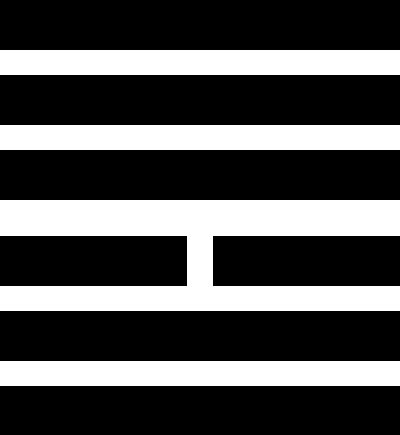
I Ching Hexagram 10 symbol: TREADING (CONDUCT) (Lu)

Hexagram 10. TREADING (CONDUCT)

Lu

The Judgement

TREADING. Treading upon the tail of the tiger. It does not bite the man. Success.

The Image

Heaven above, the lake below: The image of TREADING. Thus the superior man discriminates between high and low, And thereby fortifies the thinking of the people.

The Lines

6

Nine at the top

Look to your conduct and weigh the favorable signs. When everything is fulfilled, supreme good fortune comes.

The Image says: 'Supreme good fortune comes at the top.' This is a great cause for congratulation.

5

Nine in the fifth place

Resolute conduct. Perseverance with awareness of danger.

The Image says: 'Resolute conduct. Perseverance with awareness of danger.' The place is correct and appropriate.

4

Nine in the fourth place

He treads on the tail of the tiger. Caution and circumspection lead ultimately to good fortune.

The Image says: 'Caution and circumspection lead ultimately to good fortune,' because the will is carried out.

3

Six in the third place

A one-eyed man is able to see, a lame man is able to tread. He treads on the tail of the tiger. The tiger bites the man. Misfortune. Thus does a warrior act on behalf of his great prince.

The Image says: 'A one-eyed man is able to see,' but not clearly. 'A lame man is able to tread,' but not to walk with others. The misfortune of being bitten comes from the fact that the place is not the right one. 'A warrior acts on behalf of his great prince,' because his will is firm.

2

Nine in the second place

Treading a smooth, level course. The perseverance of a dark man brings good fortune.

The Image says: 'The perseverance of a dark man brings good fortune,' because he is in the middle and does not let himself be confused.

1

Nine at the beginning

Simple conduct. Progress without blame.

The Image says: 'Simple conduct. Progress.' One carries out one's own will.

The Wisdom of Hexagram — An Eastern Perspective

Walking with Tigers — The Art of Conduct

While Hexagram 9 taught us how to gently restrain others, Hexagram 10 (/Treading) teaches us how to conduct ourselves. Structurally, both hexagrams share the same makeup—one lone Yin line amidst five strong Yang lines—but the dynamic has shifted. In Hexagram 9, the gentle controls the strong from above; here, the gentle must walk respectfully beneath the strong.

The I Ching uses a vivid and dangerous metaphor: "Treading on the Tiger's Tail." This hexagram explores the rules of Li (Propriety)—the code of conduct that allows us to walk among powerful forces without getting bitten.

The journey requires self-awareness. It begins with the simplicity of "Simple Conduct" (Line 1) and the integrity of the "Recluse" (Line 2) who is not swayed by the world. But danger arises when we overestimate our abilities—like a "lame man trying to walk" or a "one-eyed man trying to see" (Line 3). When facing power, we must tread with fear and caution (Line 4), and when holding power ourselves, we must avoid being "Decisive and Arrogant" (Line 5).

The secret to survival is "treading on hardness with softness." We must be gentle in manner but firm in purpose. Even when the path is smooth, we remain calm; when we gain authority, we remain humble. The journey ends only when we look back at our whole life ("Reflecting on Conduct" - Top Line). If our actions have been consistent, virtuous, and flawless from start to finish, we achieve "Great Good Fortune"—the ultimate reward of a life well-lived.

Structural Relatives

Cast Your Own Reading

Confused by the changing lines? Use the authentic Yarrow Stalk method to discover which lines apply to your specific situation.

Start a Free Reading