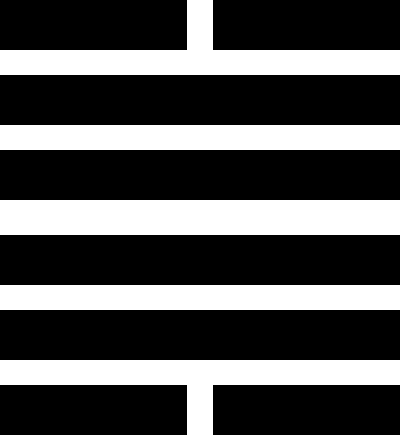
I Ching Hexagram 28 symbol: PREPONDERANCE OF THE GREAT (Ta Kuo)

Hexagram 28. PREPONDERANCE OF THE GREAT

Ta Kuo

The Judgement

PREPONDERANCE OF THE GREAT. The ridgepole sags to the breaking point. It furthers one to have somewhere to go. Success.

The Image

The lake rises above the trees: The image of PREPONDERANCE OF THE GREAT. Thus the superior man, when he stands alone, Is unconcerned, And if he has to renounce the world, He is undaunted.

The Lines

6

Six at the top

One must go through the water. It goes over one's head. Misfortune. No blame.

The Image says: The misfortune of 'going through the water' is not to be blamed.

5

Nine in the fifth place

A withered poplar puts forth flowers. An older woman gets a husband. No blame. No praise.

The Image says: 'A withered poplar puts forth flowers.' How can this last long? 'An older woman gets a husband.' This is also shameful.

4

Nine in the fourth place

The ridgepole is braced. Good fortune. If there are other motives, it is humiliating.

The Image says: The good fortune of 'the ridgepole being braced' is that it does not sag toward what is below.

3

Nine in the third place

The ridgepole sags to the breaking point. Misfortune.

The Image says: The misfortune of 'the ridgepole sagging to the breaking point' is that there can be no help.

2

Nine in the second place

A withered poplar puts forth sprouts. An older man gets a young wife. Everything furthers.

The Image says: 'An older man gets a young wife.' This is an extraordinary association.

1

Six at the beginning

To spread white rushes underneath. No blame.

The Image says: 'To spread white rushes underneath.' The weak is at the bottom.

The Wisdom of Hexagram — An Eastern Perspective

Managing Critical Mass and Overwhelming Pressure

Hexagram 28 (Ta Kuo/Preponderance of the Great) depicts a moment of critical mass. Following the accumulation of Hexagram 26 and the nourishment of Hexagram 27, the energy has swelled to a breaking point. The structure of the hexagram—four heavy Yang lines weighing down two weak Yin lines—resembles a sagging roof beam. It signifies a time of "Great Excess," where rapid development brings immense pressure and instability.

In this precarious environment, the I Ching offers a manual for Crisis Management. The first rule is absolute Reverence and Caution. As symbolized by the "White Rushes" (Line 1), one must be meticulously careful at the foundation; overlooking small details now leads to disaster later.

To survive the pressure, we must break free from convention. The text encourages Unconventional Cooperation—mixing the hard with the soft, like an old willow tree sprouting new shoots (Line 2). This implies that rigid traditions will fail; only flexibility and new alliances can sustain growth.

However, there is a fine line between innovation and vanity. The hexagram strictly warns against arrogance and superficial displays. Putting on a show without substance—like an old tree flowering just before it dies (Line 5)—only accelerates the collapse.

Ultimately, Ta Kuo demands the highest form of courage. When the crisis peaks, the Superior Man must be willing to "Stand Alone" and, if necessary, "Wade through the water until it covers his head" (Top Line). It teaches us that in extraordinary times, saving the world requires a selfless spirit that fears nothing—not even the ultimate sacrifice.

Structural Relatives

Cast Your Own Reading

Confused by the changing lines? Use the authentic Yarrow Stalk method to discover which lines apply to your specific situation.

Start a Free Reading