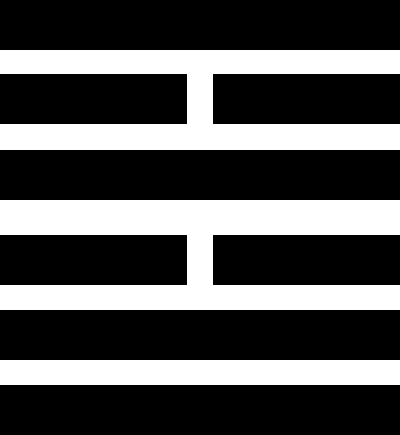
I Ching Hexagram 38 symbol: OPPOSITION (K'uei)

Hexagram 38. OPPOSITION

K'uei

The Judgement

OPPOSITION. In small matters, good fortune.

The Image

Fire above, the lake below: The image of OPPOSITION. Thus the superior man, In the midst of association, Retains his individuality.

The Lines

6

Nine at the top

Isolated through opposition, one sees one's companion as a pig covered with dirt, as a wagon full of devils. First one draws a bow against him, then one lays the bow aside. He is not a robber; he will woo at the right time. As one goes, rain falls; then good fortune comes.

The Image says: The good fortune of 'meeting with rain' is that all doubts disappear.

5

Six in the fifth place

Remorse disappears. The companion bites his way through the wrappings. If one goes to him, how could it be a mistake?

The Image says: 'The companion bites his way through the wrappings.' To go forward brings congratulation.

4

Nine in the fourth place

Isolated through opposition, one meets a like-minded man with whom one can associate in good faith. Despite the danger, no blame.

The Image says: 'To associate in good faith, no blame.' The will is carried out.

3

Six in the third place

One sees the wagon dragged back, the oxen halted, a man's hair and nose cut off. Not a good beginning, but a good end.

The Image says: 'One sees the wagon dragged back.' The place is not the right one. 'Not a good beginning, but a good end.' One meets a strong line.

2

Nine in the second place

One meets one's master in a narrow street. No blame.

The Image says: 'One meets one's master in a narrow street.' One has not lost the way.

1

Nine at the beginning

Remorse disappears. If you lose your horse, do not run after it; it will come back of its own accord. When you see evil people, guard yourself against mistakes.

The Image says: 'When you see evil people,' you avoid blame.

The Wisdom of Hexagram — An Eastern Perspective

Unity in Diversity and the End of Suspicion

Hexagram 38 (K'uei/Opposition) explores the necessary tension between opposites. Like Fire moving upward and Water flowing downward, differences are natural. The I Ching teaches a profound truth: "Harmony generates vitality, while sameness leads to stagnation." If everyone thought exactly the same, civilization would cease to evolve. Therefore, the goal is not to eliminate difference, but to find Unity in Diversity.

The hexagram outlines a strategy for reconciliation that begins externally and ends internally. In the early stages of conflict, the advice is to be broad-minded. One should not rush to force unity or chase after those who leave; give them space. As opposition deepens, the text suggests the wisdom of "Compromise in the Narrow Lane" (Line 2)—bending one's ego to meet others halfway for the greater good. When faced with severe pressure or deadlock (Line 3), the key is resilience—enduring the "disfigurement" of the situation with a soft and flexible spirit.

The deeper work, however, is psychological. The upper lines reveal that the root of prolonged conflict often lies in our own minds. Sincerity and trust are the only cures. The text warns vividly against Paranoia (Top Line), where suspicion makes one see "a pig covered in mud" or "a wagon full of ghosts" instead of a friend.

Summary: The path to resolving K'uei lies in "Seeking common ground while reserving differences" (求同存異). By removing the lens of suspicion and treating others with absolute sincerity, we realize that the "enemy" was never an enemy at all, but a potential partner in disguise.

Structural Relatives

Cast Your Own Reading

Confused by the changing lines? Use the authentic Yarrow Stalk method to discover which lines apply to your specific situation.

Start a Free Reading