What are Moving Lines? A Case Study of Hexagram 6 Changing to 20
If you are new to the I Ching, you might expect a single, static answer. You cast the coins or stalks, get a Hexagram, and read the judgment.
But the true power of the Book of Changes lies not in the static symbols, but in the Moving Lines (变爻).
Think of a Primary Hexagram as a "snapshot" of your current situation (State A). A Moving Line is the variable that triggers a transition, turning that snapshot into a movie, eventually leading you to a Relating Hexagram (State B).
In this post, we will explain how Moving Lines work by "debugging" a real-world example from our user community that turned a code error into a profound life lesson.
The "Bug" in the Code vs. The "Bug" in Life
Recently, on a Hacker News thread discussing our app, a user shared a reading that initially confused me.
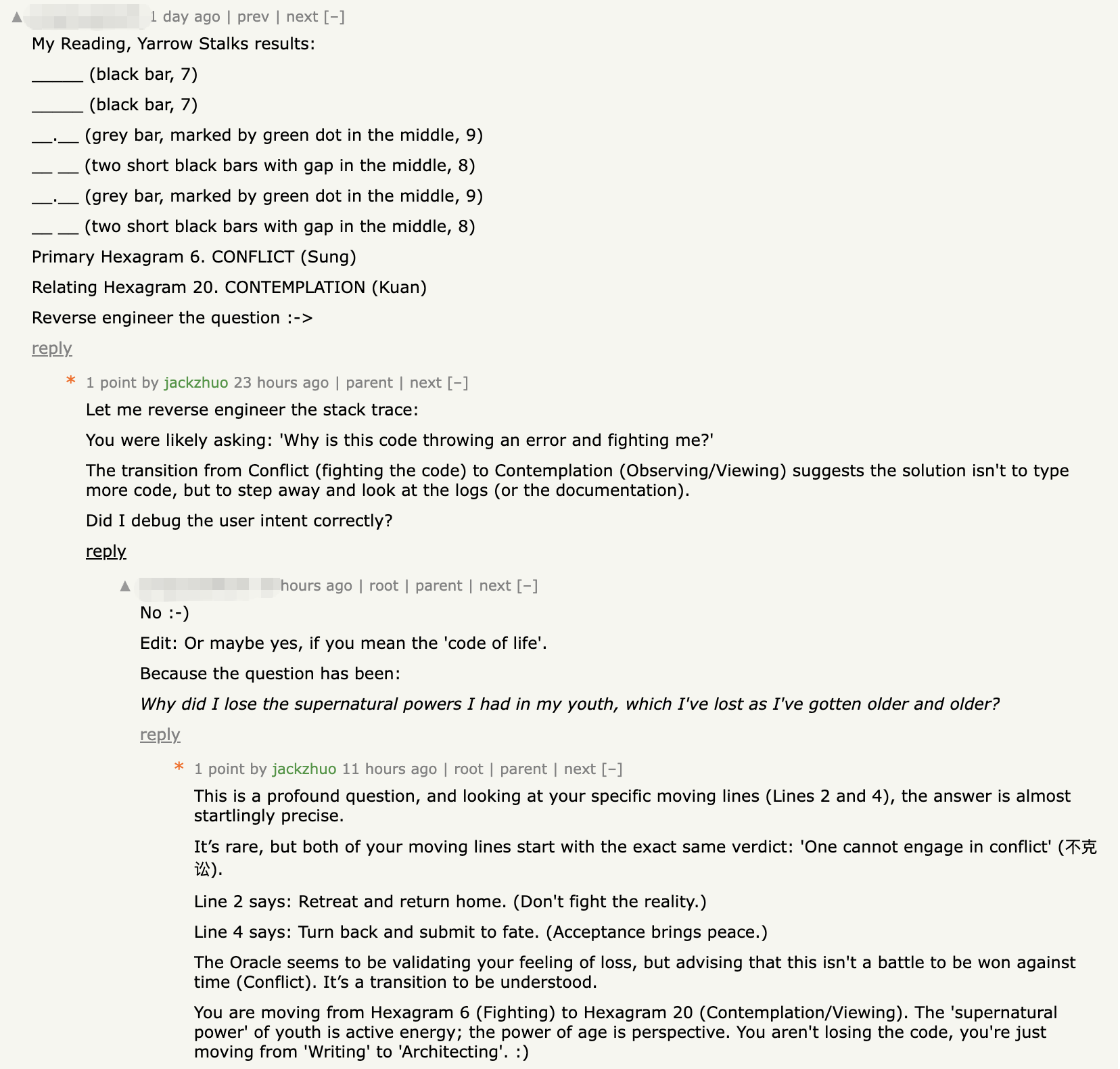
The user received Hexagram 6 (Conflict) changing to Hexagram 20 (Contemplation).
At first, seeing "Conflict," I assumed the user—likely a developer—was fighting with a buggy codebase. I interpreted the moving lines as advice to step away from the keyboard and look at the logs.
But I was wrong. The user corrected me:
""No... The question has been: Why did I lose the supernatural powers I had in my youth, which I've lost as I've gotten older?"
This wasn't a syntax error; it was an existential crisis about aging and lost potential. This is where the Moving Lines became the key to unlocking the answer.
Understanding the Mechanics: The "State Transition"
In the Yarrow Stalk method or Coin method, getting a "Old Yang" (9) or "Old Yin" (6) means that line is unstable. It is about to change polarity.
- Static Line: The situation is stable.
- Moving Line: The specific focal point where action is happening.
In our case study, the user had two moving lines in Hexagram 6 (Conflict):
- Nine at the 2nd place
- Nine at the 4th place
Let's trace how these lines tell a story of transition.
Debugging the Fate: From Conflict to Contemplation
The Starting State: Hexagram 6 (Conflict)
The user started in a state of internal friction. They felt they were "losing" something (their youthful power) and were unconsciously "fighting" against the natural process of aging.
The Variables (Moving Lines)
Line 2 says: "One cannot engage in conflict; one returns home." This line advises that the enemy (time/aging) is too strong to fight directly. Retreat is not defeat; it is strategic.
Line 4 says: "One turns back and submits to fate... changing one's attitude brings peace." This is the pivot point. The oracle explicitly advises accepting the cosmic order rather than forcing your will upon it.
The Target State: Hexagram 20 (Contemplation)
When these lines change, the hexagram transforms into the Hexagram of Viewing.
This is the "Aha!" moment. The I Ching wasn't saying "You have lost your power." It was saying: "You are changing your class."
As I replied in the thread:
""The 'supernatural power' of youth is active energy; the power of age is perspective. You aren't losing the code, you're just moving from 'Writing' to 'Architecting'."
Conclusion: Don't Ignore the Change
If we had ignored the moving lines, the user would have only seen "Conflict" and felt stuck. By reading the moving lines, we saw the narrative arc: a journey from fighting reality to observing and understanding it.
The next time you cast a reading on CastIChing, pay close attention to the changing lines. They are the specific functions in the code of your life that tell you not just where you are, but where you are going.