Image Reference
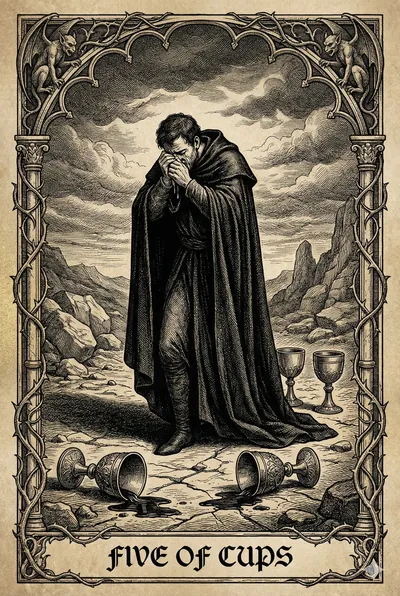
A disconsolate man in a hooded black cape stands with his head bowed amidst five wine goblets, three of which have been overturned. That’s more than half- emptied. Crying over spilt wine, he pays no attention to the two full goblets remaining, to which his back is turned. His ingratitude with what remains risks the loss of this as well. This is disappointment, but not not yet disillusionment, since he still has illusions.
Interpretation
As the word emotion implies, we draw energy for motion from affective states. We use them as a motive or motivating force. We also have inherited an evolved inclina- tion to feel loss more acutely than we feel gain: loss hurts us more than gain pleases us. Along with this, we have a disinclination to feel content with an emotionally neutral status quo. This is why crisis mode, upset, and stress are such normal states, and a part of why people like to play the victim. Affective adaptation is being forced upon us here. We suffer because it drives us, no matter that it drives us insane. We mistake intensity for meaning or power and fuel up on our resentments and losses. Force can be dramatic, but it isn’t power. As naive, irrational, and unintelligent as our feelings and emotions can be, there is still good guidance to be had here. But we cannot mistake them for who we are. We are born to dissatisfaction. When we have enough to eat, then we still don’t have enough friends. When we have enough friends, then the color of paint on the house is all wrong. These are sometimes referred to as low, high, and meta-grumbles. We behave as though we have a right and entitlement to everything going our way. Ingratitude often becomes our normal state of mind. Emotions and perspective are almost opposites. Emotions pull us out of both moment and context and into themselves. It always takes some time to process and sort them, but meanwhile, our reason and judgment are hijacked and gone. They can leave us naive and destabilized, overwhelmed and maladapted, and still we regard them as sacred somehow. We can even lose such priorities as living preferred over dying, or longevity over quick burnout. The multi-stage process of grieving a loss is fairly well understood, and we can expedite this, as long as this is not rushed, pushed, or forced. Feelings are somewhat more present than emotions, but these are not as much of a Five of Cups problem as they are a way to point the way out. We need to feel like there remains something more, beyond the setbacks, troubles, and clouds over our judgment. We need to find some reason to pull ourselves out of our pits. Beyond some early point to all this, our suffering is voluntary.
There is much information to process here. When we are disappointed, we can ask ourselves what went wrong in making those appointments. When we are disillusioned, we can reexamine our illusions. When we find ourselves disenchanted, we can look at who cast those enchantments. Things didn’t work out as promised, planned, or predicted, but we can’t use our failed expectations to judge or measure the world. The world is change, and powers beyond our own. It’s our job to find our own way to survive. Unlike disillusionment, maybe our discouragement still wants to discover some new source of courage, just not in an inflated sense of the power we wield or the luck we deserve. We still look to external circumstance, but we take Castaneda’s advice by 'using all the event.' Naturally, here, we look to the two cups remaining. The three were nothing more than the high costs of living in the real world, like cutting a check for the rent or the mortgage. Or dues. Or tuition. Or an offering. Or the rainy day write off. It doesn’t hurt us to feel a little dissatisfied, though it still helps to remember that needs are more secure than desires. Hunger is good: it feeds us. In the end, it’s ingratitude that kills us. We are lucky to have the two cups remaining. Realism is the best position to take here, reorienting to a changed reality, and acceptance of the losses. But this is not the same as approving of the losses.
What we have lost is a number of unhatched chickens, all painstakingly counted. We have to reclaim what remains. The Yijing counterpart is Gua 03, Rallying or Difficult Beginnings, we rally with and around what remains, despite our initial difficulties, and fight for the higher priorities, with all of the energy that the Fives and the Thunder can offer. Since these are Cups, we might have some challenging issues with appeals made strictly to reason. We need to sense or find our most urgent needs, outside of this narrow context and inside the bigger picture. We have to see this greater perspective as relevant here and now, and turn the urgency into an urge. We can draw off some force for this project from where it is currently being wasted: letting go can be an empower- ment. We might not even need to calm down, which is not a good fit for the fives anyway. We just want to get redirected and make ourselves more effective and less maladapted. We say ‘bygones,’ suck it up, snap out of it, rub some dirt on it, grunt, and move on. Nor do we need to play the victim before we can ask for some help.