Image Reference
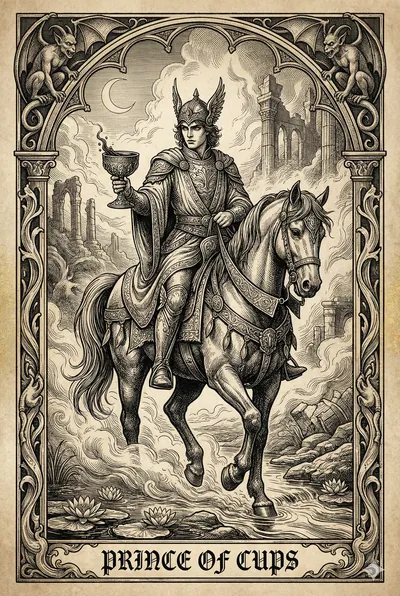
A handsome young prince, dressed for diplomacy or courtship, rides slowly towards the reader on horseback, bearing a full cup as a gift. He has intentions, perhaps in layers, but has not yet made them known. Whether for experience or love, he’s a suitor coming to call. He may be bringing a proposition, an invitation, or an oppor- tunity. He seems important. If he is not a knight in shining armor, he either thinks he is or is trying to look like one for reasons that he’s not sharing. He may not yet know what dreams he follows.
Interpretation
The Prince of Cups has the costume and bearing of the alternatively named Knight of Cups. He seems to be a man on a mission or quest, a knight errant in search of chivalrous adventures, or a marital suitor of the sort that the Book of Changes calls indistinguishable from a robber. And he probably would have a winged horse, if he could. His mission may be known only to himself, but whatever it is, he appears committed and convinced, and would like to appear convincing. He could be roman- tically principled, or he could be a ladies’ man in the garb of prince charming, just trying to get some desires satisfied. In all likelihood, he is sincere in his quest. But in the books this card raises a lot of questions as to the Prince’s true character and motives. You get the idea that you might want to check his references, or even check the cup for roofies. Driven by internal chemistry, which expires, he won’t always spend the night and cook breakfast. If this is some sort of pon farr, he might not even hear a loud No. It’s likely true that if he is seeking relationship, it’s for what it can do to enhance his own feelings or emotional states, and that he wants something that the one he approaches has probably not been planning to give him. But there is nothing inherently wrong or disingenuous about this. He may yet have much to offer in return. And even if this approach is a deception, it may be from self-deception, not wicked- ness. With all the trappings and mystery, it might not do any good to announce his intentions, since a con artist would do the same anyway. One looks for other tests, as for empathy.
As one of the four Princes, he is out to explore the extents of feelings and emotions, to see how far these go. There is a hunger for experiences that bring up feeling and emotion, an interest first in how things affect him. Intensity and passion are often the first measures of this, getting wound up, or getting up a head of steam, or some personal hydrodynamic. These feelings are felt down in his personal pool, and this is a private resource. He would like them to be deep, important, significant, and at least a little bit profound. They get amplified and exaggerated so that he gets a full measure. Of course he is full of himself. This is all a private and personal experience, however much he may want to share it. Of course he is following his desires more than real- world feedback, and while reaching for deeper personal truths he may yet be unable to understand others. This is not, after all, an especially discriminating intelligence that he is cultivating. He may be moved in wrong directions by his feelings, or driven into error by his emotions. He may, for the sake of intensity or intoxication, seek out pain and suffering, if it only feel potent and true.
The Prince is a romantic, who likely believes in himself and his mission, a dreamer within his visions, or a poet in love with love itself, who believes his poems non- fictional. Few experiences will enter his world unaltered by the romantic view. He may be driven to live for images just to add to his poems, or to be impressed for the sake of making impressions. Feelings lead, themselves in pursuit of the dream or romance. Here is a paradoxical tension, between inner senses and romantic involvement with others. He wants to not be so private, but has to live deep inside, with only his own perspective and little overview. At least the search for a romance or a purpose beyond himself suggests being more honest about his lack of completeness if he is living in isolation. Even the self-absorbed must absorb some of the other, must search for external references or sounding boards, but something more than projections and their reflections, a world that is more than their mirror. This demands development of social skills that do more than go through the acceptable motions. This demands a working Theory of Mind.
The Yijing counterpart, Gua 61, The Truth Within, begins with the subject as a private pool of personal resource, with wind and wood above to bring us news of the other. It speaks of relativity. Piglets and fishes, sons and daughters, must be expected to act like themselves, encouraged to be true to themselves, not be reflections of us. The new agers jump to conclusions from reading only the title, thinking that inner truth must be the universal truth. The message is the opposite. Yes, we have a resonance with things akin to us. But we need to outgrow our perceptual limits, to see more than our own little picture, if we want a less limited version of truth. This is not to dismiss our personal relevance, our libidinal worlds, our sub-surface selves, our undercurrents, our hidden communities of subliminal motives, our big secrets and mysteries. These are resources that we have for survival, our guts, our intentions and urgencies, our rage against the dying of the light. We simply want to learn what goes where, and know more about the big picture.