Image Reference
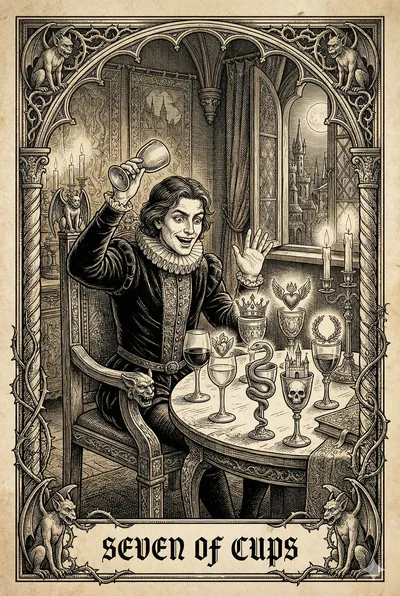
The RWS deck portrays a man from behind, appearing by body language to be full of wonderment, looking enchanted by a gallery of delights spread out before him, displayed in cups as icons of varying forms of pleasure. It’s a version of the kid in the candy store. The image asks the question of whether the subject will choose wisely or indiscriminately. Will the heart just want what it wants, period? Will he get lost in the options? Alternatively, a young, well-dressed man sits alone at a table, on which are set seven goblets of wine, some red and some white. He has finished one goblet and happily signals goodbye to the rest.
Interpretation
The Seven of Cups is about the learning of our limits in the pursuit of what we desire, but since this learning is so often done so poorly, the card is often said to foreshadow either frivolity, or an inability to defer gratification, or excessiveness and its subsequent regret. The excess and regret are the consequence of poor choices, but not the core meaning of the card, which is wanting to feel good, or better, or well, in the sense of healthy, or well in the sense of skillfully. This is the self-interest of the Seven pursued with the feeling and emotion of the Cups. We want to explore our possibilities, see what the options are, see what we can get away with, or see how far we can go. How full or fulfilled can we feel? Of course we want it all, and right now too, if we can have that. We want to feel alive, so we do things for the sake of feeling itself. At bottom, we are experimenting with our own neurochemistry, with go-to ingredients like dopamine and oxytocin.
Since feelings are so little inclined to listen to reason, the learning process here will require some experience. Except for the sense of satiety, limits and self-restraint are not an inherent or inherited part of our seeking. They must be learned. The suit of Cups lacks judgment, so the cost of our unrestrained desire needs to be felt and processed. It’s not logical to think that we are born ready to say no to something pleasant that’s free for the asking or taking. But there is often too much available that we can want successfully, and wanting gets out of control. We have no native immunity to promises and temptations. And then the advertisers get to have their say and have their way and people start to want useless and frivolous things, and want them right now, or else feel inferior to their peers. Many people will even do crimes so they don’t have to wait. But it’s just not good selfishness to destroy, dissipate, or profane the self. The degen- eration of our wanting into wantonness is selling ourselves into slavery, the original meaning of addiction. Even when we don’t go this far, we risk getting lost in the options, approach this or approach that, an ambivalence that threatens to spread us ‘a mile wide and an inch deep.’ We give up the magic for empty mystique, and deeper study for sound bites, so we don’t need to miss out on the next distraction. In Arabic they call this ghafla, a soul-emptying, mindless distraction. We become emotional gluttons starving for real nourishment.
Emotions aren’t a way of thinking critically, and feeling is only a kind of discern- ment that sometimes could use some rational help. We hope that we will have the sense, in the literal sense, to learn to pick and choose wisely, to develop good taste and high standards, without resorting to rules or authority figures. But we do need to explore and sample some of life’s variety. We hope we can learn priorities and boundaries. Among the great variety of feelings and experiences set out on this table of life, the better choices do not preclude sensuality, eroticism, intoxication, gusto, or zest. It’s only a matter of getting things experienced in the right proportion, a middle path, and a golden mean. So we simply look at our options with an eye to narrowing these down, selecting personal desires according to what we value the most, and maybe even to what we have carefully chosen to value, to what is relevant to our own evolution. Perhaps we can even order their pursuit according to our own ‘hierarchy of needs,’ that we might meet these and be free to move on.
The Yijing counterpart, Gua 60, Jie, Boundaries or Limitation, begins by depicting a broad flood of affect in need of viable channels. We need the water, the feeling, but we want it where it will do us some good. We gradually learn to pace and limit ourselves, to defer gratification, to know our measure. Pleasures might be transient and successes not retained, but they are as necessary to mental health as food, which isn’t retained either. As long as we need this we might as well be gourmets about it. There is much clucking and tsk-ing and wagging of fingers around this issue of pleasure, usually by those you would not want to have for role models. The whole subject of pleasure- seeking behavior stirs up almost as much cultural, social, and religious nonsense as the subject of death. So many of us live in fear of both living and dying.
The word hedonics ought to be a real word, for the study of pleasure-seeking behavior. Hedonism, the philosophy that states that pleasure can be a good guide to right living, is actually a broad spectrum, and its higher-frequency end can make a lot of good sense. Democritus, Epicurus and Lucretius all spoke up for good taste in pleasure, with caution, selection, discernment, and values. It was the also the first philosophy rooted in natural history. They also wrote about atoms. Lucretius wrote of evolution and natural selection. But they remain best known for saying that our joys and sorrows are our most reliable guides to the beneficial and the harmful, for suggest- ing great care care in selecting for worthwhile pleasures. This is not the same as saying that pleasure should be our pursuit, any more than we should drive for the sake of the speedometer reading. We refine our desires and defer the shortsighted self-gratifica- tion. Their highest standard of happiness, called eudaimonia, wasn’t considered a neutral, anhedonic, or apathetic state, but a positive form of pleasure. Yet happiness itself is not the best pursuit: it’s an indication of living rightly, of pursuing the best in life, but it’s only favored by chance, and not guaranteed to good behavior.