Image Reference
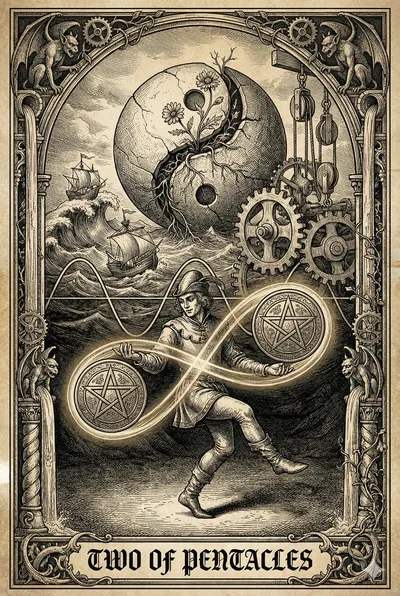
The RWS deck and most clones depict a juggler handling two pentacles, which travel the path of a lemniscate or infinity symbol. In the background, two ships ride waves on different aspects of a sine wave pattern. Alternately, a large stone, once roughly spherical, has split in two. A jagged crack divides them. The figure vaguely resembles the Taijitu. Into and through the crack a wild flower has sent its roots. Other alternatives could depict two separate material objects functioning together to create an outcome, maybe meshed wooden gears or block and tackle pulleys. The interplay does most of the work. The reality is the process.
Interpretation
The Two of Pentacles is sometimes titled harmonious change, and is said to suggest such properties and things as agility, flexibility, juggling, multitasking, financial dexterity, profitable partnership, difficult or challenging situations, precarious balance, full hands, handiness, sleights of hand, changes of occupation, getting with the rhythm of change, harmony in mid-change, a playful approach to change, stimulating develop- ments, coping with competing demands, and the deftness needed to handle two situations at once. In simpler terms, things are in motion here and want some skillful handling, as distinct from mishandling, if one wants any say in the outcome.
Things have a way of working themselves out. Each thing has its own way, which may or may not be the same as the ways some others have. There are learnable or predictable responses to the interaction of internal forces with environmental conditions. In the West this is called natural law, in the East, the Dao or the Way. A thing following its original nature has a natural behavior. This has been symbolized by an uncarved piece of wood, which, unlike an unformed lump of clay, will have a natural grain, suggestive of natural inclinations or an inherent direction. Looked at naively, this makes even inanimate things appear to have intent, or to be operating according to some plan or purpose. When we learn the way of things, we begin to see where things seem to want to go. Our lives get a lot easier when we want these things to go that way too. When we want to change their direction, we learn a little more about different responses to different conditions and then add those to the mix in necessary and sufficient quantities. When we choose a new path for a thing without due regard to givens or the facts of existence, our lives become more challenging. It’s best to want rivers to take the most direct downhill route, one that snakes between its obstacles. Such a path is also taken by weather, lightning, roots, and the young. One who acts with this knowledge appears to have mastered things, but he is merely obeying their discoverable natural laws.
The Two is best understood here as the before and after of change, even when there are yin and yang, heaven and earth, checks and balances, ups and downs, men and women, or rights and lefts in play. The world just isn’t as simple as yin-yang theory would have it, although this simplified model can sometimes help us to manage our worlds. Our ups and downs can be leveraged. If we buy low and sell high, we can even profit in the bear markets. It’s important to understand the interplay and the inter- regulation of what we may perceive to be opposites. Simplicity emerges from that, and direction. Patterns of alternation are the rhythms of the world and its concert. The harmonies interconnect us when we can be in tune with them.
The Yijing counterpart is Gua 11, Interplay, often incorrectly called Peace. This depicts Heaven and Earth moving together in concert. Contrary to popular belief, the original Yijing preceded any sort of Yin-Yang theory by many centuries, yet this Gua diagram is the closest the original Changes comes to having a Taijitu, the familiar Yin- Yang symbol. In this chapter, the interplay of forces is energetic, productive and highly creative. In humans, one type of this intercourse makes human children. In the text we are advised to move with the way things are moving. A willingness to adapt and go with the flow allows us to harness the world’s inertia, the direction and momentum it already has. This way, the world is inclined to move with us instead of against us, which can often be mighty convenient and a most productive arrangement. And if we need to steer things the tiniest bit, we have some energy already saved up from mostly not fighting the world.
The idea here is to get things done by cooperating with the world and its natural laws. Because of the synergies involved, things can get relatively energetic or dynamic here. This is why Peace is such a poor name for the Yijing counterpart. What to do may be clear, and even simple if we are seeing shining paths, but change is still inclined to be dynamic and demanding of a fuller attention, as implied by the RWS juggler. We make our best luck here by capturing available opportunities and using the world’s momentum or inertia as our primary source of kinetic energy. This is like imbalance, but in a forward direction instead of side to side. Thus we lean into the change, and get up to speed, when it is hanging back that would overwhelm us. To go the way things are already going is not doing, but it’s not doing nothing.