Image Reference
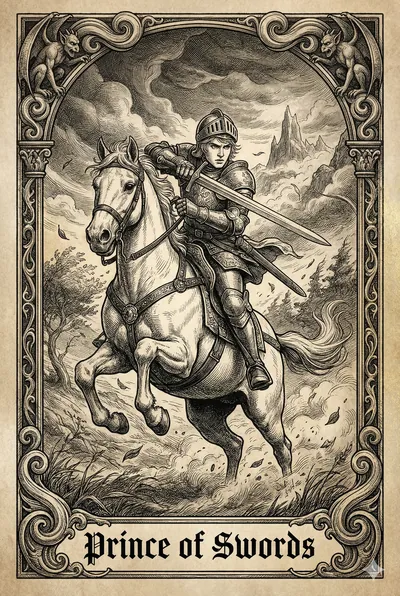
The RWS card depicts a knight in armor, visor up, mounted on a white war horse, charging into the wind with sword drawn. Alternately, a fair, young prince is shown in mid-leap from the back of his rearing war horse, wielding a sword with both hands. He is practicing skills, speed and agility with an intensity similar to battle, or typical of male youth.
Interpretation
Modern tradition describes the Prince of Swords as a brave, skillful, dashing young man. He is heroic, clever, restless, adroit, assertive, independent, quick, witty, creative, idiosyncratic, persistent, relentless and competitive. Ill-dignified, he is rash, brusque, importunate, impatient, careless, shallow, and lacking in staying power. Commentators err somewhat in overemphasizing his haste, as he is capable of far more thoughtful and deliberate paces. Yet he may be in a hurry due to time wasted in error. Sometimes what seems like haste might only be quick-wittedness, or to stay with the sword symbol, his rapier wit, enjoying the exhilarating thrill of a nervous system operating at capacity. Also, due to the common misinterpretations of the swords, writers may also attribute an aggression, quarrelsomeness, or even violence, that is by no means ever-present, even though he might be suspiciously quick to respond to stimuli. Response time is often as helpful as prowess in such mental athleticism.
Ultimately, as the airy part of air, this is the mind within the world of the mind, the entertainment of thought by more thought. As the Prince, it is his duty to explore this world, to understand how the mind works and then to work it. The frontiers here, those he is charged to go beyond, are endless, and so his explorations are up to and beyond his own limitations. Still, he is tasked with carrying these ideas out, elaborating the premises, varying the themes, exploring the what-if’s with alternate assumptions, extrapolating, projecting, ramifying, permuting, inventing, and following ideas to logical conclusions, including reductions to absurdity. He may assume too much about this applying to the real world.
At the mind’s least useful level, thoughts have little structure, no rules of construc- tion, no hierarchy of meaning or value, the monkey mind’s internal chatter. Informa- tion and its deft handling are mistaken for intelligence and intelligence for wisdom. This is not unlike turning the mind over to some French philosopher for deconstruction, or to a cloistered academic competing with his peers. The human mind serves only itself. Intellect and information exist for their own sake. Many believe that all thoughts are true, at least to their mind of origin. Everything read can be believed if it meets expectations. And others believe that all is inane, pointless, and aimless, false, and pre- refuted, ‘a tale told by an idiot, full of sound and fury, signifying nothing.’ Here we have tautology, sophistry, cultural dilettantes, cleverness for its own sake, and to no small extent, peer-reviewed academia, sucking up for tenure. There is harmlessness here too, solving puzzles, jousting and sparring, jesting and satirizing, gymnasiums for training the mind. One only hopes that the eloquence and articulation found here can find something useful to do in the end.
The whole point in moving all over the place is to visit and investigate the world from multiple angles or alternate points of view. We don’t stick with one view of things and we stay wary of beliefs and convictions. We don’t just think once and then stop: we think at least twice. And taking a second look at things is the core of the word re-spect. Revisiting ideas also gives us a chance to unlearn before an error takes root. Leaning is an ongoing process. This ongoing effort to penetrate the world is the core of the Yijing’s counterpart, Gua 57, Adaptation or The Penetrating. We reconnoiter before going in, assess before following through, optimize our approaches and occupy niches with fitness and respect. Of course we contradict ourselves: we have choices of frames and perspectives. We have devil’s advocates too. And minions. We are legion.
The Prince is not a Ronin or sword for hire. He wants a higher throne than sophistry can give him. In the end, he will need to reduce his thoughts to meanings, to touch- stones, paragons, and points of reference, to useful behaviors and methods, to the sciences and technologies, to arts and humanities. He needs to learn critical thinking skills to question himself as well as the world, to arrange his thoughts according to value, to pick his battles well, to assess the worth of his programs, to subordinate his knowledge and serve his higher purpose. To do this his thought must have feeling. Many will go wrong here with emotional commitment to rigid convictions, fanatic belief, bluster, bravado, and ego involvement. Beware the terrible, swift swords of the misguided crusaders and zealots. They have learned nothing useful. The critical thoughts are best trained first on our own delusions.