Image Reference
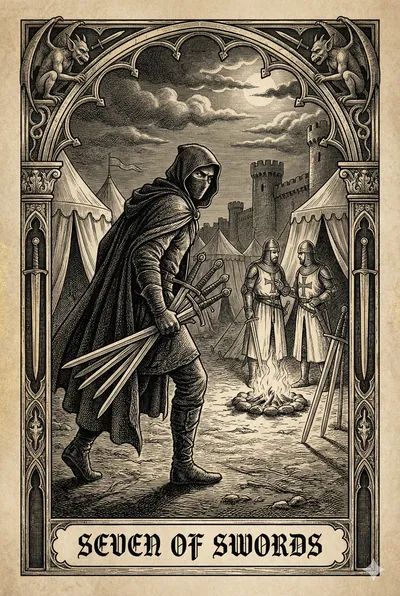
A shadow warrior has entered a crusader encampment by stealth and is making off with five enemy swords. He spots two guards in conversation and contem- plates taking their too. No guts, no glory. This is a man with a plan. It’s almost certainly not approved in advance by all parties concerned. He may or may not get away with it. Whether you want him to or not may depend on where your loyalties lie.
Interpretation
It seems to be up to the readers to decide if they are to identify with the character in the picture or with those on the other end of his sneaky plan. Seeing common interpre- tations like deception, trickery, theft, dishonesty, etc., it seems that most tarot writers identify with the victims here, overreact to the RWS design, moralize on this image and jump to self-righteous value judgments. With the preconceived notion that anything tricky is bad, they get busy shaming the subject for committing a stealthy act. This misses the point of the Seven of Swords entirely. This scene is about situational ethics, and amorality, not good or bad karma. What the subject is doing is no more immoral than the swordsman Kyuzo stealing guns from the bandits in the Seven Samurai. Would anyone have thought it wrong to steal Nazi guns? Besides, this is bing fa, the art of war here, and you’re supposed to use crafty surprises, avoid confrontation, and win without combat.
The Seven of Swords is about our self-ish thoughts. The Seven wants its Victory, or Netzach, it wants to survive first and then thrive all it can. The mind, as Swords, is set to the task of figuring out how to do this, doing problem-solving behavior, vicarious trial-and-error, running mental scenarios, choosing the best of the ones which might work and projecting their outcomes. We start with what we need, and then work on what we want. A nursing mother feeds herself first. When oxygen masks drop from the airliner ceiling, we put our own on before we help our children. There is nothing inherently wrong with selfishness, or acting out of self-interest, except for when it’s done badly and people and other life forms get hurt. Even the Buddha admitted that we are selves for now, and that these need our attention. That doesn’t mean we aren’t also one with everything else and interconnected and such. But if we want to survive and interconnect, we need strategies for survival. If we want to have our needs met, we have to negotiate a world that can kill us in a heartbeat and keep right on going as if it didn’t care. We just figure out how to get what we want without getting hurt, and hopefully doing no harm in the process. We take our steps in accord with our best projections of success. This plan is being tested against a harder reality, but more is at stake here than the plan.
The Yijing counterpart is Gua 10, Respectful Conduct or Treading. It uses the amusing image of someone about to tread on the tail of a tiger. The measure of his success is in whether or not he gets bitten, or eaten. This will not be known until after he is done. He wants his accomplishment to be without consequences or disastrous en- tail-ments. If there is to be any divine guardianship here, it will be on terms not his own. This is only accomplished with a great deal of respect for where he is and how he comports himself. Steps may be taken in accord with projections of success, but cor- rectness is situational and the real element of risk is largely proportionate to deviation from natural law, not from the plan. The steps are bold and sometimes heroic ones. It is not a place for glib appraisal, or fascination with the mystique or romance of taking bold and heroic steps. We want to set aside anything that leaves us with an inadequate quantum of attention, effort, focus, or perseverance. The world standing between us and success has powers that need to be respected and weak points to exploit. We don’t want to confuse the two.
To per-form means to move through a form. This form, Swords or Yetzirah, can be any of a number of things: a plan, a plan B, a protocol, a scheme, a strategy, a ruse, a trial, a game, a myth, and the list goes on. We make these to guide us in our adven- tures. What a form is not, however, is the reality it proposes to model. In the distance between the two lies our possibility for error. We use our mental flexibility and resourcefulness, our ingenuity and subtlety, to get the two to line up or coincide, to find the right track that follows them both. Ultimately, however, the facts of the matter are more important than our vision and ideas. Not many people truly perceive this. We cannot count the men who have marched to their deaths behind lies that they have told themselves or let themselves believe. Thoughts and beliefs are bad masters and leaders. Being true to ourselves wants a better selfishness, to let us abandon the ideas, rules, peer pressures, and expectations as soon as they no longer serve us. We experiment with variable attitudes and convictions and think what needs to be thought. This, too, can be a bold step to take, especially when there are witnesses, but according to Stuart's law of retroaction, ‘It is easier to get forgiveness than permission.’