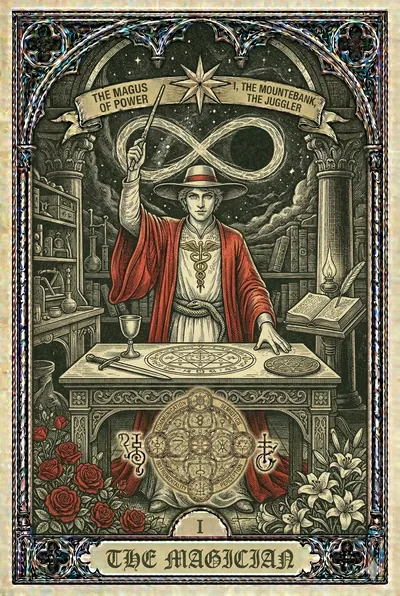
A wiry, lithe, bright-eyed young man prepares to demonstrate the Magi- cian’s craft to unseen witnesses. He stands behind a table, altar, or other platform, the field of attention, his right hand raised high, bearing a wand pointed straight up, his left hand stretched to the table, with five finger tips touching the surface. He wears two robes, the inner one is white with a golden Caduceus on the chest and a serpent belt, the outer is scarlet and flowing. A hat whose broad brim hints at infinity's lemniscate completes this deliberately distracting outfit. Red roses and white lilies obscure his feet. Arranged on the table are a silver cup, a short sword and a circular talisman. Off to the side, out of play, are his book of spells, a lamp, and a writing quill. To orches- trate miracles, or another person’s perceptions and experience, is no mean feat. His concentration is showing. Every twitch will have a purpose. The witnesses here have paid for some ‘real magic,’ assuming that these two words go together.
Interpretation
The Magician, like the Fool, underwent an upgrade of his character with the advent of the occult Tarot. Earlier versions showed a street hustler or trickster. This is not to say that the modern version should be trusted. If he is not you, then he might well be a few steps ahead of you. This character has long been associated with the practices of Hermes, Mercury, and Thoth, and the higher understanding of magick and the esoteric. Magic, the entertainment without the k, remains a useful metaphor here. The word comes from the Indo-European magh, to be able, and was adopted by the Zoroastrian Magi, who might have been seen demonstrating ‘miracles.’ The card is often associated incorrectly with power or magical powers, as is the popular understanding of witch- craft. This is merely the working knowledge or knowhow that allows the magus to direct power, and perhaps enabling an attitude of empowerment. The power is not his.
It’s important to remember that Mercury was the messenger between the worlds, now often called planes or dimensions. Here, he translates ideas from the world of thought into the world of action. Here too is his use for nested analogies, giving mobility between frames of reference and universes of discourse. Translation means that he understands both languages: that of the linguistics, semiotics, and correspon- dences of ideas in the mental world, and of the techne, technology, art, and craft in the walking-around world. He connects the two with his knowhow and his practice. Scire, the root of science, is usually glossed too broadly as ‘to know,’ but it should retain connotations of knowing how, and of the Indo-european skey, to split or dissect. It’s a kind of knowing that’s already leaning towards action. The Magus is a scientist in this sense at least, whereof it is said in Clarke’s Third Law, “Any sufficiently advanced technology is indistinguishable from magic.” The technology here would include psychology.
Language has always been a big part of the Magician’s repertoire. Words and names are handles. He knows what he wants, how to spell it out in his spells, and how to bring it about. He needs the name of the beast or demon in order to tame it. His patron deities, as if they were, were also the inventors of language. Language is an important component to both cognition and communication, covering an enormous territory, hence Mercury’s winged feet and Thoth’s Ibis wings. He delivers messages, and gets the meanings and experiences across the gulf between theory and practice. Also important to this idea is having a command of more than one perspective. Multiple points or angles of view allow him to fine-tune the message or experience to optimum effect. In the analogy of stage magic, this can involve illusion, impression, persuasion, suggestion, redirection, and misdirection. It’s important that he have all of the puzzle pieces, including the audience’s perspective. The magician must discriminate between illusion and truth while other observers may not, and he must see through his own illusions. This might give him an advantage in understanding the nature of illusion itself. Enter James Randi, Penn, and Teller as well-known debunkers.
There is always more than meets the eye here. The Magician works with the limen, the threshold of subliminal awareness, controlling the subtleties and complex nuances. He cannot fixate on a single point of view. Control of perspective is control of percep- tion. Having multiple perspectives may have an interesting effect on ethics, making them almost necessarily situational, and possibly leaving the actor amoral, at least with respect to consensual norms. Separate realities may be played against each other. Anti- cognitive processes like cognitive bias have their uses where the nature of truth may still be up for grabs. But perhaps the most salient aspect of alternative forms of a truth is that such a condition permits a choice of preferred conditions. The Magician thus has freedom to choose his own state of mind, so that when the work comes around to what is called High Magick, or the Great Transformation, he has learned a thing or two about transforming himself, or shape-shifting. The real power we have is in changing our own minds.
For the Magician, knowledge isn’t something to be gathered and stored for its own sake, or just for the comfort of knowing, much less of believing. Even the most purely cognitive aspects of this card will see the known primarily in terms of its applicability. Knowledge here is useful or instrumental. The best insights are methods. The practice here is to gain familiarity, and this in turn is for the sake of repeatability, and therefore predictability, just like the scientist’s goal. It’s not just a coincidence that this art is also associated with divination, the extrapolation of projected outcomes from limited data sets. Knowledge must prove itself, so at some point reality becomes an aid to discern- ment or assessment. It isn’t in the Magician’s interest to assert things that cannot be demonstrated. Knowledge here is also creative. Insight reorganizes perception, knowl- edge reconfigures the system. Understanding needs to learn the ways of natural laws, encoding them in recognizable, communicable, and practical forms. Knowing how things work underscores prediction, and good prediction is needed to implement our intentions.
There is also something to be said about the fun to be had in using one’s wits to their fullest potential, the hedonics of thinking at a lickety-split tempo, even perhaps thinking circles around others when they have come and paid to be fooled. Wittiness, cleverness, or nimbleness of phrasing can also be a trap of course. But there is much to be enjoyed in a mind that is working well. There is also an evolutionary advantage in the ingenuity, adaptability, and resourcefulness that are characteristic of this card, and this may have led to some of the neuro-chemical reward systems in the inherited brain. Even the Buddha identified such states as worthy forms of pleasure, naming them cittalahuta, cittamuduta, cittammannata, the agility, pliancy and efficiency of con- sciousness.
Eastern Resonance (Yijing)
Bagua 3, Xun, Wood/Wind, The Gentle, Penetrating, Xun is the symbol for the versatility and plasticity of the mind, the ability to approach a situation from all available angles in order to find and occupy a niche, to fit into or conform to the scheme of things. Its second symbol is wood, specifically green wood of roots and branches, which explores its environment, finding the paths of least resistance, in order to extend its reach and assimilate the little, specific pieces of that environment into itself. Wood is also thought of as a little boat, which gets about by penetrating water and working with the currents. A sensitivity to place and detail, and an ability to grow both by learning and dissemination of information is implied by both of these symbols.
abstractingaccess to optionsacumenadaptabilityadroitnessagencyagilityanalogiesarticulationassessmentauguryawarenesscalculationchannelclevernesscognitioncognitive commandcommunicationconcentrationconducting experienceconnectioncorrespondencecraftcraftinesscreative problem solvingdeliverydexteritydictiondirectingdiscernmentdivinationelucidationenactingexpedientsexperimentationfinesseflexibilityfocus on taskgo-betweensillusionimplementationimprovisationingenuityintermediaryinstrumentalityintelligenceinterchangeabilityknowhowlanguagemanipulation of elementsmathesismeansmediummental advantagemental disciplinemental trainingmentalismmessagemessengermetaphormoving between worldsnegotiationnimblenessnuanceoperationperceptionperspectivepersuasionpracticeprecisionpredictionproblem solvingprotocolready witreconfigurationrepertoireresourcefulnesssavvysciencesemanticssemioticssignsskillspellcraftspellingsubtletysubliminal operationsupplenesssymbolstacttrade secretstrainingtranslationtransmissiontechnetool usetrickinessversatilitywitwizardrywording
Warnings & Reversals
•charlatans
•cockiness
•confidence games
•cunning
•deception
•deceit
•decoys
•distraction
•evasiveness
•exploitation of another’s blind side
•failure of imagination
•fallacy
•fallacious reasoning
•false expertise
•hidden methods
•illusion
•inattention
•indecision
•intrigue
•misapplied skill
•manipulation
•misdirection
•narrow-mindedness
•pranks
•propaganda
•self-deception
•sleight-of-hand
•sophistry
•tricksters
•unanchored skill
•vulgar trickery
Structural Components
The Magician is a fairly straightforward symbol. Portmanteaus may be made with his associations to Mercury, Hod, and now Xun, and second-tier astrological associations to Gemini and Virgo, and the 3rd and 6th Houses. All suggest investigation, penetra- tion of the world with the mental faculties.
Mystic Correspondences
Astrology
Mercury; Kokab. Mentation, the structure of perception and communi- cation, the nervous system, information and networking, logistics, discernment, assessment, association, making connections. Nimbleness, quickness, dexterity, cleverness, craft, precision, mental agility, the trickster and illusion, analysis, creative problem solving. Cognitive tools, repertoire, skill, familiarity, repeatability.
Qabalah
The Double Letter Beth. The Jewish Kabbalists associate Beth with various other Planets, with little agreement among them (See Kaplan’s SY on that matter).