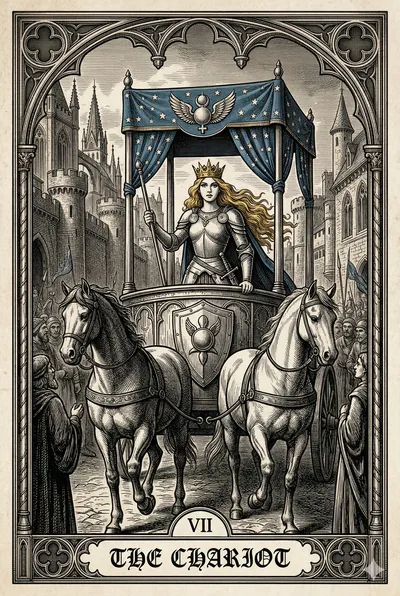
#7, Lo Carro Triumphale, the Triumphal Car, The Charioteer, Il Carro, Le Chariot,
The Chariot
The Child of the Powers of the Waters; the Lord of the Triumph of Light
Security, Confidence, Self-Control, Augmentation
Image Reference
A warrior princess, young adult, stands in a war chariot drawn by unmatched horses, in the process of leaving a fortified city behind her. She wears a six-pointed gold crown over her long, golden locks, holds a long staff in her right hand, and wears light battle armor, its epaulets suggesting the waxing and waning moons. Her chariot, canopied over four posts with star-spangled blue, bears a crest with a winged orb over a joined lingam and yoni. She seems to be passing through a triumphal procession, or perhaps a sendoff. She seems confident, self-possessed, and ready for the next exciting chapter. Her world is with her, contained both as a vehicle and a well-arranged shield. Note that her sword is not drawn or bloodied, her armor not dinged, her chariot not damaged, and her horses not yoked or reined. In many decks, these are sphinxes, one black, one white. Nor is it obvious that the horses are ready to pull in the same direc- tion. Is the driver’s seat just a little too comfy? The canopy is shade and sunscreen, but what else justifies the weight? This is either a ceremonial event or a demonstration of readiness. Deployment to the front lines of battle does not appear to be immanent, and it seems a little premature for a triumphal parade. It might at least be a victory over not getting started.
Interpretation
Like several of the other Trumps, this one has gradually moved away from its earlier associations in response to assigned astrological correspondences. The newer affiliation with the sign of Cancer has pulled the Chariot away from earlier associations with the planet Mars. There remain martial applications for the Chariot, obviously, but the primary focus shifts to its defensive capabilities and armor, thus leading to greater confidence, and away from attack and offense. Power and momentum are now more secondary aspects of this card, while security and control or self-mastery are brought to the fore. Is Phaeton up to the task of driving the the Sun god’s chariot? Can he hold or manage his horses?
There are some important solar aspects to this card’s core meaning. The tie to the sign of Cancer suggests the summer solstice and the early days of summer. This is also a time when the animals molt, surrendering the protection that they can no longer afford to carry, or shells that they have now outgrown. The Yijing counterpart, Gua 49, Seasonal Change or Revolution, also has strong ties to this image of shedding the old and encumbering weight, or renewal and lightening up. Fire in the Lake also means the time for the lake to overturn, where its bottom layer upwells to the surface. We are stirred into motion again, but we want to stay able to move with the time, to advance or retreat accordingly. All of these point out a fundamental question with the Chariot card: what compromise is to be made between the security of the Chariot’s defenses and its mobility and effectiveness in pitched battle. We don’t want a slow-moving, horse- drawn tank any more than we want a warrior fighting naked.
When we unpack this image as a metaphor, we look at psychic structure as a vehicle for moving through life. We might even find Arjuna down in there. We are born with a wide array of potential defenses: some help and some don’t. We live and learn which is which. Here we want to strip this vehicle down, to optimize our adventure, losing things like parts of the ego that do us no good at all. We don’t want ideologies that prevent us from changing direction. We don’t want convictions that blind us to our errors. We want brakes as well as forth-going power. We want to travel as lightly as we possibly can, and yet we might still want the cup-holder option and the corrosion- resistant undercoating. How at home do we want to be in our journey through this life? The hotels want us to fear going native, the villagers want to see Peace Corps with backpacks. The trick with incarnation is being at home in our skin and as little else as we need to get by and away with. There is carry-on luggage and then there is baggage.
Armor gives us a comfort zone, a way to withstand the onslaughts, a refuge and a safe space, a tiny little home kingdom to rule. It’s the circle a witch draws around her to keep the damned demons out. We protect our softest spots, where we want to get fondled, not stabbed. This is all like adding a second skin. But the problem is, only the first skin has senses. We can make ourselves so secure and protected that all we get now is numb. We get senseless and unreachable when we go too far. The persona or mask we put on to deal with the outside world has a hard time changing expression to show how we really feel. It’s the opposite of naked, or simply-girded loins, and just as problematic. The chariot stays in the middle of that road, but tries to avoid the ruts.
Aside from protection from actual damage, the Chariot gives us self-confidence and courage, a sense of being prepared or ready. We have moved the locus of conquest back to the outer boundaries of self and now try to conquer our doubts, insecurities, and fears. We don’t need the blind and senseless heroics, but we do want the kind of audacity and daring that comes through the battle still breathing and still having slain at least a couple of errors and faults. We might even hope to transform our fears into power, or adrenaline at least. We pull ourselves together like harnessing those horses and reining them in, and get our selves moving all in the same direction. What we draw on for encouragement will work best in the end if it isn’t a lie or a myth, but we do what we can here. That part of the task might come down to what best encourages the horses. After courage, we learn to command ourselves, to direct the team of selves within, to harness our beasts and even to bind our demons. We can even learn to manage our moods and their swings, to pull those contradictions together and get some control over where we are going in life. Nietzsche suggested (TSZ-49): “Do as you will, but first be able to will. And love your neighbor as yourself, but first be able to love yourself.” The Chariot gives us a very small kingdom to rule, but within that lies more sovereignty and nobility than most of us can carry.
Eastern Resonance (Yijing)
Gua 49, Ge, Seasonal Change, Revolution, Molting. Bagua Li (Cardinal, Angular) below, Dui (Water) above. “There is fire in the lake. Seasonal Change. The young noble organizes the calendar and clarifies the time.” Dealing with obsolescence, anachronism, aging institutions. Revolution as the revolving of the earth and rotation of the seasons, action is best keyed to timing. “Complete the day and then be sure. Supreme fulfillment is worth persistence. Regrets pass.” The Chinese character derives from a hide and seasonal molting, shedding protective layers. Metamorphosis, divest- ment, stripping to a minimum needed for the season, optimizing function. Security weighed against effectiveness. This would focus on the Chariot’s mobility and usefulness, wanting to minimize the armor.
aegisaffective masteryamenitiesapproach-avoidance decisionsarmorascendancyassuranceat homeness in motionaugmentationcomfort zonecommandconfidenceconquestcouragedaringdefensedriver's seateffective personalityemboldenmentemotional self-controlenabling conditionsenduring changefacing challengesfear transformedharnessing affecthidesincarnationlessening vulnerabilitylightening uprisk managementmobilitymood managementnew departurenew ventureopposite of nakedoptimizing one’s effectivenessovercomingperseverancepersonal momentumpersonal victoryportabilitypreparednesspreventative measureprophylaxisprotectionprotective layers and skinspulling it all togetherreadinessreinforcementresolutionrestraintsrisking the newsafetysanctuarysecurityself- confidenceself-conquestself-controlself-defenseself-masteryshellsshieldsupportsurmounting emotional issuestaking chargetaking reinsteamwork of selves withintriumphventurevictoryvulnerabilitywillingnesswinning ways and attitudes
Warnings & Reversals
•anxiety
•calluses and callousness
•chariot as clunker or lemon
•complication
•defensive walls
•defensiveness
•disorganization
•emotional baggage
•fear
•fragility
•hardened exterior
•hauling the past around
•hypersensitivity
•implicit dilemma
•incapacity
•inflated ego
•inhibition
•insecurity
•insensitivity
•internal conflicts
•numbness
•over- anticipation
•overcompensation
•over-insurance
•overwhelmed
•presumption
•reaction formation
•scar tissue
•self-delusion
•self-importance
•thick-skinned
•thin-skinned
Structural Components
The Chariot is assigned to the fourth of the twelve simple letters of the Hebrew alphabet, Cheth, in its turn assigned to Cancer and the 4th House. By way of this, we can make a portmanteau study of the components Cardinal/Angular and Water in Astrology, as well as Li (Cardinal) below Dui (Water) in the Yijing.
Mystic Correspondences
Astrology
Cancer, Tammuz; Cardinal/Angular Water, Fourth House, Patron: Luna. Home and security, defining the limits of environment. Sensitivity and its limits, the readiness to feel, extending the feelings as much as bruises and armor allow. Closeness, belonging, connectedness, nearness, vulnerability. The creation of worlds permitting feeling without damage. Self-importance relative to smaller worlds and limited activity. Accumulated environment, things brought home and arranged. Parental influence, protection, nurture, intimacy. Chosen influences, limited commitments. Fourth house as feeling at home.
Qabalah
The Simple Letter Cheth, the fourth of the twelve zodiac attributions, tradition- ally assigned to Cancer. (GD: Cheth, Fence, Value 8. The fence as a protective boundary works very well with this trump and contributes to its meaning. Both keeping things in and out, defining a working space, fencing out distractions, delineating a domain.