Image Reference
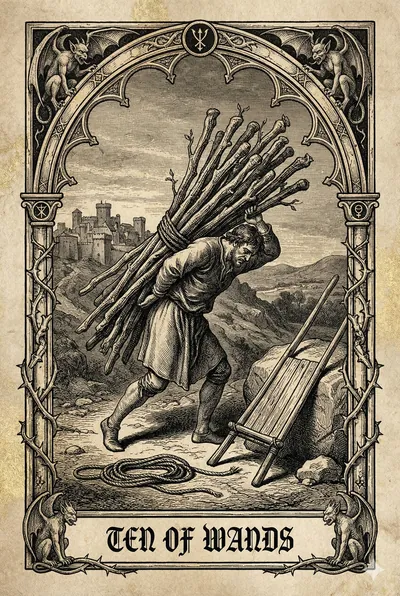
A man staggers forward, overburdened, bent over by the weight of ten heavy, unbundled staves, which also obstruct his view. He may be on the verge of losing his grip, but the suggestion is that he is nearly to his goal. Even in his slow progress, he stumbles past a rope and a potential travois. But he fails to see the possibilities. Force is one way to do this, but it implies expending energy against resistance or inertia. The alternative path to power is to expend less energy by finding a way around the resistance or inertia. Sometimes this is called sensitivity, sometimes intelligence. Smith took her idea for this card directly from the Ten of Swords in the late-15th-century Sola-Busca deck, the only deck before hers to use vignettes to portray the Pips.
Interpretation
This card depicts the burden of ill-regulated force, force that is in need of something a little extra. We have come to the limits of what we can do with raw energy, or with what we can do with our individual identity, or with ourselves as currently estimated. Our project, which might be perfectly noble and worthy, might have become an obsession. The word per-severance means making it through severity, but this is not a virtue in itself. Making it through to success has more value, and getting things of value done is the virtue. In a headstrong, headlong way, we might be compromising the effort itself, with the threat of hitting a wall, or of burnout, or at least of wasting a great deal of energy on ineffective, inept, or outmoded methods. If we are stiff-necked, locked-on, and obstinate enough, it might still be possible to push through to the end here, but as costs go up, the benefit ratio plummets. Diminishing returns compromise success. Expenditures should help, not be a burden. There should be enough energy left for better ideas.
A need for prioritization is a useful way to see this. Power is measured in terms of efficacy. In physics, power is the rate at which energy changes form to do work. It’s a rate, not a quantity of force spent, the rate at which work gets accomplished. It’s defined by effect or outcome, not by the energy spent on stress and strain. To the extent that a task is difficult, it isn’t power being felt, but resistance. This is a hint to find a path of less resistance, an approach with better leverage, or a way to delegate. Might needs right. It’s not the amount of effort expended but the elegance of the outcome. The reward will not be proportionate to the struggle but to the intelligent application of energy. Doing things the hard way, taking on challenges without thinking things through, might get things done, but it isn’t power. Efficacy or efficiency is not a complete substitute for vigor or force, but they make a good team. Power incorporates both energy and wisdom. It learns to do more with less. Laziness, they say, is the father of invention. A little more discovery is needed here.
The Yijing counterpart, Gua 34, Big and Strong or Power of the Great, shows a billy goat or ram butting a hedge, and recommends a pause to rest and look around, in case there might be a better way through or around. This is like moving towards the axle of the wheel, where the motion is least. The most effective pace might include pausing to rest and reconnoiter, to look at the problem as being more like a puzzle, to use one’s head in loftier ways than as a bludgeon. There is an adage in Zen that suggests: “You should sit in meditation for twenty minutes every day, unless you are too busy; then you should sit for an hour.” This is a good adage to use here. A better way is likely unseen due to current effort and a narrowness of focus. Meta-solutions require an overview of the problem. Too linear a direction can even find us blocked or thwarted by inanimate objects that should not be expected to cooperate. The Ten of Wands may suggest finding a different mode now, one that uses elements other than fire, a need to start using other faculties, rethinking the elemental components of the effort. The need for this sort of transition is typical for the Tens. We’ve run out of things that energy alone can do well. In particular, new inputs might be sensory or informative, ways to find a more optimum path from this place: feeling in Cups, thought in Swords, and practicalities in Pentacles. Insight is sometimes defined as a dynamic reorganization of the perceptual field, getting a new perspective or scale. Looking can hinder seeing. In Permaculture there is a principle about spending information before spending energy. Intense focus misses the peripheral view which may hold better options. Lastly, there may be issues of personal achievement here, and a sense that to delegate any parts of the task deprives us of satisfactions. We might not be assuming too much, or laboring under some delusions. This might not be a form of self-sacrifice or martyrdom, but perhaps this question should at least be asked, to help us explain why we turn down offers of help.