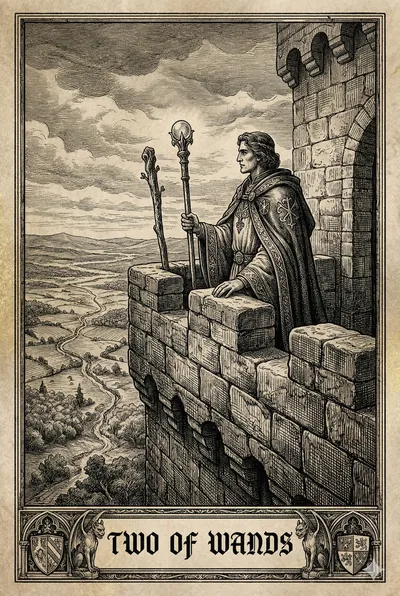
A man of strong economic or social presence stands at a battlement or parapet surveying his world and its boundaries from a commanding vantage, holding a longstaff and an orbed scepter. A more gnarled staff stands alone. The battlements might be regarded a defining wall, between what we are and what we are not. The territory already claimed goes up to here, where the other, with its possibilities, begins.
Interpretation
Human is as human does. Poets will say something different, philosophers too, but they largely describe their own fantasies. We adapt or fail to adapt by our actions, and this is how we become what we are. Such a definition denies us our greatest human hypocrisy. The Two of Wands is about knowing who we are, what we want, and how we enact our choices. It’s the development of our identity and purpose, and then about how we take responsibility or ownership of the world around us, however big or small that world may be. Given the clarity of direction that the wisdom of the Two can develop, a deeply personal path or calling, we can claim the right to create the world we live in, sometimes on a grand scale, but easily on our own. This takes the courage to change the things we can. Of course the platitude says we should try to change only ourselves. But this is our choice: “If I were not Alexander, I would be Diogenes.“ It is knowing who we are that tells us what to do. The rules are simple then: be true.
Dominion is probably the best single word for this card, and it is commonly used here. It comes from the Latin domus, meaning home. It refers to our own domain, what we claim as our own turf and purview, what we are ultimately responsible for, what we are lord or domine of, what we are able to dominate, and what is within our rights to domesticate. We are not required to take charge of anything, not even ourselves. This helps to explain why the world is run by a hive mind. Some of us would change this. And some of us who would will only make things worse. But the character of this card is to apply directed energy to further the good, to make the world a more habitable place, and perhaps to give something back to the world. The counterpart in the Yijing is Gua 14, Big Domain or Possession in Great Measure, enrichment, treasuring, which needs little explanation. The Chinese speak of wu wei, not doing or inaction, as a value for living, but the kind of doing (wei) that is not being done means ‘acting’ in the sense of playing a specified role that is far too frequently sideways to our original nature. And this in its turn tends to emerge from inferior wisdom about what we need and want, and what it means to have. The truly noble can ‘have’ as much just holding a pilgrim’s staff: the greatest power is in the power to assign a value to things, and a high value to evaluation and revaluation themselves. It’s the appreciative and the grateful who are rich. This is knowing what you have and what you want or need, all sorted by their value to your life. Of course, the truly noble will also own their mistakes, or own the consequences of their actions.
As we search for our identity, the empowerment of knowing ourselves, we look first for a continuity in time. We prioritize around this identity. We try for a binding alliance of the many parts of ourselves, a unity that is our integrity, an integer or an undivided wholeness. We compile a self out of the sum of our values, starting with likes and dislikes. We seek to own ourselves, and to own up to our errors, then responsibly alter who made them. So continuity is one thing and discontinuing error another. We are not just the line we like to draw between only our shiniest moments. Delegating tasks and influencing others will do little outside of the world we can manage, and what we cannot demonstrate or exemplify will not be adopted. We can manage this only by walking the talk. In short: be excellent.
Eastern Resonance (Yijing)
Gua 14, Da You, Big Domain, Possession in Great Measure, Great Havings. Da Xiang: Qian (2) below, Li (Wands) above; “Flame in heaven above. Big domain. The young noble suppresses the bad and promotes the good, accepting heaven’s terms and higher laws.” Endowments, dominion, enrichment, laying claim, wealth of experience, owning one’s power to assign, rearrange and revise values. “Supreme fulfillment.” Where we learn to make our own values we command our own enrichment.
affirmationaffluenceambitionappropriationaretéaspirationassetsassumptionattainmentauthorityavowalbeing lordboldnesscallingcausechoiceclaimingclear positioncommandconfidenceconfirmationcontainmentconvergenceconvictioncounting of blessingsdedicationdeterminationdirected willdirectionelectivesemboldenmentendowmentenrichmententitlementexaltationexcellencefuturitygratitudehigher purposeidentity and identificationintentintentionlicensenobilityoverseeingownershipowning upowning your lifepersonal powerprideprinciplesprivilegepurposeresolveresponsibilityrevaluation of valuerightsrulesovereigntysummoningtaking chargetaking controltaking holdtaking titletaking responsibilityvalidationvaluationvaluewealthwherewithalwillworth
Warnings & Reversals
•arrogance in arrogation
•blind ambition
•conflicted sense of identity
•disappointing success
•domination
•domineering
•greed
•haste
•ingratitude
•linearity of purpose
•loss of will
•mismanaged claims
•obstinacy
•opposition from others
•overweening ambition and pride
•recklessness
•shamelessness
Structural Components
Two plus Wands. The directing of energy towards an aim, or the focusing of a dynamic force according to a chosen purpose or want, and also the forces converging behind that choice. Avowal of purpose or direction. Crowley says, “energy initiating a current of force.” There is not a lot of circumspection, reflection, or reviewing of options here: it’s closer to knowing than knowledge.
Mystic Correspondences
Astrology
Uranus in Fire Signs and Houses. Issues of autonomy and autocracy in decisions to change the world, the courage to change the things we can, taking responsibility outside of ourselves, sense of personal purpose or higher purpose.
Qabalah
Chokmah in Atziluth. Wisdom in action, setting forth principles and establish- ing precedents.