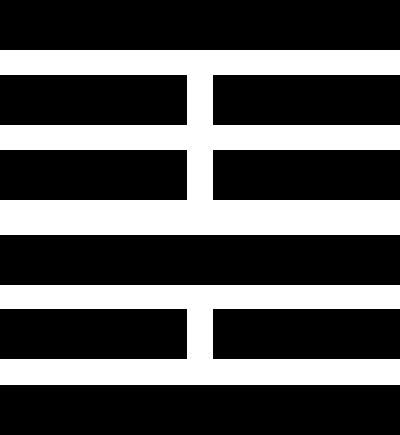
I Ching Hexagram 22 symbol: GRACE (Pi)

Hexagram 22. GRACE

Pi

The Judgement

GRACE has success. In small matters It is favorable to undertake something.

The Image

Fire at the foot of the mountain: The image of GRACE. Thus does the superior man proceed When clearing up current affairs. But he does not venture to decide legal cases.

The Lines

6

Nine at the top

Simple grace. No blame.

The Image says: 'Simple grace. No blame.' At the top, the will is fulfilled.

5

Six in the fifth place

Grace in the hills and gardens. The roll of silk is meager and small. Humiliation, but in the end good fortune.

The Image says: The good fortune of the six in the fifth place is due to the joy it brings.

4

Six in the fourth place

Grace or simplicity? A white horse comes as if on wings. He is not a robber, he will woo in due time.

The Image says: 'The six in the fourth place is in the right position, yet there is doubt.' 'He is not a robber, he will woo in due time.' In the end there is no blame.

3

Nine in the third place

Graceful and moist. Eternal perseverance brings good fortune.

The Image says: The good fortune of 'eternal perseverance' is that in the end no one will be put to shame.

2

Six in the second place

Lends grace to the beard on his chin.

The Image says: 'Lends grace to the beard on his chin.' He rises with the one above him.

1

Nine at the beginning

He lends grace to his toes, leaves the carriage, and walks.

The Image says: 'He leaves the carriage and walks,' because according to right he should not ride.

The Wisdom of Hexagram — An Eastern Perspective

The Aesthetics of Simplicity and Truth

Hexagram 22 (Pi/Grace) explores the delicate relationship between Form (Wen) and Substance (Chih). It asks a timeless question: How much decoration is too much?

While etiquette and beauty are the hallmarks of civilization, the I Ching reminds us that all external adornment must be rooted in an internal truth. Decoration is meant to serve the essence, not to mask it.

The hexagram takes us on an aesthetic journey through its lines. The lower half represents the ascent of ornamentation—from simply adorning one's "toes" (Line 1) to the "beard" (Line 2), culminating in the dazzling, "glistening grace" of Line 3. This is the peak of external beauty.

However, the upper half reveals a deeper wisdom: the return to simplicity. The imagery shifts to a "white horse" (Line 4) and a meager gift of "simple silk" (Line 5). Finally, at the summit, we reach the ultimate ideal: "White Grace" (白賁). This signifies that the highest form of beauty is colorless and pure.

Summary: Pi studies decoration only to emphasize the supremacy of the essence. As Confucius famously stated, if substance outweighs form, one is uncouth; if form outweighs substance, one is superficial. The goal of the Superior Man is "Wen Chih Pin Pin" (文質彬彬)—the perfect harmony where outer grace reflects inner truth, and simplicity becomes the ultimate sophistication.

Structural Relatives

Cast Your Own Reading

Confused by the changing lines? Use the authentic Yarrow Stalk method to discover which lines apply to your specific situation.

Start a Free Reading