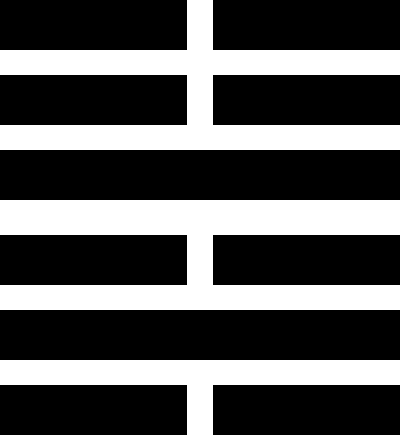
I Ching Hexagram 40 symbol: DELIVERANCE (Hsieh)

Hexagram 40. DELIVERANCE

Hsieh

The Judgement

DELIVERANCE. The southwest furthers. If there is no longer anything where one has to go, Return brings good fortune. If there is still something where one has to go, Hastening brings good fortune.

The Image

Thunder and rain set in: The image of DELIVERANCE. Thus the superior man pardons mistakes And forgives misdeeds.

The Lines

6

Six at the top

The prince shoots at a hawk on a high wall. He kills it. Everything serves to further.

The Image says: 'The prince shoots at a hawk,' in order to deliver from the rebellious.

5

Six in the fifth place

If the superior man can be released, good fortune will follow. Thus he proves his sincerity to the inferior man.

The Image says: 'If the superior man can be released,' the inferior man retreats.

4

Nine in the fourth place

Deliver yourself from your big toe. Then the companion comes, and him you can trust.

The Image says: 'Deliver yourself from your big toe.' The place is not the right one.

3

Six in the third place

If a man carries a burden on his back and nonetheless rides in a carriage, he thereby encourages robbers to draw near. Perseverance leads to humiliation.

The Image says: 'If a man carries a burden on his back and nonetheless rides in a carriage,' this is also shameful. 'He himself invites the robbers.' Who is to blame?

2

Nine in the second place

One kills three foxes in the field and receives a yellow arrow. Perseverance brings good fortune.

The Image says: 'Perseverance brings good fortune in the nine in the second place,' because one has found the middle way.

1

Six at the beginning

Without blame.

The Image says: 'When the firm and the weak are in contact,' according to right there is no blame.

The Wisdom of Hexagram — An Eastern Perspective

The Art of Liberation and Decisive Action

Hexagram 40 (Hsieh/Deliverance) signifies the lifting of tension. Like a thunderstorm that clears the sultry air, it represents a time when obstacles are removed and pardon is granted. The I Ching offers a strategy of "Gentle Liberation" for the aftermath of a crisis. The text advises that "Advantage lies in the Southwest," implying that when the immediate danger is over, one should adopt a policy of forgiveness and rest, letting go of minor faults to restore peace.

However, true liberation is not passive; it often requires cleaning house. The hexagram narrates a progressive removal of toxic influences ("The Inferior Man") from one's inner circle. It begins by warning against cunning flatterers—symbolized as "Three Foxes"—who must be removed to clear the air. It then vividly depicts the danger of "Carrying a burden while riding in a carriage" (Line 3). This metaphor describes an inferior person acting above their station; such pretension is dangerous because it invites theft and disaster.

As we sever these ill-fitting connections to gain the trust of true friends, the journey culminates in a moment of sharp contrast. While the general mood of the hexagram is one of forgiveness, the Top Line reminds us that some evils cannot be tolerated. When the time is ripe, the Superior Man must be like an archer "Shooting the Hawk on the High Wall." This teaches us that while we should generally be lenient, we must possess the courage to strike decisively when the root of the problem is finally exposed.

Structural Relatives

Cast Your Own Reading

Confused by the changing lines? Use the authentic Yarrow Stalk method to discover which lines apply to your specific situation.

Start a Free Reading