
How Hatcher's Word Chain Works
"A simple guide to the linked chain system in Bradford Hatcher's I Ching word-by-word translation.
Think of each Chinese character as a bead on a string. When the same character appears in different hexagrams, Hatcher threads them together into a chain. Each entry points to the next place where the same character appears.
This lets you read how one character's meaning changes across the entire I Ching.
The Data Table
Each character entry in Hatcher's matrix has columns for:
| Column | Meaning |
|---|---|
| Pinyin | The pronunciation (e.g. yuan2) |
| Hanzi | The character (e.g. 元) |
| Mathews | Dictionary number (e.g. 7707) |
| Stats | How many times it appears: Lines + Hexagram Texts |
| Reference | Where to find the definition of this character |
| Gloss | The meaning in this context |
| Next | Where to find the next occurrence in the chain |
The First Witness
Every character has a First Witness — the first place it appears in the text. This entry is special:
- It has the stats field filled in (other entries leave it blank)
- It is the start of the chain
- It is marked with a star (*) in the original text
For 元 (yuan2), the First Witness is at Hexagram 01, Gua Ci (01.0):
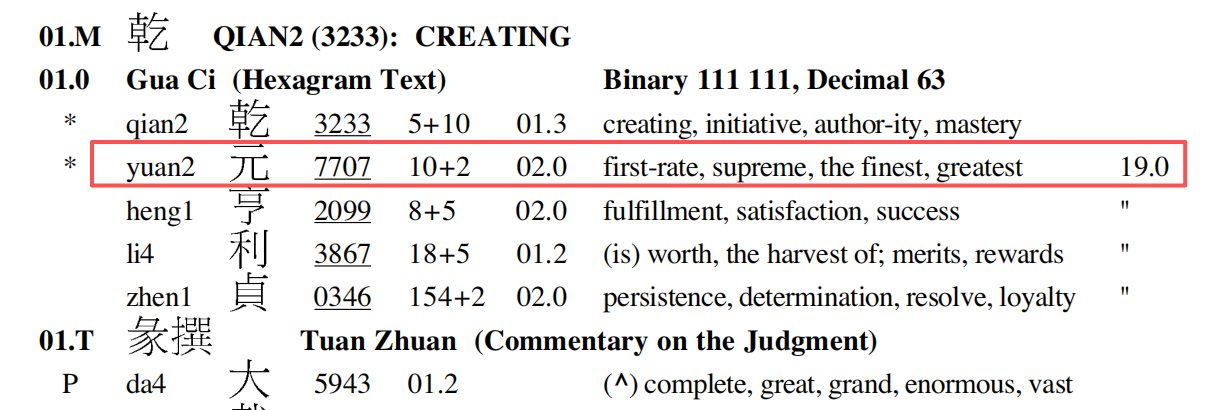
Here we can see:
- Stats:
10+2means 元 appears 10 times in line texts and 2 times in hexagram texts - Reference:
02.0— the definition lives at Hexagram 2, Gua Ci - Next:
19.0— the next occurrence is at Hexagram 19, Gua Ci
Following the Chain
From the First Witness, we follow the chain:
Step 1: 01.0 → 02.0
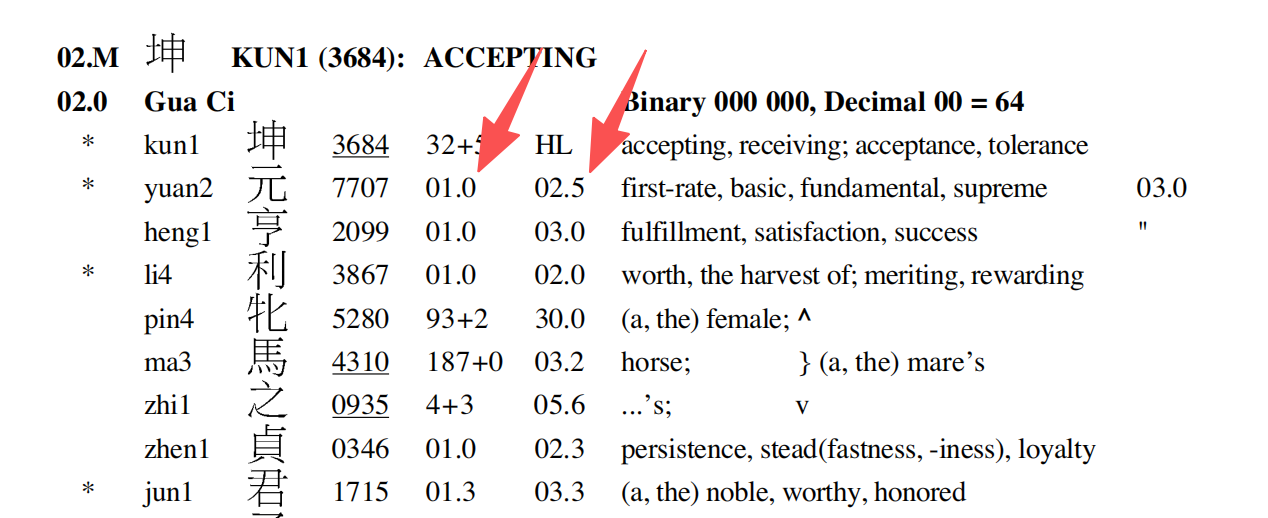
At Hexagram 02, Gua Ci, we see 元 again. The reference column says 01.0 — this points back to the First Witness (where the core definition is). The next column says 02.5.
Step 2: 02.0 → 02.5
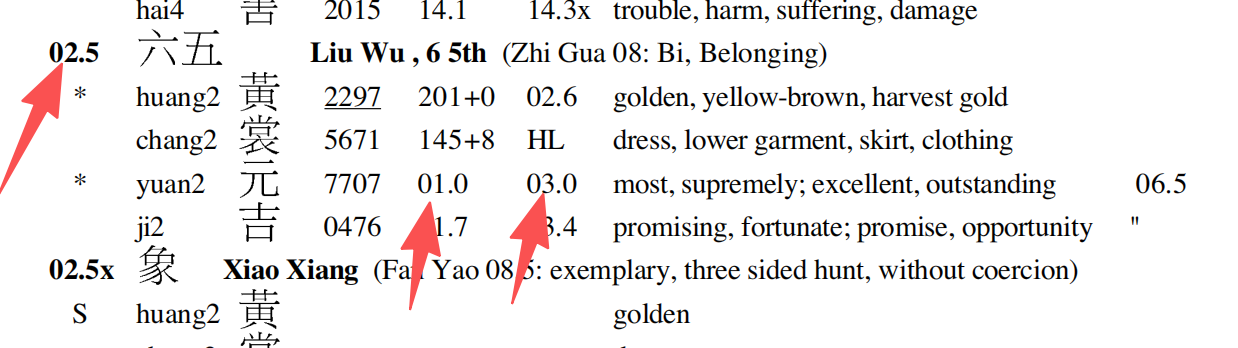
At Hexagram 02, Line 5. Notice that 02.5x (the Xiao Xiang for this line) also contains 元 — but it is a subsidiary entry (marked "S"), not part of the main chain.
Step 3: 02.5 → 03.0
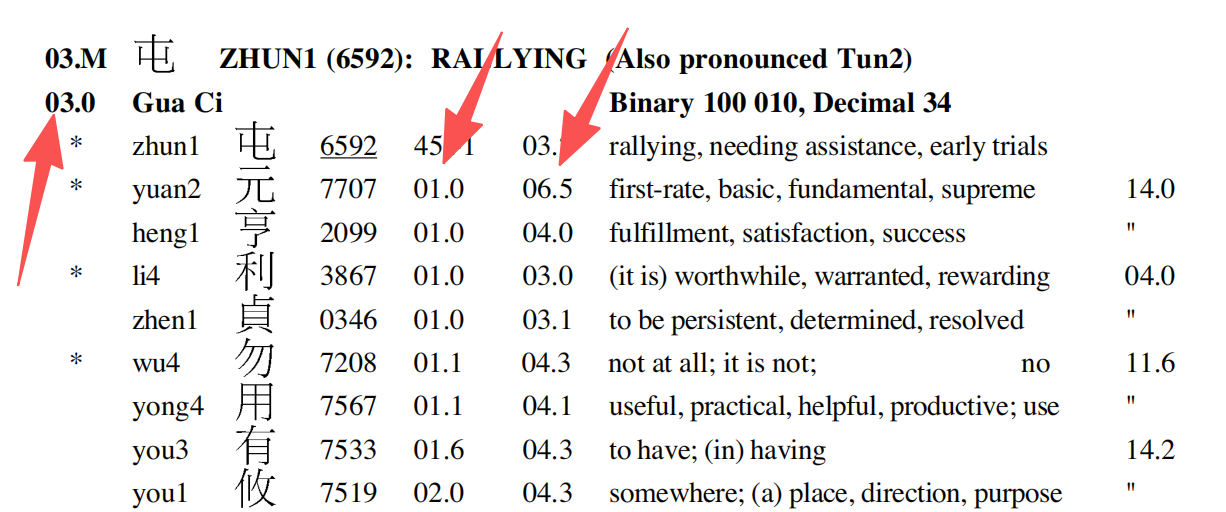
At Hexagram 03, Gua Ci, 元 appears again in the "yuan heng li zhen" formula. The chain continues to 06.5.
Step 4: 03.0 → 06.5
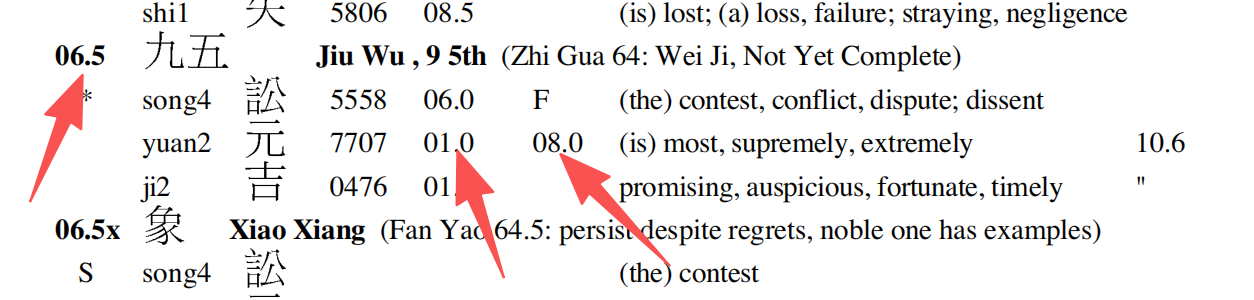
At Hexagram 06, Line 5, the gloss is "(is) most, supremely, extremely". Next stop: 08.0.
Step 5: 06.5 → 08.0
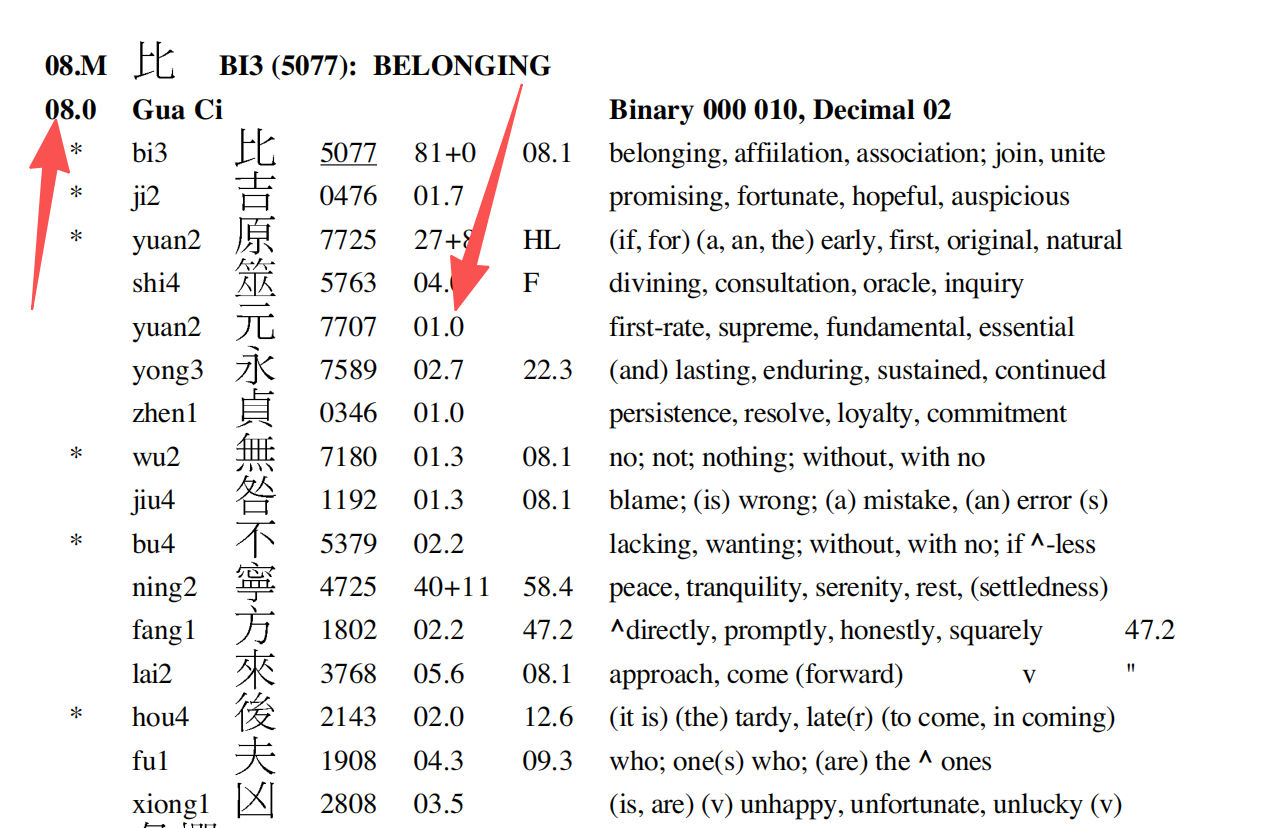
At Hexagram 08, Gua Ci. Notice another character: 原 (yuan2, Mathews 7725) with stats 27+8 and reference HL. This is a different character — same pronunciation but different Mathews number. HL means Hapax Legomenon: it appears only once in the entire text.
Three Types of Entries
| Type | Example | In Chain? | Description |
|---|---|---|---|
| Main | 01.0, 02.0 | ✅ Yes | Part of the reference chain |
| Subsidiary | 02.5x, 10.6x | ❌ No | Xiao Xiang commentary, attached to a main line |
| Commentary | 01.T, 02.T | ❌ No | Tuan Zhuan or Xiang Zhuan entries |
Subsidiary and commentary entries point back to the First Witness directly. They are attached to their parent entries, not independent stops on the chain.
How It Looks on This Site
On our Word Index pages, we display this chain structure visually:
- Chain mode: Words with a reference chain show entries in Hatcher's linked order, with the First Witness marked ★
- Flat mode: Words without a reference chain (like 水 "water") show entries in natural order
Subsidiary entries (Xiao Xiang) are indented below their parent line entry.
Try it yourself: see 元 (yuan2) in action at yuan2_7707.
Summary
The chain system lets you:
- Find where a character first appears (First Witness)
- Follow its journey through the entire I Ching
- Compare how its meaning changes in different contexts
- See which entries are main stops vs. commentary
This is what makes Hatcher's work unique: every character is connected to every other instance of itself. The entire text becomes a web of meaning.