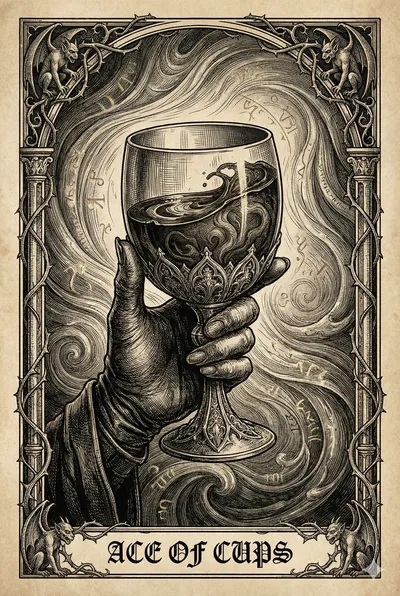
A chalice, in a man's hand, is tipped slightly towards the viewer, exposing a cup half filled with what might be water, wine, or blood. There is a suggestion in this shape of the human female pudenda. Many cards and authors imply that the cup is the holy grail and would depict it as ornate. If you wish to use this image of a sacrament here, see ‘Indiana Jones and the Last Crusade’ and choose wisely. But we don’t need this magic pretend blood to commune with the sacred. We merely need to be open, sincere, and worthy. An alternative image could depict a cup that’s just beginning to be filled in a Japanese tea ceremony.
Interpretation
As discussed in the introduction to the Suits, the Cup is not the water. The Ace of Cups is not affect, feeling, or emotion. It is our readiness for these, the place we have made for them, and our worthiness, or our sense of worthiness, as well. Without this, the liquid is just a spill. The card speaks to the process of opening up, to how we make room within ourselves for authentic and heartfelt experiences with others, or opening to our own inner lives, or to the natural world. This is what starts the flow. It’s our readiness to both give and receive, to respond to gifts, to meet someone new, to acknowledge a muse, to let ourselves be stirred. This is about precursors or preconditions to genuine feeling.
Muju wrote: “An inquisitive professor once visited Nan-In to pay his respects, but he could hardly bring himself to stop talking. Nan-In served him tea, pouring the cup full and not stopping. ‘It is overfull,’ cried the professor, ‘no more will go in!’ ‘Like this cup,’ said Nan-In, ‘you are full of your opinions and speculations. I cannot show you Zen unless you first empty your cup.’”
Just like at home in the kitchen, we want to put our fresh beverage into a clean, empty cup. Cleanliness here is emotional clarity, a freedom from any of the undesirable residue from our past experience, from our residual sentiments and resentments. Just about any sentiment is legitimate once: it’s when we pummel ourselves with the same emotions over and over again that we jam up our opportunities for fresh experience that respects what we are facing. Several authors list fulfillment as a meaning for this card, but it isn’t, yet. The meaning is closer to full-empty-ment, not being so full of ourselves that we cannot make room for the fullness we want from the world. This emptiness is capacity: a capacity for enjoyment, for love, for rewarding experience, for receiving new gifts and blessings, for feeling and emotion in general. The Ace of Cups represents a new new sensitivity, or a sensitization, a readiness to feel. The analog in the plant kingdom, of course, is the open flower, ready for pollination.
The astrological correlation of this card to Saturn in Water signs underscores the big challenges we have in relaxing our inhibitions and opening ourselves up. While someone with this configuration might be said to define themselves in terms of their sensitivity or their capacity to feel, this same sensitivity can also lead to damage, overexposure, and subsequent desensitization. Our capacity for openness is a function of our wounds as well as our wants. The fear of our being hurt again, mistrust from having our trust betrayed, self-doubts that are often deserved because of our bone- headed mistakes, all of these can shut down our willingness to receive the new. Saturn ‘rules’ the skin, the metaphorical boundary where we receive our wounds. But there is nothing in the rules that says that the part of our identity that is symbolically repre- sented by Saturn needs to play the victim or martyr. If we are to succeed in life, this part of us needs to learn mastery of these fears and doubts, to learn the worth of vulnerability and to keep coming back for more. We are not, however, avoiding that old definition of insanity here: we make different mistakes next time.
Security and insecurity are also the primary theme of the Yijing counterpart, Gua 45, Collectedness or Gathering Together. The vessel here is the reservoir or pond, raised above the earth, requiring that its banks be maintained so that the water doesn’t leak out. There is also an emphasis in the text of the social aspects of security, how we congregate wanting connection, and attain comfort levels in our safe environments and sanctuaries, allowing us to open up. There is much crying and sighing depicted in the Yijing’s text. We prepare the place for our water and fulfillment follows when we are ready. We seem to like a little insurance beforehand.
The Ace of Cups can be related to four exalted states of sentient awareness described in Buddhism as the Brahmaviharas or Abodes of Brahma. These largely concern our better social relationships, which tend to dominate our affective states. Metta is loving- kindness or good will; karuna is compassion or sympathy, but not fellow-suffering; mudita is a sympathetic gladness in the well-being or success of another; and upekkha is equilibrium or equanimity. At least four more pertinent states can be added here: khama, forgiveness; katannuta, gratitude or thankfulness; garava, reverence, deep respect or a sense of the sacred; and khanti, patience. All eight of theses states show an openness of the heart, or a readiness to accept, that characterizes this card.
Eastern Resonance (Yijing)
Gua 45, Cui, Collectedness, Gathering Together. Da Xiang: Kun (Ace) below, Dui (Cups) above; “The pond is raised above the earth. Collectedness. The young noble puts aside weapons and instruments, guarding against unreadiness.” An elevated pond requires embankments, shoring up, and maintenance to hold the water. Security, freedom from insecurities, preparedness, readiness, sanctuary. “Fulfillment. The sovereign approaches his temple. Rewarding to encounter a mature human being, making an offering. Worthwhile to be dedicated. To offer great sacrifices is promising. Worthwhile to have somewhere to go.” There is much weeping and emotion in some of line texts. Pulling and holding yourself together. Composure, dignity. Congregating with others for comfort.
Ace plus Cups. Readiness to open up within and into the world of affect, to give reign to the feelings and emotions, and the comfort level needed to do this. Work on precursors to feeling, finding the source or wellspring of love or other genuine feeling.
Mystic Correspondences
Astrology
Saturn in Water Signs and Houses. Issues related to opening up the feelings, sensitivity and sensitization. We can define ourselves as a feeling being if wounds and traumas don’t lead to emotional shut down.
Qabalah
Kether in Briah. The fountainhead or source of sentience, opening up the heart, understanding with feeling, readiness to feel and for expression of feeling.