Image Reference
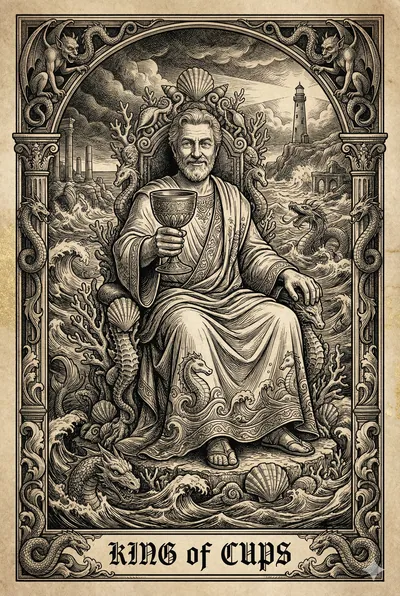
A mature or paternal, but still bright-eyed King on his throne offers a cup to the reader in the attitude of a toast. One cannot be sure if it’s wine. A bemused but mischievous glint in his eyes gives him the air of a old Bedouin chieftain, but with strong suggestions of both sincerity and kindness. He is both dignified and approach- able here, a potentially fierce or highly enthusiastic nature with a calm and warm exterior. Marcus Aurelius might be a good model here. So would Downton Abbey’s Earl of Grantham. He wants both respect and gratitude, but he wants to earn them.
Interpretation
The King of Cups is usually described as a decent and mature man, with a calm exterior and good humor, experienced, deliberative, considerate, and approachable. He is likely to be likable and charming, and perhaps even charismatic. He might not appear to be a sensitive or emotional fellow, since he has developed some reserve or reticence in his maturity, but he is not at all cold, nor especially judgmental. He has a big heart, but also an understanding that won’t submit to the frivolous and ephemeral. He is familiar with the ranges and options of his own feelings, and can feel them vicariously in others. Once consenting, he can be touched. He is responsibly responsive, or careful about his arousal, and steady in his enthusiasms, even if they may not last long. He could be both sensuous and sensible at the same time. He may or may not be deep, but he has collected some substantial life experience. We spoke earlier of the four Kings’ degree of maturity and sovereignty each relying on one most-important life lesson. This King must learn about time in a related pair of aspects: ephemerality and deferred gratification, summed up as patience. He will be guided, but not controlled, by affect. He might also be fearful of losing control from some past experience. But then, because affect is fleeting, he will be on to other things.
The King of Cups is not without emotion. Rather, he is so comfortable in the realm of emotion that it is an area of expertise for him and he can feel empathy and com- passion for those around him without becoming upset himself. He may seem reserved, restrained, even reticent. This is emotional self-control, or better, self-management, that is not at all unemotional. It is a kind of discriminating intelligence that is best learned by one who has been open to his feelings and emotions and learned some good lessons from this. His emotional intelligence has become emotional wisdom, even sagacity. He is the leader of his feelings now, not their obedient follower. Experience has given him a stock of alternative ways to feel and emote, including the skill he needs in order to hold them in abeyance until some more of his options have been weighed, and compared in the light of their longer-term outcomes. He knows some things now about promises and bait, some of them learned at some cost. He can estimate what is important before choosing to get involved, when his criteria for a more promising experience have been met. This is done by slowly learning his nature and developing his personal values.
You will find this King responding just about right in between repression on the numb side of things and catharsis on the overblown side. But when you witness him emoting you are apt to see some enthusiasm and earnestness, or caring and com- passion. Feelings and emotions are not things that wise elders outgrow. The Buddha had much to say about emotional self-management, particularly when he spoke of right intention. But he trained his wisdom on our more problematic emotions, craving and greed, ill-will and aversion, harmfulness and cruelty. The superior states, while not to be hunted down, were not to be dismissed. Both the Stoics and Epicureans shared similar values. The Stoics were a bit more extreme in seeking apatheia, life without passionate suffering, although this was not nearly as numb as what we now refer to as apathy. Both sought eudaimonia, human flourishing and well-being. The final word on the matter might be that our feelings can choose, not just our thoughts. With a little experience and practice, these too can have standards, good tastes, and values. This is how to cultivate the Stoic and Epicurean ideal of eudaemonia, or human thriving.
As a king, of course, he has his subjects. He needs to know what his subjects need and want, and even what they could be helped to want. As a counselor, he has clients. As a therapist, he has patients. As a dad he has kids, as a grandpa, grandkids. He will want to be a good listener, concerned and sympathetic, attentive and understanding, tolerant and comforting, but not a chump or a sap. Understanding doesn't mean agreement, support doesn’t mean indulgence, empowering doesn’t mean permissive- ness. He may not be at all sympathetic with impatience or shortsightedness. As these are his duties, all he might want in return for this guidance and perspective is a little respect and gratitude, and these because these two help others to learn.
The Yijing counterpart is Gua 54, Little Sister’s Marriage. Much of the text looks at the problems of haste and impatience that resolve with our maturity later, but a couple of the lines depict the patience and self-control that this card is trying to develop. An ideal King of Cups is depicted as the King Diyi in Line 5. The lessons of immaturity, impulsiveness, or jumping to conclusions, will eventually lead us to longer time horizons and better perspectives. This is the one who says ‘no, thank you’ to the Marrying Maiden, despite the near certain promise of short-term gratification.