Image Reference
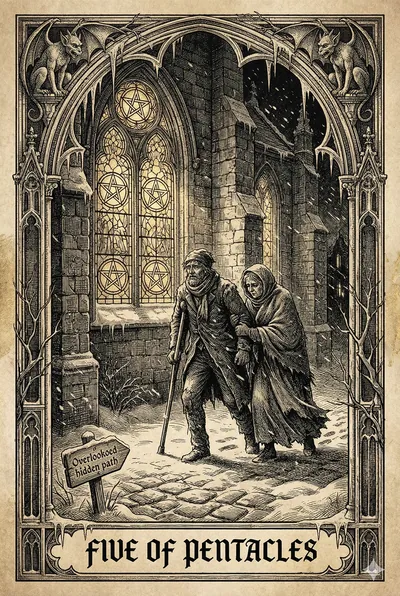
In the RWS deck, a man on crutches and a shabbily dressed woman trudge through snow, past the lighted stained-glass windows of what appears to be a place of worship. There is no visible door, but they might see one soon, once they get a bit further or turn a corner. There is hardship here, but they are also missing something, or failing to notice a reason for hope. Most variants and clones depict distress, especially endured in winter. A bright future is not currently visible, and it takes an effort or a special insight for hope or reassurance to overcome despair.
Interpretation
The Five of Pentacles is often called material trouble or worry. The energetic force of the Five has disrupted the balance found in the Four and things are knocked off of their course, or fortunes are reversed. As such, most associations indicate an unpleas- antness of circumstance that might take some time to escape, typically loss, anxiety, destitution, impoverishment, setbacks, adversity, unemployment, overextension, privation, delays, poverty, dry spells, stretched resources, challenging circumstances, indigence, strain, or riding out the winter. Short-term relief remains a possibility, with a refuge or sanctuary, or even a temporary home, but the real light at the end of the dark tunnel is generally thought to be some distance away, asking for endurance, faith, or patience. An inability to see any short-term solutions is sometimes implied, and ironically, this is due to the nearsightedness brought about by the nearness or immedia- cy of this distress. If they only knew better, the half-frozen urban homeless could just as easily be eating mangoes while camping in some tropical forest, on roughly the same budget. As Gandhi suggested, “to a hungry man, food is god.” We can see no further in time or space. We only see our toil unrewarded and rewards too long deferred.
There is probably no more fortunate time in the life of an alcoholic or drug addict than the moment in time known as ‘hitting bottom.’ It’s at this point that the alternatives to utter failure come into view. The moment when multiple options are seen and felt at the same time is known to the Buddhists as samvega. Sometimes we have to reach this state or point before we have any true choice. It’s here that we turn our lives around. The Earth just creeps past this point at the winter solstice, but it does this every year like clockwork, and we count on spring’s return. When we can understand this during our lowest lows, some gratitude will also help turn things around. Poverty can assume a cloak of voluntary simplicity, and even a freedom from burdens.
The sense of time is important in this card. When a force is applied to material, the discontinuities of the response are a function of mass or inertia. Matter responds more slowly than energy, and recovers more slowly. We are but lightweights and inertia is not on our side. Forces applied to our little lives can lead to large dislocations, while forces like seasons applied to the Earth take time to show and time to rebound. The Sun reaches its nadir on the winter solstice, but the cold has only begun. The recovering light takes time to catch up, to warm an enormous mass. Sometimes inertia resists change as long as it can, and then yields suddenly, as with landslides and earthquakes, but more often the large-scale change is more continuous, while our small adaptations to this proceed by fits and starts. Then life wants buffering, to meet our short-term needs amidst the long-term changes. This is the worried relationship (and its cycles of viciousness) between the family farmer and the local bank. We try our best to survive with rainy-day planning, savings, reserves, stockpiles, caches, nest eggs, and safety nets. These estimate the distance between real and ideal. Sometimes we ask for trouble by insisting on unreal ideals, and get far enough off course and out of balance that we fully deserve our extremity. And sometimes it’s just bad luck that intervenes and nature does some selecting. But we find a way through.
The turnaround ‘out there’ may be some time in coming. The longest, darkest night at least gives us hope when we know it’s the longest and darkest. Sometimes we know when a bad trend reverses, when the bottom has been reached, or when we will take no more. Then we can turn our perspectives around ahead of the cycles and seasons. We can have turnarounds in attitude when worry proves maladaptive. The homeless, the pilgrim, the bum, the sanyassin, the drifter, and the monk all have roughly the same material resources and the same size load to pack for a journey. Those with some inner freedom can change the weather by moving out from under it. Poverty can become simplicity. Thoreau didn’t suffer at all at Walden Pond. We just need some trust in the great wheel’s turning, some kind of minimal faith that swings of circumstance will average out on an acceptable course. Whether time hurts us or heals us, we have to know that spring is just ahead, even when it’s the end of the current spring.
The Yijing counterpart is Gua 24, Returning, which specifically speaks to the winter solstice and cycles of time that are longer than short-term concerns. This is more about coming around full circle, or moving through the cycles of things, carrying the lessons learned with us, and not so much about quitting and turning back, although turning back is something to do when wrong turns have been discovered. The core truths will survive any such change or digression, and things will eventually return to their proper place. Nietzsche suggested that ‘a loss rarely remains a loss for an hour,’ a fine observation on our opportunistic adaptability that can help to replace the moronic ‘everything happens for a reason.’ The Yi observes something similar in a few places: what we really need is restored within seven days. If it doesn’t come back, we didn’t need it. Readjustment is gradual. We just need a little endurance and patience.