Image Reference
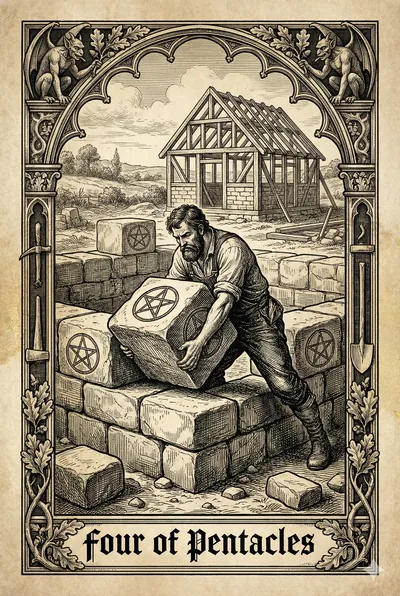
The RWS deck features a man holding on to three pentacles and balancing a fourth on his hat, appearing to be using everything that he has to hang on to what he owns. The image is a little silly and it seems to imply little more than insecurity and miserliness. Maybe a better alternative would show a hard-working man wrestling a huge stone into place, the fourth of four cornerstones for a house. Indications are that the house will be small, humble, well made, and built to last many generations.
Interpretation
The Four of Pentacles is usually interpreted either in terms of the RWS image or else meanings cast in terms of power. Those who call this card mundane or earthly power don’t understand what the word power means. In physics, it’s the rate at which energy is transformed to do work. It has next to nothing to do with this card. The image of the miser, on the other hand, has led to such associations as ownership, property, posses- sion, establishment, love of wealth, acquisitiveness, surety, satisfaction. realism, fortification, stockpiling, banking, savings, holding on, holding back, clinging, cleaving to what one has, gain of money and influence, physical materials and skill in allocating them.
Matter, materialism, and the material world have long been the target of verbal abuse by the spiritual and religious folk. But there is another whole wing of philosophy that sees the spirit as emerging from this. Laozi suggests “those who are most mature keep to the substance and do not dwell on the sham, keep to the fruitful and do not dwell upon the flower.” (DDJ 38). The secular mystics and scientists like their terra firma. Existence precedes essence. If they even have gods, they tend to be chthonic. They want to build on foundations, constitute their theories with evidence, and reason from ascertainable and even unassailable facts. The Four of Pentacles concerns the building of something real, tangible, authentic, or palpable. It asks for engineering, infrastruc- ture, and maintenance. It seeks surety, soundness, and reliability. Because failures here cannot be dismissed as readily as errors in the mind, there are concerns for getting things right, working within realistic limitations, and defensibility against the real- world forces inclining things to entropy. As Stewart Brand pointed out, this doesn’t mean that something like a building can’t learn things over time and change form. Stability is often misconstrued as stasis.
Conservatism is a characteristic of this card, but we aren’t speaking here of the fiscal politics and moralizing practiced by aging, fearful, and ignorant imbeciles. However, this is the opposite of revolution. Conditions of necessity and sufficiency must be met. There is concern for things that endure the ravages of time, for traditions worth keeping, for buildings worthy of having brass plaques, for bridges that don’t fall apart in the wind. We don’t want haste with the basics: if these aren’t stable, nothing on top of them is. Security is a big deal here: not the kind that leads to smugness and compla- cency, but the kind that lets us concentrate on higher endeavors. We have safety nets and margins, protective buffers, contingency plans, plans B and C, fallback positions in place, devices that blink and beep at us when things are going wrong, and two means of egress from most of our rooms. There is also concern for conserving, as in resource conservation, working to minimize our waste. This way we have something left over, for our distant descendants to enjoy and rely on.
As implied in Smith’s depiction of the miser, much conservatism can go over the top and waste available resources. There are many examples of this. The status quo it defends may have little or nothing to recommend it when seen against greater horizons and better possibilities. We might design something for worst-case scenarios, and then to be fair, generalize these designs to all things instead of staying specific, thereby wasting massive amounts of resources. We might keep standing armies, rattling their sabers, instead of hidden militias. The prison guard is stuck behind the bars as well. Erring on the side of caution is still erring. And risk still has much to teach us, from our earliest years on up. We want to be safe and comfortable without alarms and locks everywhere. But we might have some use remaining for schools and playgrounds where children can learn the harder lessons and get their much-needed owies and bruises.
It is said that telling the truth is better because we don’t have to remember as much. A corollary is that self-assuredness is more assured if we are not overreaching ourselves. Being real is a safer position than being hyperbolic. As the Bard boasted: “my mistress’ eyes are nothing like the sun.” We have a huge reservoir of abundance in what we already have. We need only to learn to want this. The Yijing counterpart is Gua 15, Authenticity. The word Modesty accurately translates this chapter’s title through most of the text, but the text is ironic, and its meanings consistently speak to our misunderstanding of the idea as self-effacement, which is another form of vainglory. This is really about the bestowing of honor, not about dismissing it, respecting and appreciating things for what they truly are, without flattery or exaggeration, without cynicism or deprecation. It’s about accurate assessment or estimation, and curtailing the superfluous. It’s all about optimizing, not minimizing or maximizing.