Image Reference
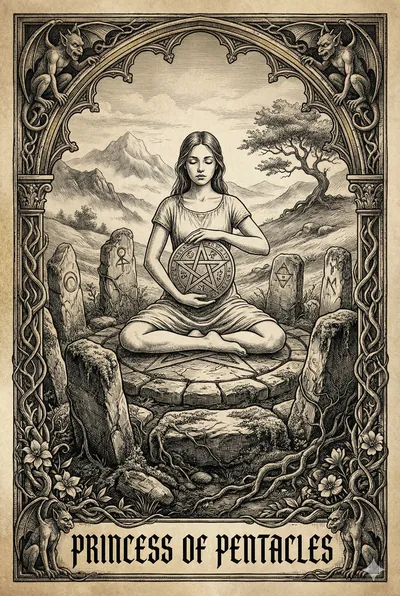
The RWS deck shows its character standing, holding a pentacle at eye level and engaged in an act of deep contemplation. Alternatively, a simply dressed, barefooted young princess practices a motionless, self-enclosed dance pose or yoga posture, one which suggests that her pose is about to unfold in full flower and graceful motion. She works within a stone circle. Some decks show her reading a book, indicating study, but even when there is a pentacle present, she is only attending one thing at a time. She may also be standing, holding a round object like a ceremonial drum or medicine shield over her belly. Deep concentration is the rule, regardless of design. As to character, we have an intent, introspective young lady searching for a remarkable woman inside her.
Interpretation
The Princess of Pentacles is among the least frivolous of the court, wanting nothing to do with nonsense or distraction. She is sometimes also said to announce commu- niques in business and practical information. She’s known to most commentators as turned inward in a sincere quest for who she really is. She’s described as absorbed, reflective, diligent, appreciative, honorable, deliberate, careful, mindful, thrifty, methodical, conscientious, steady, authentic, brooding, entranced, subdued, attentive, quiet, patient, trustworthy, solid, sensible, and sometimes pregnant, at least with her possibilities. She’s characterized by concentration, introversion, groundedness, honesty, respect, economy, and her raw potential. She may be studious, but she will learn best by doing. She’s not one to push the envelopes or get wild. Suggested vocations include curator or archivist, due to her reliable character and the respectful care that she shows.
This card starts the development of the Earth element as a personality type. As the ‘earthly part of earth,’ this begins with the search for the core of being, the most germane or essential parts. We can examine who we are from a lot of different points of view or angles, and we get most of our detailed and complex information from observing how we interact with our environments or contexts. This is not that. This is the view within, even more than the view from within. It’s getting the sense of who we are, without the without. We even have sets of nerve endings for this, the vestibular and the kinesthetic senses, for example, and some say that even consciousness is simply our sense of the central nervous system as it interacts with our chemical compounds. We withdraw in search of a palpable essence, not an etherial thing, but a substance, an original nature, a heart or core, seeking touchstones and cornerstones, and even the wisdom of stones. We reach for where the ground is, for terra firma, for tathata or suchness, or yathabhuta, reality-as-it-is. We reach for an in-derstanding. And we can often find it right in the middle of the ordinary, just under the surface of things, a treasure that was only hidden by our inability or refusal to see, our lack of respect, a word which means to look again. In skipping over the obvious and wondering where reality is, we miss out on the wonder itself. This presence, that can be rightly consid- ered sacred, or even divine if we don’t take that too far, is called the Shekinah by the Kabbalists, and is sometimes regarded as divinity’s bride.
This persona was called the brink of transformation or transfiguration by Crowley, and brooding, ‘as if about to become aware of secret wonder.’ There is a readiness here to transition into something even more special. This might be regarded as the emer- gence of sentience, consciousness, and spirit out of material form. A butterfly about to emerge from a chrysalis phase would be another model, or an egg about to hatch, or a seedling ready to sprout. Michelangelo spoke of freeing the form that was latent in the marble. The Daoists speak of pǔ, the uncarved or unworked piece of wood that still contains all of its original raw potential, but nevertheless has a grain or original nature that a proper respect will work with instead of against. It is not, in other words, pure possibility. This card’s quest for self-discovery is like this. Of course we can become much of what we imagine, but not all of this is true to our inmost, authentic nature. While this isn’t a form in the sense that Plato would have misunderstood it, discovery still means to uncover, and this may have much in common with morphogenetic fields, at least as it's understood scientifically in developmental biology: a predictable shape that will find its expression. This is also the vision quest, and the search for a totem or magical name.
The parallel to Buddhist mindfulness practice is clear enough, in both its vipassana and samatha forms, as well as to many of the yogic practices, and such meditations as weight underside in aikido. We go deeper into our sense of the real. The French jamais vu is the opposite of deja vu: you know you have been here before, but you would also swear that this is the very first time. This is the fresh look we seek here. The novice with entheogens invariably asks, ‘have you ever really looked at your hand?’ The counterpart in the Yijing is Gua 52, Stillness or Keeping Still, symbolized by moun- tains repeated, stillness over stillness, and their resemblance to a spine. The text fairly clearly describes some ancient Chinese form of yoga or meditative practice, although we do not know its name. This is regarded as a necessary practice for a time and place, but not a thing to take around in public, and not a round-the-clock practice, except for some lingering authenticity and equanimity, or meditation in action.