Image Reference
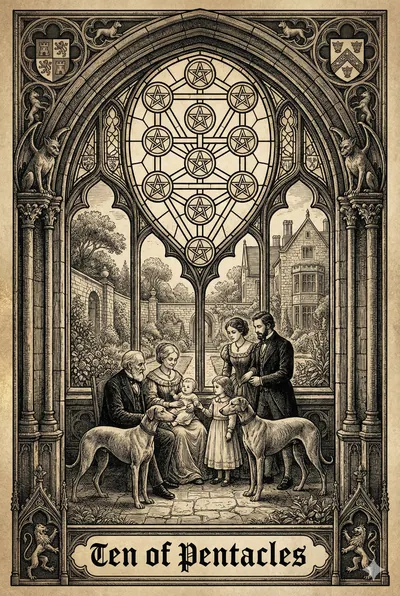
A coat of arms, consisting of ten Pentacle tokens arranged as the Tree of Life, adorns a window, through which is seen a garden vignette of family life among the landed clans. Four generations are represented at the gathering, and a couple of hounds, maybe symbolizing loyalty and breeding. The clan appears to intend to stay here for centuries. Success will depend on what they hand or pass down, including the savvy and wisdom to maintain their good fortune. There is more than one lifetime’s worth of wealth here. What’s all this for?
Interpretation
This is another card whose core meaning is both well-represented by the RWS deck and difficult to misinterpret. Traditionally, its meanings range around wealth, inheri- tance, ancestry, prosperity, accumulation, husbandry, estates, social position, tradition, surplus, affluence, heritage, domain, dynasty, legacy, establishment, pensions, savings, lineage, trusts, descent, family solidarity, wills, archives, permanence, traditions, embarrassments of riches, and cumulative cultural achievement. The Ten suggests that the accumulation has gone about as far as it can without changing into something else, but of the Tens, this is the one most likely to take a long time to do so. The Pentacles cast the scene in terms of material wealth. With the accumulation of mass come gravity and inertia, to resist the weaker forces for change. The card also speaks to the lifestyles that come along with this, particularly to those of noble or established families and their progress through time. Cultural inheritance is also strongly implied.
This is the card of the mound builders, the movers and shakers, and the makers of the ruins of ancient civilizations, the ones we find in their elaborate tombs. Compared to the mountains that these mounds mimic, the pyramids of Egypt are transient ephemera, but humans have to try building big shit to confuse their distant descendants. Also implied here is socioeconomic stratification, or strata at least, and a nobler class of family. But this often passes quickly in the longer historical stream. When it does, the fields need to be leveled off again. Them that’s got need to lose, inheritances are taxed to death, rights of first possession are forfeit, copyrights and patents expire ahead of their time, and any wealth that remains gets distributed all around. There are worthy places to go after we get to the top, but over the top isn’t one of them. Accumulation finds a way to recirculate.
For large parts of our human history, stratification has been a plague on humankind, with power and wealth passed down to entrenched and unearned privilege. And of course the spoiled rich kid that squanders the family fortune is both tragedy and cliché. But at times nobility has worked out well and been of good use to the species, far better than the equalitarians can admit. The key to how it has worked, when it has, lies at the heart of a true meritocracy and noblesse oblige or noble obligation. Thomas Paine wrote, “When we are planning for posterity, we ought to remember that virtue is not hereditary.” And just a short time later, Thomas Jefferson praised a ‘natural aristocra- cy,’ marked by merit, good character, and conscience, a real worthiness to inherit the things we’ve handed down as a culture and civilization, and a strong sense of duty to serve, and to leave the world a better place for our having been alive here. There is nothing inherent in the order of things that suggests that this and wealth cannot go together, except in the adage that power corrupts. What we want here is a genealogy of character, of beings who are worth something to this world.
We cannot agree on who first said this: “We do not inherit the earth from our ancestors; we borrow it from our children.” But Dietrich Bonhoeffer added, “The ultimate test of a moral society is the kind of world it leaves to its children.” Good stewards understand that being a worthy heir is the same thing as being a worthy ancestor. This insight and inspiration was in fact the whole point of ancestor worship. This will mean being the actual treasure that we are handing down, or “being the change we want to see in the world,” the passing of good character to future genera- tions, as well as a habitable world. Sadly, our parasitic species is now failing badly at this. As trustees and stewards, we would take up the world and the commons as a usufruct, a borrowed wealth that must not be diminished, and practice a true conserva- tion, a true sustainability, and not what this deluded and myopic culture thinks these words mean. This would indeed be the great work, of the transformation of mankind. Such trustees and stewards would be the only heirs truly worthy of all of these cultural and economic riches. Wealth piled this high will not rest. The best among us spend it, pass it down again, to build a better world, and establish foundations and philanthropic trusts, award grants and endowments, re-energize the energy stored in material and currency, making both destiny and new traditions. We conserve and protect the land and oceans and their non-human inhabitants. The great work is inter-generational, work to be done in deep time, by lineages of humanity.
The Yijing counterpart is Gua 26, Raising Great Beasts, or Taming Power of the Great. The Junzi, a young member of the noble class, receives his instruction in social duty and ethical training, and is encouraged to get some exposure outside the noble household and beyond the great stream. This is the term so frequently translated badly as ‘superior man.’ Throughout the book, in fact, the Junzi is encouraged in his noble obligations or noblesse oblige. This is a steward of the land and a caretaker of the people. The job requires a lot of work, service, and sacrifice, but this is as much the inheritance as any wealth received. To assist are great stores of accumulated riches and culture, as symbolized by a mountain full of heaven. This is another way of saying that we stand on the shoulders of giants.