Image Reference
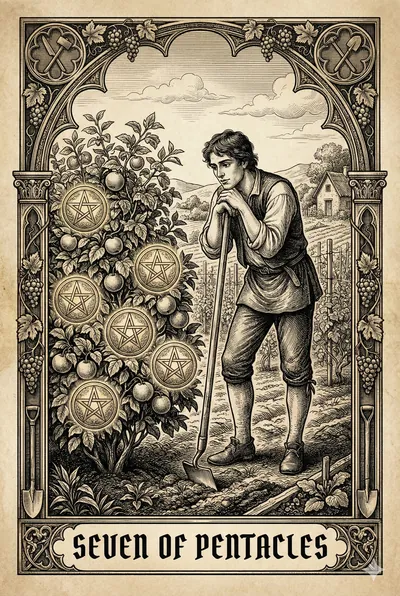
A young man takes a break or breather from working in his garden. He leans on his hoe and daydreams that the fruit on the bush in front of him has turned into money. Seven large coins appear, but it isn’t harvest time yet and there still remains much work to be done, and the odds are that rewards will be proportionate to the labor invested. The break he is taking may be a midcourse appraisal, and evaluation of progress to date, with an eye to improvement of probable outcomes. It wouldn’t be at all timely if this were just goofing off.
Interpretation
The RWS version of the Seven of Pentacles is fairly clear about this being a break in the work, but leaves open the question whether the break has positive, negative, or neutral value. The hope is that this labor will eventually be converted into something nourishing. But resources are finite and we want the best return. The book commenta- tors tend to lean towards the negative readings: anxiety, dreamery, delay in growth, inertia, hesitation, relaxing efforts too soon, unprofitable speculation, premature worry, unrealistic hopes, unrealized success, failure, or fear of both failure and success. Sometimes this is a simple re-evaluation of goals, or a questioning of the effort in terms of worth, or of the time and labor invested. It nearly always has something to do with the pursuit of reward or profit, and the break is always taken before the end of the labor required. More broadly, the symbology of the Seven with that of the Pentacles suggests, simply, wanting stuff that has some value. This will almost certainly involve some investment of labor. A little more narrowly, this could be one of those get-rich schemes where you get adequately compensated for a lot of hard, honest work. You want stuff that’s not ready to be yours yet. You aren’t yet done with the tasks you need to do to get this. It might be preferable if everything was right here already, and free for the taking, but it’s just not working out that way. Nothing is often the preferred price for something, but this is a way of thinking that often leads to crime.
The getting of stuff that has some value is described by economics. The more value it has, the more it will tend to cost. Of course, if you want to work less, you can also learn to want less. Now, the really good stuff takes a lot of work. This is on average, of course, as luck and privilege poke some holes in this theory. So on average, this becomes a question of whether this most excellent thing is worth the cost of obtaining it. We assess our costs and risks against our benefits and rewards. And it’s still permitted to do this assessment halfway into an effort, and perhaps to cut losses or sunk costs early and bail out. It’s also hard to be sure of the future, even with the good Tarot cards. Our motive is profit, our hope of reward. Work is either the best or the only guarantee of success. But there is also working smart, and often information can be as good an input as energy. Sometimes this warrants taking a break, to look for a better or easier way, and sometimes this time is wasted and diminishes our returns. We speculate that rewards will be worth it, but the nature of speculation is that sometimes we lose. This is one of the costs of our anticipated profit that we don’t like to think about, but remembering adds to our savvy.
As with most of the Pentacles, things tend to move slowly here, being made of material instead of wishes. The fruit takes time to ripen. We have plenty of time on our hands to count up our unhatched chickens and weigh the next year’s harvest. But this doesn’t get the work done. We can’t just jump to these kinds of conclusions. Ongoing assessment, management on the fly, tracking investments, and mid-course corrections are all a part of the budget with any good long or end game. But we step back to stay with it. Dreams and extraneous thoughts only help when they open the mind to better ways to get the job done. We don’t want to waste past efforts in present inaction. Slacking off too soon will compromise our momentum, follow-through, and elegant dismount, and those cost lots of points in the final score. But we also don’t want to burn out. Much time and dedicated work may lie between here and rewards, unless the rewards are intrinsic.
The key to sustained motivation is value, and to value, relevance. Work worth doing is worth commitment and diligence because intrinsic rewards want more than half a heart. We want to want in moving ways, in ways that drive us forward, whatever the Buddhists might say. The earth is unresponsive to wishes and prayers. The Yijing counterpart is Gua 19, Taking Charge or Approach. It’s core meaning is in the word accession, stepping up to a challenge. It’s one of the twelve seasonal Gua, specifically, the season to get dirty and sweaty, to get the ground plowed and seeds planted before the season has passed. While this depicts a time a little earlier in the growing season than the RWS card, it is still about the work to be done between beginning and end of the effort. And it also refers to the perils of standing too far back too soon to observe: the Eighth month is Contemplation, which in this untimely season suggests more unfortunate outcomes. This coincides with taking a break. The sentence yuan heng li zhen is used here, as it is in a few other places. Because these are also the first words of the Yi, all sorts of hyperbolic metaphysical meanings have been proposed, but its literal meaning is straightforward: the greatest fulfillment rewards persistence. The best things in life are the ones that we work hard for.