Image Reference
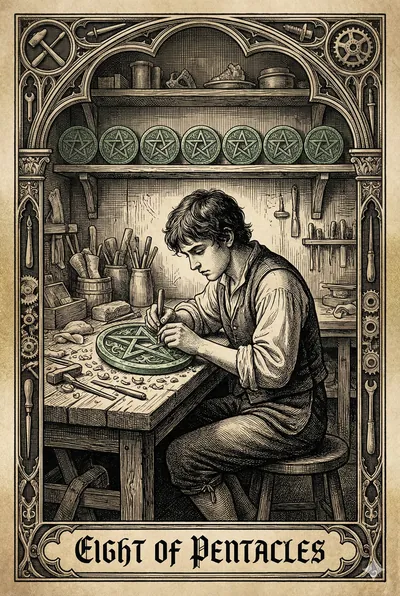
An apprentice sits at his bench, absorbed in his work on a set of eight sculpted jade pentacles. A shelf above him holds the first seven of these and he nears completion of the eighth. Although they seem identical, we get a sense that each is ever-so-slightly better than the next. This is more than manufacture or mass production, even though work may be done pursuant to a model or mold. Care is included.
Interpretation
The RWS deck captures the core meaning of the Eight of Pentacles well, and unlike many cards, it’s difficult to misinterpret. One of the Buddha’s final words, appamada, also sums it up with a meaning that combines heedfulness, diligence, conscientious- ness, care, and even a little bit of zeal. Adding the Buddhist and Pali term vinaya, meaning discipline, practice, and education, could round out the core meaning of this card. The Buddha even called out eight stepping stones on the path to liberation. Combining key words for Eight and Pentacles, we have intelligence applied to material affairs, the taking of rational steps, one at a time, towards practical ends. Other traditional meanings include prudence, employment, apprenticeship, promotion, skill, commissioned work, candor, frankness, honesty, modesty, covering bases, preparation, training, regularity, earnings, planning ahead for the future, orderly progression, going step by step, long preparation, applying oneself, thoroughness, incremental gain, set- asides for rainy days, graduated tasks, banking, hedging, calculation, and paced efforts. Progress is graded or measured. Although the focus of the work is on the matter at hand, a more distant future is kept in mind and distractions are set aside for the sake of these more distant goals. One plans for long-term development and thinks the steps through carefully. We have the idea here of starting out small and humbly. We have a modest approach, but this is a means to one day being able to take some pride in our work, maybe even great pride. It’s a bold sort of humility that seeks competence, proficiency, or mastery. No matter how precocious we may be, cockiness and smugness won’t take us to the heights. We observe those who are further along, practice with those who are better than we are, train with those who are quicker. We pay some dues and log some late nights and long hours. We listen to people who tell us where we’ve gone wrong or off track. We learn some dumb-seeming prerequisite stuff, like how we are holding the pencil all wrong, or how we aren’t sitting correctly. The one not rolling his eyes at all this is the one who will go the farthest. We will earn our self-esteem and not work for praise or flattery. If we do it right, at the end of our long-term commitment, we can hope to find students as good as we were. As Nietzsche wrote, “He repays a teacher badly who remains only a pupil.” We will want to be competent students if we want to be competent teachers. Consciousness, conscientiousness, and conscience will all blend into the same right attitude. Doing things right takes more time. The final two percent of the work, the polishing and honing, might even take as much time and effort as the first ninety-eight percent. We have to care about quality, and the standards will rise as we go.
Education and edification both apply here, but they aren’t the same word. Education means to lead out of, which is simply being led out of not knowing how. Edification is to build an edifice in our minds, an organized structure of skill sets, tools, and techniques, and we must construct this one piece at a time, often according to a plan or curriculum. Perhaps we do models and prototypes first. We are graded on our progress here, to learn where we stand, to learn how far we still have to go, and to keep any self- esteem real. We upgrade ourselves, learning slowly but well. We may use the word ‘perfecting’ as though we might one day be perfect, but any true master knows better, or will show you by making mistakes of his own. Still, there is something that might be called mastery, even well shy of perfection, that gives us examples to build towards. Now note that creativity has yet to be mentioned here. We are more likely in vocational tech, not art school, but even if we were, we would still be studying technique and techne first, until it became second nature. The Yijing counterpart is Gua 46, Advancement or Pushing Upward. It’s built on the image of wood underground, sprouting and rooting itself, constructing or assembling itself one molecule at a time into something big and sturdy. The name of the chapter, Sheng, means both measure and taking incremental steps. This long and patient effort happens one day or one step at a time.