Image Reference
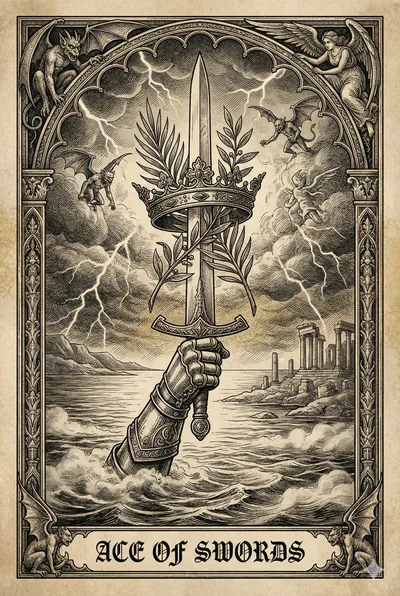
A beautiful, but dangerous-looking broadsword is held triumphantly aloft from below the card by a hand which could belong to either a man or a woman. In many decks this sword is shown piercing a crown, which could symbolize both sovereignty and Kether, and with palm and olive branches to keep the Christians happy. The RWS card and most clones depict the hilt being held by a hand emerging from a cloud. Others show the hand emerging from a lake, alluding both to Excalibur and to Yetzirah emerging from Briah. Some variants show Excalibur embedded in a stone. Decks may show the sword pointing up or down, the former being more common.
Interpretation
The Ace of Swords carries the connotations of the Swords in general: one-pointed- ness (the Buddhist cittekeggata) and penetration at the pointy end; the two edges, for cutting, dividing, and shaping, and a warning about unintended consequences; and also the hilt, wanting a firm grasp of matters at hand, the practicalities of thought. It’s not a power but a tool to do the work that’s the measure of power. It’s a strong signal to others, a sign of authority, or a suggestion of competence. It symbolizes the cutting edge of discrimination or the making of distinctions. It’s the power of having just the right word in both magic and science. The Vorpal blade goes snickersnack and takes off the Bandersnatch head.
This Ace can speak of the formation of a good idea, of the process of ideation or conceptualization, of a figure emerging from its ground, getting resolution or sharp- ness, the process of getting a definition or a name affixed to an experience, the cognition that precedes re-cognition, the reduction of the flow of experience to a form, principle, or order. It is in-formation, both a specific insight or special piece of information and a summary or generalization of many such insights and pieces of the puzzle that in turn becomes a component in a still-larger comprehension. It’s a way to pack up a lesson so we can carry it with us, a distillation of experience or new piece of knowhow, a likeness or model that we can use as a tool. It’s the name or word the wizard needs to make the demon run errands. It’s the new word you’ve just learned that rearranges half of your thinking. The word concept means ‘to capture with.’ This is an organizing or central principle, a specific affirmation, command, or emphasis, which may become the central nexus of a new order or organization. It’s a good question, or a good answer, but as an Ace it ought not be both: it’s not both beginning and end.
One of our more vapid and erroneous platitudes declares that there are no new ideas. It’s spread by those who have none. The word discovery suggests that we are uncover- ing something that is already there, but this is only sometimes the case, and even then the perception, cognition, concept, or name is often new. The Ace of Swords can be the birth of a new idea. It could be an invention or a patent, a new meme, a seed idea, a new key, a core meaning, a key piece to a puzzle, a new category, a new algorithm, a new thought, or a new application for an old thought. On a personal and even unspoken level, it might be a lucid vision, an epiphany, a mental breakthrough, a getting of the right idea, a new perspective or focus of awareness, a eureka moment, the formation of a gestalt, or even a whole new paradigm that starts a scientific revolution. A good, multi-layered example was the formulation of William of Occam’s Razor: entia non sunt multiplicanda praeter necessitatem, the principle that entities in a theory are not to be multiplied beyond necessity. This is a way to slice fat from our theories and a mighty fine Ace of Swords.
With this Ace we might be working on our first premises and postulates, or forming new questions or hypotheses, still at our cognitive starting point, or getting to the bottom of knowledge, questioning the ideas that we build our mental lives around. Perhaps we are integrating a new idea into an old framework. We have a lot of work to do here, since by birth and culture of origin, we are the heirs to a vast array of what might be called anti-cognitive processes, ways to not know or to keep ourselves from learning more: cognitive biases, defense mechanisms, coping strategies and logical fallacies. And when these things have taken over our cultures, we take up our literal swords as a sterner and more serious instrument of correction, righting wrongs outside of our own heads as well. As such, our sword can stand for our purpose, or our Excalibur, if we have a higher purpose, our noble cause or conviction, our highest priority and point of focus, our oath or word of honor.
Truth changes with point of view, although it is often merely the same truth enriched by adding new points of view. The Ace of Swords suggests that we look at our perspective, the starting points of our observations. The Buddha saw what our suffering did to our perceptions and asked how clear our vision could be if it had fear and pain at its base. For this reason, he dismissed our gods and religions, and looked instead to the suffering clouding our minds. Perhaps if this could be cleared up, if we developed a more comprehensive collection of points of view, we might see things more as they truly are. This is the theme of the Yi’s counterpart, Gua 20, Guan (as in the name of the Chinese goddess Guanyin) perspective, contemplation, or the act of attending. This is the issue of being both subject and object and seeing from multiple sides, a true comprehension that combines both specification and generalization. It’s about getting our minds and concepts wrapped fully around things. It advises the missionary to read the signs and the natives first, to understand other perspectives before imposing new ideas.