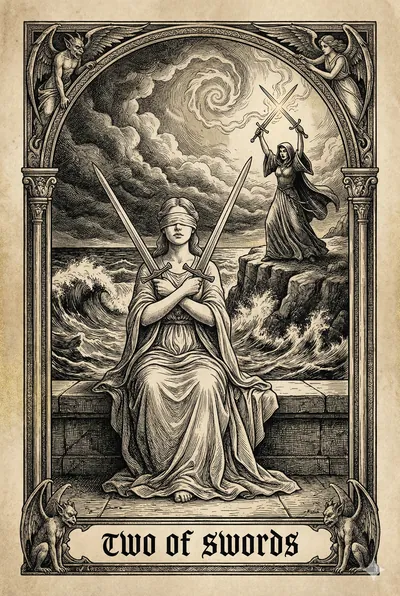
The RWS deck and most of its clones depict a blindfolded woman, seated with her back to the sea, with arms crossed and holding two crossed swords in a symmetrical position. She appears to be in a deep deliberation or meditation, culti- vating inspiration, possibly trying to Feel the Force. She is training to listen as well as see. Alternately, a sorceress with cowl thrown back holds two different swords high above her head in clashing contact, liberating a spirit fire against an unstable sky and a rough sea that she faces.
Interpretation
The RWS Two of Swords character seems to be working out or through a problem of perception, perhaps having blindfolded herself to wake up her other senses, to see other possibilities, even alternate realities, as though the solution has not been available to ordinary states. She want to be blind to the obvious or the expected. Her back to the sea is said to be emotion held in abeyance, dispassion, a search for equanimity and equilibration rather than submitting to vacillation, ambivalence, or indecisiveness. She is deferring a decision or judgment, perhaps suspending both belief and disbelief, avoiding distraction while her analysis is in progress. Since we all have at least two brains, it often makes sense to think twice. We all contain contradictory natures, we all contain multitudes. The world has its tricky duplicities too: wave and particle, elec- tricity and magnetism, space and time, mass and gravity, and so on. The mind wants some rising above. We pause here to rearrange our data, and even our methods of arranging the data, and perhaps we can ask some different questions.
At the lowest level of interpretation, we see most readers and writers concerned with the cognitive problems of dualism: two swords, dueling, en garde and touché, the fight to see which side is better, or who has the better argument. Those trapped in dualistic or either-or modes of thinking, which might be most of us, tend to see this card as some kind of conflict or conflictedness, clash, indecision, stalemate, or at best a détente, truce, or compromise, as a conventional title ‘lord of restored peace’ suggests. Even the mystics will get trapped by Yin vs Yang. As with our court system, such adversarialism is often the worst way to get at what’s true, often just forcing a choice between exag- gerated half-truths. It’s our fault when we oversimplify things, reify or harden our thoughts, and take our ways of simple-minded thinking and talking as the basic rules for the universe. While binary systems exist in plenty of places, simplistic distinctions are often too sharp for a higher or more complex reality. There is nearly always some middle excluded. Sometimes this is a problem of perception, between us and what we think is the world, and the cognitive dissonance undoes us. Sometimes it’s an analog of our retinal disparity or stereopsis: each eye gets a different picture. We argue about which point of view is correct, when we need them both to see depth. Polemics do not often serve us. The sum of these kinds of two-alisms is less than the sum of the parts. We need to do some work to get the rest of the data and perhaps even change our minds or our entire way of thinking.
On a level above our right-and left-handed options is a reconciliation of opposites, a resolution of paradox, a finding of common ground, a harnessing of opponent ideas into a working team. This does not always mean win-lose compromise: as with a good market transaction, both sides can get what they want and come away winners. This might take finessing and haggling. As Fitzgerald noted: “The test of a first-rate intelligence is the ability to hold two opposing ideas in mind at the same time and still retain the ability to function.” We might call this trans-partiality. Here we have arbitra- tion and mediation, or diplomacy, the finding of harmony, perhaps even making use of the tension, disparity or stress between different ideas and points of view, and development of the skill, deftness, and dynamic control that this requires. Or else we have syncretism, putting two halves back together, a unified perspective doing double the duties, the power of synthesis leading to synergy, a whole that’s made greater than the sum of the parts. This is the vision of depth that we get from combining visual perspectives. It’s only increasingly complex until it all comes together: then we often get elegance. Insight is sometimes defined as “a dynamic reorganization of the perceptual field.” A decision doesn’t always require compromise. Sometimes an answer just needs a different question.
The next level up is just that: rising to a level above. Here we find Einstein’s advice: “The significant problems we face cannot be solved at the same level of thinking we were at when we created them.” This is also known as de Bono’s lateral thinking. Here we find Solomon’s baby, and Alexander’s Gordion Knot. We are the masters of our ideas, not servants. Here we ask new questions. Problems are good things here. We break up old patterns to suit our objectives. We think outside the box. We posit a tertium quid, a third thing unlike the two. We take liberties with the order, especially how we perceive things. Arthur Koestler suggested that creativity emerged from the juxtaposition or joining of two separate matrices, or separate fields of structure, thought, or perception, or movement between two mental disciplines. He called this ‘bisociation,’ the “simultaneous mental association of an idea or object with two fields ordinarily not regarded as related,” The theory also accounts for the success of hybrid vigor, the successful evolution of sexual reproduction, and even the nature of humor. Koestler's Act of Creation is well- represented by the Two of Swords. Strong emer- gence provides another example in philosophy, how new things under the sun come to be out of unions of the old.
We can get outside and above ourselves here, and ask “what would the universe do?” We have a lot of momentum and power if we can get onto this ride. We can look to higher and natural law, and possibly even find loopholes. Here is vocation, calling, true purpose, living up to our fullest potential, and higher purpose as well, living for something greater and longer-lived than we are. It means several lifetimes of study, and a long, tough road to any real or earned success. Here we find Buddha’s last words: Compound beings are ephemeral, strive with heedful diligence. The Yijing counterpart is Gua 01, Creating, symbolized by the growth of the dragon. This is the slow maturation or ripening of genius, precociousness not withstanding. This is a look forward to persistence or duration in time, a perspective beyond the human, towards the being who comes next to replace us. A dragon is above the dualities, above yin and yang: why would he favor his left or right wing when a sky full of stars is what he wants?
Eastern Resonance (Yijing)
Gua 01, Qian, Creating, Heaven. Da Xiang: Qian (2) below, Qian (Swords) above; “Heaven moves inexhaustibly. The young noble is naturally energetic, without rest” Sovereignty, command, self-mastery, authority, cogency, will, dynamic life. “The greatest fulfillment rewards persistence.” Genius, in the original sense of beget or create, still carries the more modern attribution of 90% perspiration. We work for it. Creativity as a function of mastering or harnessing opposites, as a dragon’s left and right wings.
advaitaalternate realitiesarbitrationartistryautonomyawaiting more inputbalancebilateral agreementbisociationcausechoicechoice pointclarificationcognitive challengecomplementscomplexity resolvingcompromiseconcertednesscoordinationcreativitydecisiondecisivenessdedicationdeterminationdichotomydispassiondualismduplicitydyadicseleganceemergenceemergentismequanimityequilibrationequipoisefeeling the forcegeniushigher groundhigher lawhigher order thoughthigher purposehigher wisdomhybridizationingenuityinitiativeinsightintentioninventivenessius naturalemasterymediationmetacognitionmetasolutionnegotiationnon-dualismoriginalityquandaryrapprochmentresolving disparityreconciliation of oppositesparadoxquandaryreintegrationresolveresolutenessresolving paradoxsimplificationsuspended judgmentsyncretismsynergysynthesistertium quidthinking twicevisualizing outcome
Warnings & Reversals
•adversarialism
•betrayal
•binary or dualistic thinking
•cognitive dissonance
•contradiction
•denial
•discord
•disparity
•dissension
•duplicity
•excluded middle
•falsehood
•incongruity
•inconsistency
•indecision
•irresolution
•misrepresentation
•offsetting factors
•paralysis
•polemics
•provocation
•stalemate
•uncertainty
•vacillation
Structural Components
Two plus Swords. Mental direction or directing the mind. The need to look at the right form of dualism, such as outmoded vs improved. Linear thinking is limiting, particu- larly when it limits to right vs left. Uses of higher order thought, getting above the problem.
Mystic Correspondences
Astrology
Uranus in Air Signs and Houses. Uranus, as the higher octave of Mercury, is metalevel thinking, creation of the message that Mercury delivers, transcendent thought. Quick study. Outside the box, individual, original, questioning, visionary, innovative, experimental.
Qabalah
Chokmah in Yetzirah. Vector and direction in the world of form. Adaptation of form to serve the ends of the will: creativity. Applied logos.