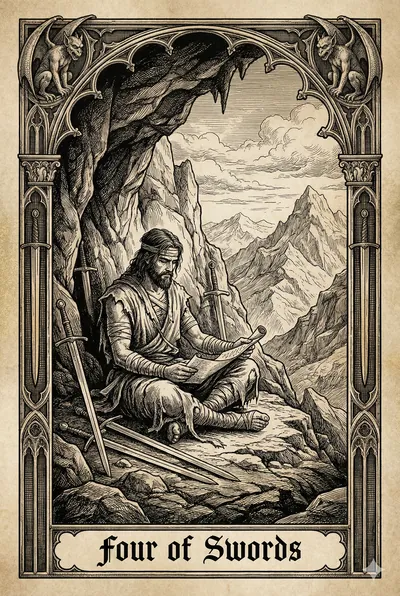
The RWS deck shows an embattled knight out of armor, in horizontal repose in a religious sanctuary, seemingly recuperating or otherwise recomposing himself. Alternately, a warrior, perhaps only recently turned anchorite as evidenced by torn robes and bandages, recuperates near the mouth of a mountain cave, sitting Zazen. His four swords are still within reach, one being more immediately at than the others. If there’s a chance he’s still a warrior, he could be reading Sunzi now.
Interpretation
The Four of Swords is sometimes subtitled Rest from Strife, but there is a larger dimension to it, specifically, larger dimension itself. It’s an adjusting of the boundaries with which we frame our worlds to optimize our perceptions. This is frequently called reframing. In psychology, cognitive reframing is “the process of identifying and then disputing irrational or maladaptive thoughts,” or rethinking a problem in other terms and from other views or perspectives. It’s a type of reflection used to transcend points of view that are proving to be less than optimal. For the person taking this rest or retreat, it’s the ability to step back or out of what they have been doing to find some new or different approaches. For the one embattled, it might be a furlough, or strategic retreat, or rest from strife, or even a rethinking of the need for battle itself. For others it might be a sabbatical, or sabbath, or other form of time out. Perceptions, and thoughts based on them, change with how they are framed, even when situations from which they derive don’t change at all. Less than optimal fixed frames can include narrow- mindedness, nearsightedness, small-mindedness, and shortsightedness. Altering these at will is a metastrategy, as with the Two of Swords. We refer our ideas to a more comprehensive or informative frame of reference.
The Four combined with Swords suggests composing or recomposing the mind, the cultivation of poise, equanimity, or equilibrium. The word strategic in strategic retreat is important here. This is not about finding an artificial mental stability that is too delicate to admit disturbance. It’s also not about escaping or fugue, or going to one’s happy place. It might mean getting out of a trap, or finding refuge or sanctuary. It’s a refreshing of our browser. It’s a re-scaling of our frame of reference, usually in order to see a little bit more of the ground or context surrounding a figure, to try to see what might be missing in the current view, by looking at the bigger picture. Sometimes we back up far enough to see that what we have been obsessed with was never important at all.
The Yijing counterpart is Gua 33, Distancing or Retreat. It depicts a mountain standing tall under heaven, making it also not so very tall. This might suggest our own mountain-and-molehill image. One of the metaphors used in the lines is military, but this and others apply to any situation that we might be advised to back or move away from. It’s common for people to leave a situation by making themselves and everyone around them unhappy in order to get pushed out, often leaving only resentments behind. The optimum retreat is a simple disengagement that will leave no such mess for others to clean up. Freedom-to is better than freedom-from, but both can usually be achieved. We have a choice of point of view or perspective. We are permitted to choose among options for the path that best serves our longer ends and objectives. In battle, of course, we call call this slippery or crafty, but here it’s whether you win or lose that counts.
Reframing is recontextualizing. It’s like looking through a zoom lens and having the freedom to change composition. It’s the paradox of finding stable mental formations by liberating ourselves from fixed ideas, dogma, and toxic beliefs. The Fours want some form of stability, but they still permit changing the scale at which we look at things. This especially includes changing our time horizons. Today we have politicians with two years or less worth of vision, making hundred-thousand year promises about storage of nuclear waste. Much human endeavor looks quite different under the aspect of evolutionary or geologic time, and our failure to see from this angle might help put us out of that picture. Patriotism is another example, since mighty nations come and go like the seasons. And conscience requires a better vision of what a higher law might say. A frame with more ground and less figure lets us see our problems from more or multiple sides. And fractal self-similarity gives us analogs at multiple scales. Il faut reculer pour mieux sauter: we take steps back to make better leaps. Or to make better choices in life.
Zhuangzi wrote: “Men of great wisdom, looking at things far off or near at hand, do not think them insignificant for being small, nor unwieldy for being great.” There are different measures to use in sizing something up. Tiny little molecules are some of our hugest discoveries, while some of our greatest achievements will be nothing in ten- thousand years. Love only lasts forever for the span of a handful of decades at most. We change the universe of discourse the better to master the space around an idea. We don’t want the space too big either, or else we dismiss real problems. Like Goldilocks, we manage our perspective to find the thing that’s just right. We look for optimums here: problems don’t fill the whole screen, but they don’t vanish into the background.
Eastern Resonance (Yijing)
Gua 33, Dun, Distancing, Retreat; Da Xiang: Gen (4) below, Qian (Swords) above; “Beneath the sky is a mountain. Distancing. The young noble is distant from the common people, not with ill will, but with reserve.” The mountain stands high against the horizon, but heaven is not diminished by this. Choice of distance and scale. “Success. Little reward in persistence.” If what we are doing isn’t working as it should, we should be doing something differently. We are missing information that might be available from a larger picture and more complete context.
abandonmentabstentionacquiescenceadjusting perspectivealternativesarkasylumbacktrackbackupbig picturebreadthbroad-mindednesscautionceasefirechanging perspectivecircumspectioncollecting the witscompositioncomposurecontemplationcontextconvalescencedeparturediscretiondisengagementdisentrapmentdistancedistancingeconomyequanimityequilibriumescapeevacuationexitexpansivenessextricationfallbackfiguring it outframe of referenceharborhavenhigher order thinkingholding backinaccessibilitykeeping a distancemental consolidationmental rebalancingneutralizingoptimizationperspectivepragmatismproblem solvingproportionreassessmentreconsiderationrecontextualizingrecuperationreevaluationreflectionreformulationreframingrefugeregroupingrejuvenationreliefrenewalreplenishmentreservationreserveresortrestabilizingrestating criteriarethinkingretreatretirementreviewrevisioningrevivalsabbaticalsafe distancesafe spacesanctuaryscalescaling down or upself-preservationsolitudestepping backstrategic suspensionstrategic withdrawaltime outtreatytruceuniverse of discourse
Warnings & Reversals
•being enmeshed
•entangled
•or implicated
•cognitive inflexibility
•denial
•dismissiveness
•dogma
•escapism
•evasiveness
•fear
•fixed frames
•fugue
•guarded advance
•flight to happy places
•pedantry
•precaution
•rigidity
•shortsightedness
•stubbornness
•running away
•toxic beliefs
Structural Components
Four plus Swords. Composing and balancing the mind. Four boundaries make a frame of reference with an inside and an outside. Thought can be put in order, but it wants to be an order that works, so the boundaries are for reference, not for protection. Rigid beliefs will need too much defending when negative feedback suggests error. The mind needs both firmness and flexibility.
Mystic Correspondences
Astrology
Jupiter in Air Signs and Houses. A sense of personal identity that’s founded on perceptual and cognitive experience, on how we see things, over which we can learn some control by expanding our perceptions and mastering our perspectives. For Jupiter, this includes the including the Olympian or Jovian view, equanimity, patience, and equilibration. We can reconsider what we do mentally in order to optimize our worlds. Higher-order thinking.
Qabalah
Chesed in Yetzirah. Self-stabilization in the world of form will want form that keeps learning. An objectification of form in multiple dimensions allows it to be studied from different angles and at different scales. Figure implies ground.