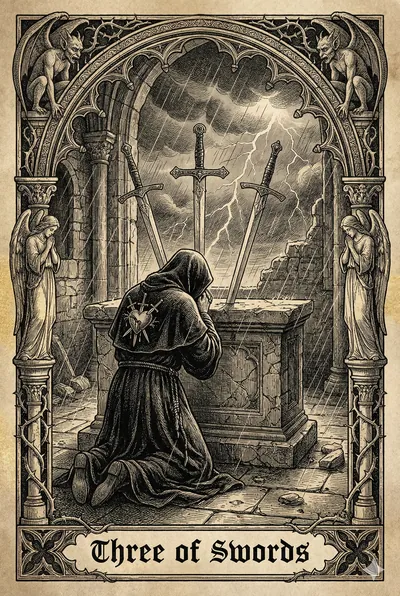
The RWS image shows a valentine-style heart, pierced by three downward thrusting swords. The image was taken directly from the late 15th century Sola-Busca deck, making this by far the oldest of the pictorial pips. Alternately, a robed penitent kneels before an altar in which three swords have been embedded, point down, resembling crosses. On the robe is an emblem, a bleeding heart pierced by three swords.
Interpretation
The Three of Swords is almost universally correlated with sorrow. This is another card with head (Swords) and heart (Threes) in a fragile partnership. In this case, the world has grown too big, or the options too many, or the better choices too few. Perhaps a painful truth has shown itself. Head and heart need to come to terms and agree on how to handle this. Our disobedient feelings are not following the rules of reason, or else our rational choices are leaving us in emotional quandaries. There are cognitive components to the suffering, and suffering is bewildering the wits. The meanings can be as simple as triage, trivialities, triangles and third parties, all threes, of course. Sometimes they take or tear us apart. It may be not so much about getting our feelings hurt as what alienation, abandonment, existential angst, or betrayal can do to us, and not so much our emotional pain itself but the pain of understanding things we might rather not face or see, which calls up the question of whether we are truly understanding things at all. The head must allow for feelings, and feelings, the need for good choices. This card isn’t always about love for another person. This is merely a fine example of how things may not work out according to our wishes or designs. Others may have a say in how it all works out. But we will have some kind of losses to grieve or mourn, and this may leave us with little choice but to walk away. Choosing what to feel might mean choosing what not to feel. These are swords after all. Some problems can’t be solved. The mind passes, the heart breaks.
What we thought was true, or wanted to be true, was not. The world that we thought was small and simple enough to manage was not. Things won’t always go our way. We can't have it all. We might even have known this in theory already, and this new insult is just a reminder. Disappointment, disillusionment, and disenchantment have to be good and instructive things, don’t they? The finitude of intellect is one of the truths to be found on the quest. There is too much data awaiting collection. When a hungry mind wants it all, it winds up with noise and much with no value, plus a neocortical overload. Those with a want to believe will stuff up their minds with guests best left uninvited. Soon the mind can take no more, including its cure. More critical skills are best instilled at the start, best by the end of childhood. If we sort our data on the way in we can have much less to toss out. So we say goodbye here to some things that we liked. A perfect lover loves someone else more perfectly. Another species goes extinct forever. An old growth forest is cut down to make toilet paper. A promising nation is lost to lack of vigilance. Your species flirts with its own extinction. We may face hard truths that can’t be denied. Sometimes we need to have a good cry, and then get up the courage to change whatever things we can. Where bitterness and rancor do little to help this, it isn’t inauthentic to cut our losses with our swords and part ways with them.
Helplessness and finitude can be our big problems here. We want to live in the largest world we can manage, but this world isn’t made for our feelings, or limited brains, and it’s easy to feel or perceive too much. Somehow we must come to grips with the news of the world, and crucial decisions made by lowest common denomina- tors. We can’t have it all our way, much can’t be helped at all, and much of it is out of our hands. We still have reasons to try, instead of just praying, but try telling that to your woe. And this immense frustration drives much of the bad philosophy that tells us why to just let it be. Sebastien Chamfort suggested: “Whoever is not a misanthrope at forty years can never have loved mankind.” The idealism of this card can be individu- alistic or cultural, but even the rugged individual needs some inspiring peers. The world’s suffering won’t diminish any time soon, but for us it’s still largely optional when we know we are doing all that we can. And we can always not cooperate, not participate, disobey bad laws in civil ways, and vote by how we live and spend our wealth.
We have to move on and divest ourselves of the things that hold us back. We have to see the bad for what it is, if we’re honest. We have to make choices and these will negate some options. Each decision means opportunities forgone. It’s the cost of living, but it’s still a bargain. Nietzsche said: “let my sole negation be turning aside.” Angry negation and denial do more damage than this. Therefore, we simply part ways at the crossroads, acknowledge our incompatibilities, and lose the friends we are better off losing. We find that even love must have conditions, and sometimes it must be tough. It’s this or dwell in our suffering. We need to grieve our losses as part of our nature, but grief does not need to own us for life. There are plenty of other fish in this tree.
We should also not forget there are sacred forms of sorrow and sadness, and reasons for having tragedies as well as comedies up on the marquee. We are finite and mortal, or for some, all that we’ve loved and learned will be lost to the next incarnation. We can do existential nausea over this for a while, and wallow in our weltschmerz. We can explore where our meaninglessness and senselessness take us. We can have our crises of faith, our dark nights of the soul, and our sloughs of despond. How long is art, how short is life? But there is nothing wrong with the longing of the Portuguese saudade. Or the Japanese mono no aware: the pathos of things, awareness of impermanence, or wabi-sabi, the acceptance of transience or imperfection, or yugen, the mysterious grace of a world beyond our ken. The fact is, we are lucky to be alive and prone to be ingrates about it. We are Vonnegut’s Bokonon’s lucky mud that got to sit up.
The Yijing counterpart is Gua 12, Separating or Standstill, imagined as Heaven and Earth moving in different directions, and the wise and the foolish moving in different directions, and the problems of saying goodbye to good things gone bad and the good things we cannot have. What we thought was true or wanted to be true was not. Next?
Eastern Resonance (Yijing)
Gua 12, Bi, Separating, Standstill, Stagnation. Da Xiang: Kun (3) below, Qian (Swords) above; “Heaven and earth do not interact. Separating. The young noble conserves virtue and avoids trouble, not allowing himself the luxury of compensation.” Heaven and earth are moving in different directions. This is often mistranslated as ‘Obstruction,’ but it's closer to abandonment. “Separating oneself from inferior people, those not worth the young noble’s loyalty. Greatness departs, smallness arrives.” Mind necessarily moving away from portions of reality for reasons of self-protection. Sensing a necessary conditionality to our loves, our likes, and our wants.
abandonmentabsenceabstractionalienationbaffled hopesbereavementbetrayalbleeding heartbluescoming apartdecaydelaydeparturedeprivationdetachmentdisappointmentdisapprovaldisarraydisengagementdisharmonydisintegrationdisjunctiondisorderdisruptiondissensiondissonancedistancesdivergencedivisiondivorceemotional discordestrangementgoodbyesfacts of failurefailed dreamsfarewellfinitudegrieving losssesheartacheheartbreakhelplessnessincompatibilityinterventioninterruptionisolationlamentletting golonelinesslonginglooking asidelossmelancholymourningmoving onnegationnumbnesspainful truthspartitionpowerlessnesspulling apartrejectionremovalriftrupturesadnesssaudadeseeing too muchshismsegregationseparationsettling for lessseverancesorrowsplitting upstagnationstandstilltragic dramatrying timesvulnerabilitywabi-sabiweltschmerzyugen
Warnings & Reversals
•agony
•aloofness
•angst
•apathy
•aversion
•bleeding heart
•confusion
•decadence
•denial
•despair
•disintegrity
•disloyalty
•distraction
•divisiveness
•divorce
•error
•failed dreams
•hatred
•heartbreak
•indifference
•mental anxiety
•misunderstanding
•pettiness
•quarreling
•self-defeating negativity
•small-mindedness
•unhappiness
•world suffering
Structural Components
Three plus Swords. Expansive thought, visionary about the possibilities. The possi- bilities are far greater than the reality could ever be, and so opportunities are foregone. Cognition and affect are at odds and may be overthought. We will need to set higher or narrower standards, leave some things behind, perhaps even our suffering. Reason and emotions conflict. Conditional and tough love.
Mystic Correspondences
Astrology
Neptune in Air Signs and Houses. Wants affiliation with other minds, or hive mind. Moving through mental and therefore cultural relationships. Too much of identification with the human cultural experiment might lead to understanding how few are really contributing, and a sense of isolation or smallness.
Qabalah
Binah in Briah. An ocean of pure possibilities, as seen from a tiny little boat. This is too much for us, but we lose some jetsam and sail on. We can’t do nor learn to do this in safe harbors.