Image Reference
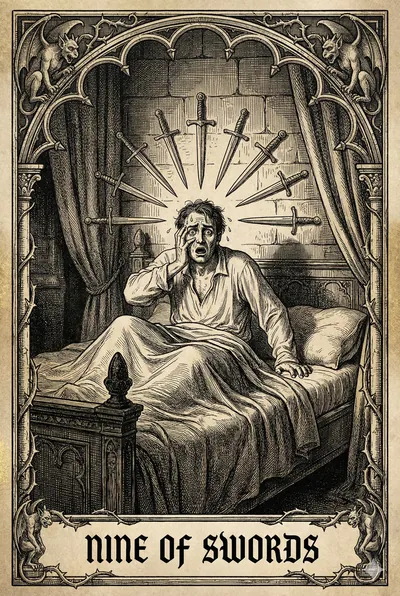
A dreamer sits bolt-upright in bed, as if awakening from a nightmare in a cold sweat, both hands to his face and wearing a look of horror. An arrangement of nine short swords or daggers on the wall behind seem to point inward towards him, forming an aura. One suspects this character might be clinging subconsciously to an outdated, toxic, or partial idea, and it festers in his sleep. Dreams are often of our unresolved issues kept on standby. He might not even be aware of this conflictedness when awake, except for a general sense of anxiety, stress, or unease.
Interpretation
Traditionally, this card can refer to a number of unpleasant emotional states of mind: despair, anxiety, suffering, cruelty, tribulations, angst, shame, resentment, helplessness, guilt, regrets, desolation, doubt, crises of faith or confidence, or demons in general. It suggests unresolved troubles, complications, conflicts, quarrels, and other miscarriages. One might well ask what all of these wet emotions are doing in a card in the suit of Swords. The answer to this must eventually come back to cognitive structures and the psychological problems that errors in thinking or perception might lead us to. This also suggests that these problems have either been buried or else have gone unnoticed, allowing them time to fester, to awaken us later with bad dreams. Mind runs amok and life makes no sense. While emotions are not some hydraulic fluid that’s somehow conserved in its quantity, requiring channels, outlets, catharsis to vent or release, it’s still the case that repression, suppression, or stuffed emotions do not solve problems, but drag them along, beneath the threshold of awareness, where awareness gets its power and problems do the most damage. To correct this condition, the unpleasant emotions must be seen as information leading back to the problem, as friendly signs or reminders that we have gone off track. What is it that we have ignored for too long? Thoughts and reality are two different things. If you need to give up one or the other, give up the thoughts or let them adapt to reality. We need an ability to unlearn, to replace faulty parts in our cognitve edifice, to maintain a nimble and healthy mind.
Careless or sloppy learning is one usual suspect. As discussed under Numbers, the Nines symbolize states that have come into their fullness, with little room remaining for more, other than maintenance and adaptation to ongoing changes. This implies that the mind is full, or processing as fully as it it is able. This in turn implies that when the mind is troubled and confused, we might think to switch tactics and start preferring quality over quantity of information and its processing. In theory, this will enrich us. Some claim to not care, openly disliking critical thought as being ‘too negative,’ citing a preference for emotional happiness or popularity instead, but then they show puzzle- ment when their happiness turns inevitably into trouble and confusion. Their reasoning is now automatic and out of their control. Questioning everything on the way into the mind should have been ongoing. Now there is much catching up and unlearning to do. The big problem here is that our views of the world are interconnected, and built up on a foundation that includes early experience, basic assumptions, and core beliefs. We build with what is at hand, often before we have seen or learned better ways. The mind is a bricolage, with outdated stuff embedded in important places. Errors accumulate and compound each other. It’s hard work rebuilding foundations, but it’s never too late to start being more choosy about letting our minds fill up with unexamined data and unquestioned beliefs.
We want a better criterion of truth than the simple convincingness of ideas. Beliefs that cannot be questioned, or faiths and convictions, are how we get viruses in our minds, toxic memes that spread out to the horizons of our perceptual worlds, where we ought to be learning new things instead of twisting what we see there to suit our mental diseases and pathologies. Fixed ideas may promise comfort and security, but the deception catches up. Beliefs are self-serving, self-maintaining cognitive loops. Some- times we know them by bad names: presumptuousness, prejudice, dogma, propaganda, and fanaticism. But more often we take pride in having them: we have the answers. Well, how is that working out? Getting into lots of fights? Nightmares? While absolute relativism, where all ideas are equal, is the sloppiness just discussed, the other wrong- headed extreme here is advocacy, adversarialism, partiality, partisanship, or polemi- cism, all from the fixed idea that admits no second opinion. This is the theme of the Yijing counterpart, Gua 06, Contention or Conflict. Strife and resistance, or unpleas- antness in general, is information, not something to die for. We navigate better when we can use this simply as data, and adapt our thinking as we move along.
Suffering is information that can lead us to its own cessation. For this we need adaptive cognition, with continuous questioning, revision, and unlearning, even of some of our most basic assumptions. This is especially true of challenges to our identity, beliefs, or sense of belonging. This is a basic teaching of the Buddha. With life comes a great capacity for self-deception and a host of mechanisms to assist in its practice. It isn’t easy to live life counter to this. Generally speaking, our choice is suffering or diligence. Most, it seems, choose to suffer, rather than admit and shed error, because this is a lot of hard work. Even those claiming to be on a path to the light will scornfully scold those who discriminate and select the superior things to learn. But this aversion to judgment only leads to bad judgment. We don’t need the teacher within if we know the learner within. We don’t need the answers if we have the right questions.