Image Reference
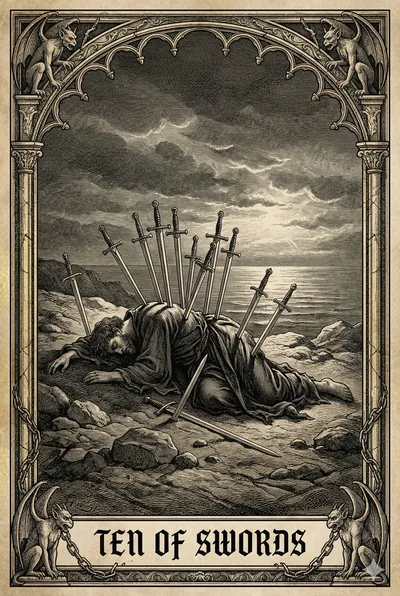
The RWS deck shows a man alone, face down, stuck in the back with ten swords, and this does not leave him among the living. No single wound seems to be a mortal one. It looks as though he had turned his back on insignificant threats, reprisals, or things that he thought could be put behind him, and transcended or ignored, perhaps out of arrogance or pride. But things caught up with him. The Sufi Inayat Khan might have called this “a total annihilation of all that you believed in and thought that you were.” But he would have called this a positive development, since now you can move on to the next great thing. The first of the twelve steps is admitting defeat, for now at any rate. Sometimes it takes destructive force to unseat overlearning or a stubborn way of thinking.
Interpretation
Commentators on the RWS deck are often very quick to point out that this is only a metaphorical death, although there is still plenty of ruin, affliction, grief, bankruptcy, desolation, troubles, misfortune, dashed hopes and dreams, and the utter defeat of hope or intention. There are similarities here to the Tower, but this is in the mental realm. The most significant aspect is that the damage is cumulative, a death of a thousand cuts, not one mortal or devastating wound, but a death by attrition. As a Sword card, it warns of a potential failure of the mind, a failure of the intellect to cope with the ‘slings and arrows of outrageous fortune.’ We have many handy metaphors that might be applied here: an accumulation of thought or theory can collapse like a house of cards. A final straw breaks a camel’s back. A government grows too complex and the center can no longer hold. A boxer takes one punch too many. A lapsed alcoholic might say ‘I was run over by the caboose.’ Environmental damage reaches a tipping point and a system collapses in a cascade failure. By the Peter Principle, a man gradually rises in his job to his level of incompetence. In sum, this is the climax of something a long time in coming, a function of accumulation and not a sudden event. This suggests the question of why this outcome was not foreseen and acted upon. One might well answer with the frog in the hot water metaphor, even though this doesn’t really happen in reality. The frog got the hell out when it was actually tested. But many humans are not this bright. Paradigms die hard, taking lots of blows on the way down.
The Ten of Swords is the wearing force of excessive detail, an erosive process, by the abrasive grit of the sands of time. We are slowly worn down or detailed to death. An architect, probably while praising himself, once coined the phrase “God is in the details.” It wasn’t long before someone countered with “the Devil is in the details,” which soon became a lot more popular. Whichever may be the best, it’s awfully crowded down there in those details, and really hard to work around those two. The Yijing counterpart, Gua 09, is Raising Small Beasts, or Taming Power of the Small. A modern English equivalent of this amusing title might be ‘herding cats.’ It speaks to the diminishing returns of fussing over details, advocating a simplification and stream- lining of our character or being, a smoothing of rough edges that we get by moving to a larger scale or more distant time horizon, a ceasing to sweat the small stuff. This principle is often applied in politics as devolution, the transfer or delegation of power to lower or local levels. This is also the ombudsman with vertical mobility through a world of layered bureaucrats. The trifles, irritants, and back-breaking straws still do their work of fine-tuning, but this is seen to have its place in self-regulatory processes. This is also about our ultimate finitude as it’s seen from high above: our species going extinct is a galactic trifle, as is our glorious Sun’s burning out. Eternity, for man, is the briefest flash of all.
Micromanagement makes existence overly complex. The mind will never surround or comprehend a reality seen at this scale, where all it is is little things adding up to take us down. We want the view with the most information for the least effort. Our lives, our minds, our cultures grow and elaborate themselves into Rube Goldberg contraptions. At some point, only hive mind can take control. This is great for self- organizing systems, made of elements that are ’fast, cheap, and out of control,’ like insects. But it’s not as promising when decisions need to be made that will determine the fate of the world, like nuclear disarmament or the destruction of the environment. We don’t want the averaged behavior of insects to make these kinds of decisions. We want to have more components with higher perspectives, longer horizons, and authority instead of helpless anonymity.
Hyperextended systems eventually collapse, in parallel ways to crashes in popula- tions, which fall to below their long-term sustainable levels. Sometimes the standard models just disintegrate with a single unwanted datum. A bubble bursts or a market collapses. A delusion ends, or a way of thinking suddenly gets abandoned. Sometimes we simply hit bottom and decide we have now had enough. Sometimes this is a very good process, a quick conclusion to the ill-conceived, and saves us dismantling some- thing noxious one bit at a time. Dead-wrong ideas invalidate themselves, gone the way of phlogiston. To paraphrase Max Planck, science progresses one funeral at a time. In the best revolutions in science, the newer, simpler, more elegant paradigm is already waiting in the wings, to take the sting out of letting go. Besides the devastation, the Ten of Swords is also this large-scale rethinking, the finding of simpler, more versatile schema, like an aerodynamic mobility through the levels of awareness, like the vultures thermaling high above the wasteland, looking for signs of life to erase.