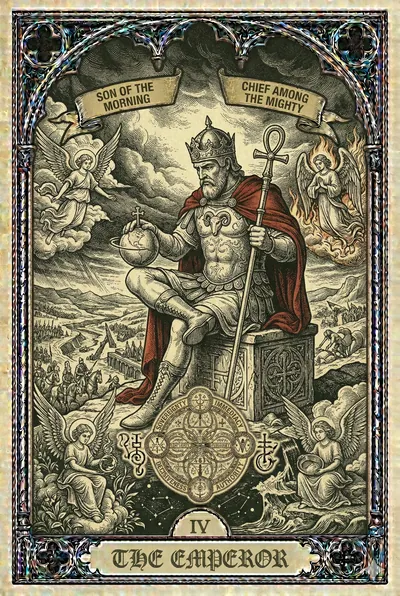
A mature, bearded man sits half-comfortably on a cubic stone, his right foot resting on his left knee, figuring a four. Between his foot and his left hand he absently spins a small globe. In his right hand he holds a long scepter, capped with a crux ansata or ankh. He’s wearing light armor, a breastplate with the sign of the ram, a battle helmet that doubles as a crown, and a scarlet cape. His garb is not new, nor is it ceremonial. He is intently busy supervising a great deal of activity occurring below his position of vantage. The background terrain is relatively rough and barren. One gets the idea that below him this is being transformed dramatically, that this was his idea, and that little time elapsed between the idea and its large-scale implementation. Perhaps his idea of doing well, or doing good, is doing much, and without needless delay. He values his time. His regalia varies between decks. Sometimes his scepter is capped with a globus cruciger, or orb and cross, of Holy Roman Empire infamy, and sometimes this is also the form of the globe in his left hand. Other decks have him holding a sword, to add some extra confusion. He has guards to do his swordplay for him.
Interpretation
The Emperor is the like-it-or-not fact of concentrated secular power, and the inclina- tion of human alphas, particularly males, to seek such positions. Not surprisingly, this is the feminist’s least favorite card, with the Hierophant close behind. This social role has been with us for ages, even defining some ages. It continues to evolve, and now it co-evolves with democratic ideas and corporate influence. The throne itself might still be ascended by divine right of birth, conquest, arrogation, or inherited wealth, and its occupant may range from despotic tyrant to powerless figurehead. If imperious enough, he can start a war, at the cost of far too many lives, just for something that he thinks is a bright idea. It is one of humanity’s great and fatal weaknesses that it has not learned a reliable way to govern its own collective behavior. Democracy can only be thought promising by failing to account for the intelligence and insecurities of the average voting citizen. Otherwise, it will simply be mob rule in slow motion and peer pressure writ large. Importantly, for our purposes here, popular committees cannot make executive decisions with the speed and clarity that energetic and confusing times call for. This sort of ship frequently requires a captain with at least some protection from mutiny. The key to success here may be twofold: we find a way for merit to rise to power more easily than corruption, and we find a way, as a matter of course, to depose a rising tyrant before he gains too much power and armor. Privilege, prerogative, and entitlement need to be forfeited for specified breaches, even when one is safe behind the legal walls that those in power can build. But once again, for our purposes here, this leader has a use, and a service to perform, and needs some benefit of the doubt. He is the father of his people and the only one who can make the hard choices at the speed at which they need to be made. Knowing that he may be more inclined to strength than wisdom, we still give him one more chance to show his character. We can only hope he finds the need to delegate to helpers more skilled than himself at the various aspects of ruling, including wisdom. We can hope that he is strong enough to meet and negotiate with rivals and peers, and to respect his subjects and underlings. We can hope for some feminine counsel, or someone else to openly question his judgment, someone not bound to agree. We can also hope for increasing numbers of women on the throne.
The Emperor is a symbol, of course, for sovereignty and self-mastery, for dignity and autonomy, for service to higher purposes, for obedience to our own self-made laws, for holding faithful to the prime directives of beings, for taking charge when everyone else is confused, for finding courage where needed, and stepping or ‘manning’ up when this is called for. Sovereignty is a divine right, even without a divinity, and even if all that you rule is yourself or the smallest of empires. This doesn’t always need to be done alone, but it needs to be done from the center, where the creating gets done and respon- sibility gets taken. Authority is for authors. Leadership at its most basic level is service, even when acting alone and leading our selves. Having a commanding presence is sometimes the only commanding that needs to be done, and being a compelling exam- ple, the only compelling. Nietzsche asked, “Free, dost thou call thyself? Thy ruling thought would I hear of, and not that thou hast escaped a yoke.... Many a one hath cast away his final worth when he cast away his servitude.... Free from what? Free for what?”
The Yijing counterpart is Gua 55, Abundance. Perhaps the best Western equivalent is ‘be careful what you wish for.’ This is the peak experience, as busy and confusing as life gets, overwhelming to ordinary folk, demanding the clarity and decisiveness of quick and competent judgment. The diem has to be carped. Tunnel vision is a recurring theme in the text, and the end of these tunnels may be where the only light is. Options are limited and actions are taken with limited recon and intel. There isn’t the time to carefully examine alternative points of view. There is only objectivity and objectivism, no time for subtleties and ramifications. The thing held in focus may be all that is not a distraction. Peripheral vision is limited, the big picture is absent, time is short, and presence of mind is a must. If advice can be taken at all, it had best be on the run and right to the point. Immediacy requires that responsibility begins and ends here. This too may be a metaphor, for life down deep in the clutter of selves that we are, and all of the business and mischief that these can get up to. One of us needs to take charge and find a way to some daylight.
Eastern Resonance (Yijing)
Gua 55, Feng, Abundance. Bagua Li (Cardinal, Angular) below, Zhen (Fire) above. “Thunder and lightning, coming as one. Abundance. The young noble executes justice and carries out judgment.” A time of much busyness, hustle, confusion, crowding, multiple choices, complexity. “Fulfillment. The sovereign approaches this. Do not be anxious. It suits the sun to be at midday.” A culmination or zenith. Many demands on the attention, a challenge even to the sovereign. Tunnel vision of daytime stars, or polarized light. Directions may be limited to one, exigency and execution.
achievementambitionassertionassertivenessassumption of rightattentionaudacityauthorityautonomybirthrightchallengecloutcogencycommandcompetenceconcentrationconquestconstraintcontrolconvictioncreating orderdecisivenessdecreedeterminationdignitydirectiondirectnessdispatchdominancedominionedictefficacyefficiencyemphasisenforcemententitlementexampleexcellenceexecutionexecutive abilityexecutive decisionexemplarfearlessnessfiatfirmnessfocusgoalsgovernancegovernmentimmediacyinitiativeintentions manifestedjob onejurisdictionlaying down the lawleadershiplegislationlimited options and pathsmanagementmandatemasterymeritocracyobjectivesopportunity for advanceorderoverviewpatriarchypatronagepioneeringpolarizationpreeminenceprerogativepresence of mindpressing affairspressureprioritizationpriorityprivilegeproficiencypurposepurposefulnessreconnaissanceresolverole modelruleself-determinationself-educationself-masteryself-respectself-ruleshining pathsovereigntystressstructuresummary justicesuperioritysupremacytactical striketaking chargetests of abilityurgencyvirilitywillpowerword of a sovereign as law
Warnings & Reversals
•abuse of authority
•abuse of power
•armor
•arrogance
•authoritarianism
•autocracy
•blind ambition
•bullying
•butt-headedness
•coercion
•conceit
•cruelty
•despotism
•dictator
•ego
•high-handedness
•hubris
•impatience
•indecision
•inflated ego
•inflexibility
•insensitivity
•jealousy
•lost focus
•rage
•rashness
•rigidity
•impetuousness. isolation
•micromanagement
•peripheral distraction
•polarization
•presumption
•rashness
•severity
•stress
•stubbornness
•temper
•thick skin
•tunnel vision
•tyranny
•volitional paralysis
Structural Components
The Emperor is assigned to the first of the twelve simple letters of the Hebrew alphabet, He, in its turn assigned to Aries and the 1st House. By way of this, we can make a portmanteau study of the components Cardinal/Angular and Fire in Astrology, as well as Li (Cardinal) below Zhen (Fire) in the Yijing.
Mystic Correspondences
Astrology
Aries, Nissan; Cardinal/Angular Fire, First House; Patron: Mars. The Spring thunder, the seed germinating, quickening. The primal spark, burning to exist, prime directive of beings, feedforward movement. The spirit of enterprise, initiative, vim and vigor, drive, impetus, adventure, courage, spiritedness, willfulness. The coherence and persistence of identity, self-reliance. Boldness and urgency. Personal sovereignty as a birthright, self-assertion, self-assumption, and self-definition.
Qabalah
The Simple Letter He, the first of the twelve and the beginning of the Zodiac attributions, traditionally assigned to Aries. The Window symbolism can suggests that the self of Aries and the First House is a unique point of view or outlook on the world, a locus of opportunity, and an alternate means of egress.