Image Reference
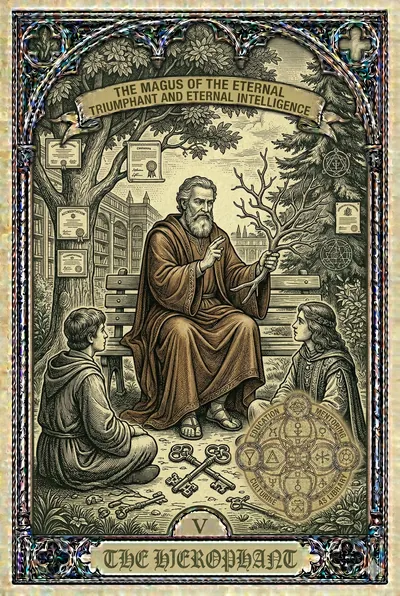
A mature man, with a graying beard, wearing a long, flowing brown robe and sandals, sits on a park bench between a deciduous tree and an evergreen. This is a temple, school, or academy, and he is fielding questions from two thoroughly unalike students seated on the ground before him. Between them, on the ground, lay two keys. He is showing them a many forked branch, maybe as an analogy, to which he points with the first two fingers of his right hand. This is an ambiguous gesture: it could be a benediction, an “ah, but” or a “slow down.” He appears to be trying to find right words, and wears an amused expression. This question might send him to the library. He still has a recognized institute behind him. The original Pope here became a Hierophant, interpreter of doctrine, a gatekeeper to arcane knowledge, and a mentor. The original Hierophant was the chief priest at the Eleusinian Mysteries. His successors interpret sacred mysteries and arcane principles. We have no more use for a Pope.
Interpretation
We have de Geblin to thank for the name ιεροφαντης, the one who shows us what is holy, according to our need and readiness. Before this was the Pope, our father confessor, whose truth was somewhat more standardized. And yet, over the centuries, it appears that what this teacher has to offer has grown increasingly exoteric and even commercial. We have many challenges here, not the least of which is that human beings are not equal in their ‘spiritual’ wisdom or understanding, and more controver- sially, are not equal even in long-term potential. Muhammad is credited with saying, “Speak to each in accordance with his degree of understanding.” People must progress at their own pace, young or old, dim or bright. And yet at the same time, we live in societies where we require at least some consensus on the core curriculum and the universe of discourse, if not on its precise content. Our minds require structured learning and enough of the common culture to live together. Second-hand wisdom needs to be conserved between generations, so teaching (pedagogy) and well-paced education are necessary. This can be done well by good mentors, or badly by pedants and proselytizers. The Hierophant can refer to either. The more gifted among us are normally left to fend for ourselves as autodidacts and eclectics. We will crack open that box of pretty rocks and gems that everyone gets and is told to treasure and worship, toss out the fool’s gold and paste, and the box, pocket the good stuff and move on with lighter loads. At least these days we are put to death less often for our heresies. We do philo-sophia. We love that wisdom. In the Buddha’s words, “You should train thus: we shall be wise men, we shall be inquirers.”
Any shared spiritual ‘truth’ will be parochial to some degree. There will be middle- men to keep the gates and keys, and they may or may not any have real contact with the truths locked up inside. They are occupants of a place, not the essence of the place. There will be exaggerations for impact, and lies told for comfort, and profit in even the most sacred of scrolls. There will be many things lost in translation and transmission, including the first person and due credit to fallible human authors. Pay no attention to the man behind the curtain. There will be accounts of what happens to those who fall short with the teachings, and to those who lack the good sense to join in, and many depictions of the bliss that comes with belonging. It seldom really matters if the ritual or ceremony has no more inner content. Most people want others to do their thinking for them, as long as they don’t have to know this. One must be blessed by someone duly licensed to bless. Believers get stuck in the rhetoric, parroting without under- standing, languishing in the lingo, with the wisdom reduced to vacuous platiturds pretending to be knowledge. The pros and cons take their marks. Someone is minding the valve that regulates the flow of wisdom, but given what we know of the human capacity for real wisdom, this is all probably just as well. We still need the consensus just to get along, even when belief does not seem to be helping, even when we align with beliefs that are not endemic to our nature. The flock will demand some sense of order, and the outliers will have something else. Most will still crave a fixed sense of identity, belief and belonging. It really isn’t so surprising that this sort of pedagogy produces more permanent disciples than graduates, innovators, and teachers. But for the latter, getting up to speed with the cultural literacy, with the aid of a teacher or mentor, is still a necessary step for all but the fiercest of autodidacts. Still, getting that badge, certificate, or accreditation can be a big investment of wasted time.
Yet there is one kind of person who makes sense of this whole apparatus, and redeems all the time and expense. This is the young noble one, hungry in mind and spirit, still full of potential and questions. The Hierophant exists for him or her, if not in patronizing ways, then at least in avuncular ways, in loco parentis, as mentor, with special counsel to offer and an abiding concern for the generations to come. Such students and seekers are excellent long-term investments. This will only take the young one so far, to a certain degree or grade, to a point of graduation or some accreditation. They may not need to pay dues to the guild in the end, but it doesn’t hurt to be licensed to bless. We have a great wealth of memes in our cultural libraries, of nuggets and gems of wisdom, both in and out of original contexts. Even some religions can lack a little in foolishness.
Most of the cosmic wheels have already been invented as well, and others have offered instructions in lighting the cosmic fires. We can make good use of our earlier years in this part of the world, finding giant shoulders to stand on. It rarely hurts to ask for some help or guidance, By-the-book education need not be a problem when we know that it was fallible people who first wrote the books. We learn a language in our studies that others can speak as well, and this lets us share what we can, and help where we are able. This is where rebellion and iconoclasm are not productive. The good student doesn’t need to become a believer. He can simply place himself in a place of learning, and avoid the need to reinvent fire-making and the wheel. He can admit that others are better educated and have things to offer. Many will resist this and insist on the democratization of knowledge, where all perspectives are equally valid. This is flunking the grade and faking diplomas with crayons.
The patience required to associate and synch up with resonant Taurus, from Astrol- ogy, and Wood, from Yixue, means the student becomes part of a very long process of growth, a co-author and a co-conspirator in an ever-evolving culture. Nietzsche offered, “One repays a teacher badly who remains only a pupil.” But first we must have teachers to help us to grow ourselves, past all the pat and premature answers. As David Haselkorn noted, “Teaching is the essential profession, the one that makes all other professions possible.” Bless the teacher or mentor who primes us first with hunger and teaches us first to take charge of our learning, both in the how and the why of it. Then the prescribed progressions are just the food, not the diet. Then education begins as it should, with a subject learning, not with subjects taught. We get self-directed behavior, instead of generalized prescriptions and proscriptions. There will be frustrations. The academy will permit only one creative idea per paper, and this must be defended, and often approved by others for whom the idea is new. Ideas must be supported by other people’s ideas. One is not supposed to think for oneself, only as a collective. But we try to keep our eyes on the real prize.