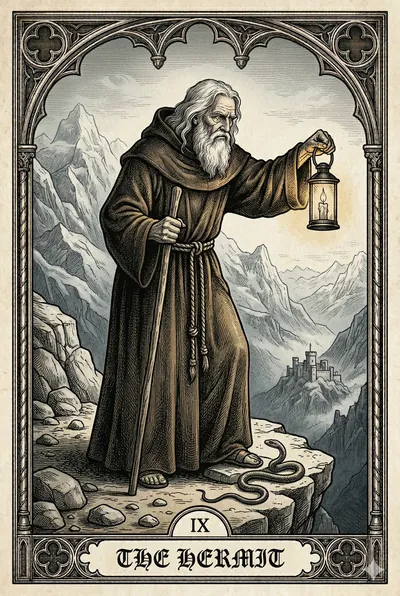
A world-wizened old man, with long, white hair and beard stands at the edge of the same precipice seen in the Fool. This may be moments later, or his own life later. The air is colder, thinner, and cleaner up here. He wears a coarse, brown, cowled monk's habit, belted with a rope knotted three times. He leans on a simple, uncarved staff in his left hand and holds out a simple candle lantern with his right. The light is partly shielded by the sleeve of his robe. As an Arabic proverb has it, “If it’s dark enough, one candle is plenty.” His face expresses serious questions, as though secure in knowing he now owns the puzzle’s pieces, but he has yet to complete the puzzle. Time flies. His lantern does very little to light the valley below, especially in daylight. Perhaps it signs welcome to a single, promising protégé. There is a small serpent at his feet, just because. Does the old one still have exuberance and laughter? Only if the truth he has built up here allows it. The end of his quest is a question. Some old versions of this card show him as Father Time, with an hourglass instead of a lantern. Others depict Diogenes, the original cynic, looking for an honest man. Still others simply call him a Capuchin or Franciscan monk, with the knots in his belt representing his vows of poverty, chastity and obedience.
Interpretation
Nobody provides a better entry into this card than Thoreau in Walden: “I went to the woods because I wished to live deliberately, to front only the essential facts of life, and see if I could not learn what it had to teach, and not, when I came to die, discover that I had not lived. I did not wish to live what was not life, living is so dear; nor did I wish to practice resignation, unless it was quite necessary. I wanted to live deep and suck out all the marrow of life, to live so sturdily and Spartan-like as to put to rout all that was not life, to cut a broad swath and shave close, to drive life into a corner, and reduce it to its lowest terms.” Other than the true hermit, perhaps nobody lives the life more completely than the Theravada Buddhist renunciate, because he also gives up the comforts of belief. His quest is in fact vipassana bhavana, a mindfulness training for insight. But the Bhikku still has his Sangha. In this card we have someone here who has renounced the traps and trappings of culture in order to get at the meaning of life. He is as serious in this quest as humans can get: he has to be to forego the persistent demands of the social needs of a highly socialized primate. This doesn’t mean he is antisocial, only extra-social or asocial, wanting removal of cultural and linguistic distractions. In the end, Lily Tomlin noted, “We're all in this alone.” This negates the conventional wisdom that all meaning is in relationship, at least for the time spent here. The duration of this quest is not known. It could be permanent or indefinite retirement, a one-year sabbatical from ordinary life, or a two-year pilgrimage like Thoreau’s. One might assert that the Hermit can also be a walking-around attitude with which to move through daily life, but this is simply called introversion. Fundamental to the adventure is the setting of high personal standards and goals, and the renunciation of any aspects of life that distract from this. The Hermit raises the bar here and makes big demands on himself, trying to set aside all that isn’t seminal and germane. The thing he gets most of is time, in frightening amounts at first, but soon enough the days will be plenty full again. The word contemplation means ‘with time.’ There is also plenty of silence here, in which to hear himself think, and if so inclined, to hear that still, small voice. Some search their souls, others search for them. This is an analog of sensory deprivation and ganzfeld experiments. Jung suggested that the “animation of the psychic atmosphere [becomes] a substitute for loss of contact with other people.” The mind abhors a vacuum, but he still must be careful so the desperate mind won’t fill that with hallucination and fantasy, unless that is the kind of vision that he has set out in quest of. He puts himself where the hidden can speak and the dim can be seen, but where society is unable to offer suggestions of what should be heard and seen.
A few commentators have recognized Prudence (Phronēsis) in this card, completing the set of four cardinal virtues contained in the Trumps. This means taking a great deal of care in what goes into the mind, on the cybernetic axiom that ‘garbage in means garbage out.’ The Hermit manages his inputs with care. Critical thinking is an important part of the process. Thrift and parsimony are used here at all levels, with Occam’s razor proving useful on the fuzzy ideas. He needs to be suspicious of what his mind can do. He might be especially wary of the kind and quality of the questions he asks, since these not only frame the answers: they also establish a universe of discourse that can leave the best answers out of the frame. The spirit of inquiry is philosophia, the love of wisdom. When it’s real, it’s a lifetime commitment to learning. Edification, then, is the long and patient building of a mind, with ambitions of some height for the views and therefore concern for foundations. We grow one molecule at a time, build one piece at a time, and fill up one drop at a time. This is why he is picky. He is not just a seeker, but a finder as well. He is an autodidact, first-personing his knowledge, high-grading the teachings as if they were ore, reinventing wheels at times, being deprived of sounding boards and stereopsis, or other perspectives. Who knows what he might learn? The fellow who wrote the Kama Sutra was a celibate hermit too.
The Yijing counterpart, Gua 04, Inexperience or Youthful Folly, examines the process of inquiry, beginning with taking the care to ask the right questions with the right amount of respect. The book takes the role of the teacher or mentor, but ultimately this has to be the ability to learn, the learner within instead of the teacher. While Waite suggests that this is a card of attainment instead of a quest, we have to suggest this is wrong. Many of the Hermit’s commentators stress the need of this character to broadcast his doctrine, and view his lantern as a signal for students to come. We can only ask of these authors: “What part of Hermit, or what part of leave me alone, did you fail to understand?” He’s not about to proselytize or be loose with the pearls. He’s not there to be your guide. Any leading here is done by example. Nevertheless, we almost have to believe that he might entertain an especially promising seeker or two. This goes along with setting high standards. It might also be useful to mention that other hermits might be around in this neighborhood also, with whom he might on occasion share the belly-laugh scene from old Chinese paintings, perhaps with Han Shan himself.
Eastern Resonance (Yijing)
Gua 04, Meng, Inexperience, Youthful Folly. Bagua Kan (Mutable, Cadent) below, Gen (Earth) above. “At the foot of the mountain emerges a spring. Inexperi- ence. The young noble proceeds to fruition by nourishing character.” This chapter concerns the spirit of inquiry and investigation, symbolized by a youth who must learn to ask the right questions. “Fulfillment. It is not I who seeks the young and inexperi- enced, the young and inexperienced seek me. The first consultation informs, while the second and third show disrespect. Disrespect deserves no information. It is worthwhile to be dedicated.” The Yijing here takes the part of the elder sage, whose wisdom is being sought out. Early development, education, guidance. Inquiry, questioning, questing, discovery. Gradual fulfillment is like a pool fed by a spring. Learning and unlearning, training the mind like a wild vine.
abstentionassayattention to detailautodidactscarefulnesschoosinessclose readingcognitive housecleaningcoherenceconcentrationcriteriacritical thinkingcultivationdeliberationdiscernmentdisconnectingdiscretiondiscriminationdistancingearned revelationeclecticselder knowledge and wisdomelevation of standardseruditionessentialsexaminationexplorationfarsightednessfiltering inputfirst-hand wisdomfocusgermanenessguardednesshigh standardshonestyindependent investigationindependent thoughtinquiryinsightintrospectionintroversionisolationlearninglearner withinlearning how to learnmeaningfulnessmeasuremindfulnessmoment of silencenarrowcastown counselown termspersonalizingperspectivepertinenceplace of learningprivacyprivate pathprobingprudenceprudent assimilationquestingquestioningraising the barreassessmentredrawing the personal worldre-evaluationreflectionrelinquishingrenunciationreserveretreatrevaluation of valuesrigorroads less traveledsabbaticalsacrificesagacitysamma satiscrutinyseclusionseeking and findingselectivenessself- awarenessself-examinationself-guidanceself-knowledgeself-possessionself- relianceself-scrutinyseparatenesssilencesimplificationslowing downsolitudesorting outsoul-searchingspecificationspecificitystudytime outunlearningvipassana bhavanavision questvoluntary simplicitywatchfulnesswisdomwithdrawalworthiness
Warnings & Reversals
•abdication
•alienation
•boredom
•coldness
•concealment
•deadly seriousness
•desertion
•dissociation
•distractions
•escapism
•estrangement
•flight
•forgetting to laugh and play
•fugue
•fussiness
•hiding out
•ignorance
•ignoring counsel
•insulation
•isolation
•loneliness
•misanthropy
•narcissism
•regression
•over-seriousness
•self-deception
•solipsism
Structural Components
The Hermit is assigned to the sixth of the twelve simple letters of the Hebrew alphabet, Yod, in its turn assigned to Virgo and the 6th House. By way of this, we can make a portmanteau study of the components Mutable/Cadent and Earth in Astrology, as well as Kan (Mutable) below Gen (Earth) in the Yijing.
Mystic Correspondences
Astrology
Virgo, Elul; Mutable/Cadent Earth, Sixth House, Patron: Mercury Epime- theus The work of self-acceptance, qualification, standards, cutting back on options, pruning. Self-care, self-improvement, self-critique. Clear identity and identification. Relevance, germaneness, pertinence, meetness, congruity. Fitness, aptness, conso- nance. Admission of qualified experience. Usefulness and aptitude. Concern for nutrition, assimilation, digestion, what is absorbed and used to build our selves, what is to be acceptable.
Qabalah
The Simple Letter Yod, the sixth of the twelve zodiac attributions, traditionally assigned to Virgo. The Finger symbol is a stretch, but some association to seed or germ, the seminal and the germane is useful.