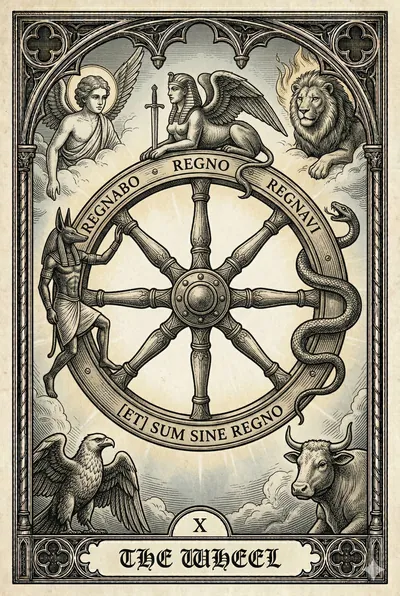
#10, Wheel of Fortune, Ruota Della Fortuna, La Roue de Fortune, Chance, Fate,
The Wheel
The Lord of the Forces of Life
Equanimity, Composure, Eventuality, Full Circles
Image Reference
A wheel occupies most of the card. It has eight spokes and an axle the length of its radius. But the wheel is not on a cart. It only goes around, widdershins, the way the Earth really turns, not the way Sol seems to go. Three figures ride on it's circumfer- ence, representing the temporal scale of three: Hermanubis rising, Typhon descending, and the Sphinx on top, for the moment. Old versions show a king on this merry-go- round, with regnabo, regno, regnavi [et] sum sine regno (I shall reign, I reign, I have reigned, I am without reign) inscribed in the appropriate places. Intoxication with today’s success may become tomorrow’s hangover. The corners of the card are occupied, from lower left, widdershins, by the four kerubs of the bull, lion, eagle and human, representing the elements, and marking the midpoints of the four seasons. These figures can be found on the World card as well. Other than traveling nowhere and being useless, most wheel metaphors apply. This Wheel belongs to the goddess Fortuna, who spins it at random, changing the positions of those on the wheel. When it spins out thread, this is done by the three Fates, to whose decrees even Jupiter, the king of the gods, is subject, and must adapt as Jovially as he can. It comes around to this: “You've got to ask yourself one question: “‘Do I feel lucky?’ Well, do ya, punk?”
Interpretation
Samsara progresses, but in the end it goes nowhere. We are always in a season that always passes. Much of the nonsense in human religion is spewed in explaining the vagaries of fate and fortune, and advice on rolling with these vagaries is a central or axial question in most human systems of thought wherever answers are packaged. This is often entangled with issues of merit and justice. What we get is supposed to be connected with what we deserve. Sometimes past or future lives are invoked to balance the karmic accounts, or account for unfairness in this life. In the Mid-East, Mohammed offered a wise compromise: “Trust in Allah, but tie your camel first.” In the far East we roll with it: “Junsei nana korobi, Ya oki” (Such is life: seven times down, eight up). The Yijing (Zhouyi 11.3) suggests moving towards the center: “There is no level without a slope, no going without a return. It is difficult to persist with no errors. Do not worry: these are certainties. Find happiness in nourishment.” Buddha was also centrist, urging upekkha, equanimity, tolerance, or balance of mind, understanding both that our problems must work themselves out, and that sentient beings must work themselves out of their own problems. But the formulae that we’ve been given by others for hindsight, insight, and foresight may fail us here. Lowered expectations may be advised, and in the end, adjusting our attitudes in the act or on the fly may be where the best wisdom lies.
Readers are generally told by Tarot books that good luck is on its way here. This might be because our being upbeat will tend to better our odds, or maybe because when systems get more energetic they like to move towards order. Momentum rolls the wheel towards resolution of forces already in play. If the outcome of a sequence of events is less than a cycle away, then angular momentum will bring it around. Effects emerge from preceding causes. But these are not always meaningful connections, and they certainly aren’t always reasons. It might have been better if Carl Jung had never given the word synchronicity to weak-minded thinkers. Except in classical physics, accidents are common. But people do love their platitudes, maybe as much as they fear their freedoms. For these, things may as well run on fortune and fate, with destiny being something that sweeps you up instead of a way you step into, with purpose being some grand and mysterious puppeteer’s plan for your soul. This we know: that the universe is big, and most of it will go wherever it will, mixing randomness up with natural law. Many of the rhythms and cycles are almost fully predictable. But tiny little parts of it are subject to our modification and agency. As if to provide an alternative for the vapid ‘everything happens for a reason,’ Nietzsche noted how life is just oppor- tunistic: ‘A loss rarely remains a loss for an hour.’ This lifts us out of the puppet mentality regarding our fates and fortunes. It has to be accepted that some fortunes are predictable, others whimsical. We don’t have to approve, but there it is. Maybe all we can do is play the odds and proceed as though character were destiny.
Many systems offer their ways for coping with our ups and downs, explaining life’s comeuppances as some kind of natural consequence. But they fail, and not only in Vegas. There is no cosmic system, and not another to beat it. The facts seem to be that bad things happen to good people, and good things to bad. Our problem here is called the excluded middle. The simple minds want simple, black-or-white answers, but life calls for more complex minds than this. Fortune behaves like a deity eager to teach. The teachable few learn quickly but the rest never seem to grasp it. “Chance favors the prepared mind,” as Louis Pasteur suggested. And “perfect sincerity offers no guaran- tee,” as Zhuangzi might add. We live and work in a world of probabilities and play the odds as best we can. Some rules of thumb can give us some advantages, ‘buy low, sell high,’ for instance, but these don’t give us a vision of what is to come. Good behavior, on average, leads into a better life. But crime and corruption do pay, especially when our governments are criminal and corrupt. And here you are reading a book on Tarot. This might help, but if you think it’s going to predict your future or tell your fortune, well, good luck with that. That learning what we can, and working with the odds, is the best that we can do is not a reason to give up. It’s simply what’s done by people who do the best that they can do. We gamble and hazard best guesses. And we sometimes must enter and play to win.
Clearly, the center of the wheel is host to the least disturbance. Being wholly ‘under the circumstances’ is like being out on the ever-changing circumference, with perpetual ups and downs, and periodically beneath the wheel. To occupy the center, as with Buddha’s upekkha, can have a couple of meanings here. It doesn’t require an inatten- tion to the rim, which is con-centrated on the center as well. Pathos or apathy remain choices here. There is a center in feeling that feels something of everything, but there is also a numb one that regards its numbness as winning. The response or reaction to a change is what matters more than its nature, and the center is almost always the place where all the best choices are made. The helmsman needs both left and right turns to steer the boat a straight course. The high-wire artist needs to use left and right in exactly equal proportions, which is only done from the center. The moment is the center of time, from which the cycles of time are best understood. Be these long cycles or short, this is the key to patience. Things always happen in season, so we only need the patience to pick the right season. Change is best undergone, if not with detachment, then at least with an overview, with deeper horizons in time. Anxiety and discontent are myopic. Not seeing the big picture is often the same as not seeing full circle. Fortune isn’t predictable, except in those places fully subject to science. We learn and guess what we can. We can bet on the probability that events will occur in their usual sequence. We can be the best beings that we can be, hoping to tip the odds in our favor. But if we want to formulate truths, we don’t want nearsighted views of the wheel to come to terms with our fortunes, and the greater time horizons are longer than our lives. At least the greater perspectives make our little problems and our ups and downs seem small, and perhaps not worth the worry.
Eastern Resonance (Yijing)
Bagua 1, Gen, Mountain, Stillness. Gen, as mountain, is a symbol of individual existence, solid and real for practical purposes, but only insofar as its foundation upon a greater reality is secure, which requires that the basis be broader than the summit. Here, security, composure and balance are inseparable. From below, the human per- spective, the big picture is grasped only when one is on top of things. Until the work is done to get to this lofty place, the mountain is an obstacle, or limit to the grander view. To be great means to be greatly grounded. Mountains are also thought of as the centers of the world, hubs, poles, axes and reference points. And, of course, they are home to the gods. This is half of the third dimension, things, as islands in time. As discussed earlier, Gen can be represented by either Jupiter or Saturn. As a force of equilibrium, equanimity, stability and a higher, or less needy, kind of love, this is Jupiterian or Jovian, and as such can be associated with this Trump. As a force that stops us or brings us up short, it is Saturnian, and this aspect doesn’t really apply here.
acceptance is not approvalaccidentbalancebig picturecentercenterednesscenteringchancecircumferencecircumstancesclockworkscomposurecomprehension in viewcon-centrationconfirmationconsequencescontrolling reactionculminatingcycles of need satisfactiondestinyequanimityeven- mindednessevennesseventualityfateful turn of eventsfatesfortuitousnessfortunefruitiongamblinghappinesshazardingimperturbabilityinevitabilityin the cardsissuelevelheadednessluckmagnanimitymanifestations in timenecessity of cyclesoddsopportunitiesoscillationsoutcomesoverturningoverviewpatienceperpetual motionpivotingpoisepossibilitypotentialpredictability of fortunepresence of mindprobabilityrandomnessrange of possibilityrecognizing inevitabilitiesresiliencerewardsrhythmright time and placeripe destinyrolling with cyclesround tripsamsaraseasonsself-possessionsequitursserendipityserenityserenity prayerspeculationstillnessstoicismsynchronizingtime framestime horizonsthe hand you’re dealtTOs and FROsturning pointturn of the cardsturns of eventsunfolding eventsupekkhaups and downsventuringwhat goes aroundwheel’s still in spinwindfalls
Warnings & Reversals
•anxiety
•apathy
•chasing the dragon
•compulsive gambling
•detachment
•fatalism
•fate
•fortune telling
•going in circles
•gullibility
•hedonic treadmill
•inconsistency
•injustice
•interruption
•intoxication
•mischance
•mishap
•myopia
•non-sequiturs
•overreliance on ideas of providence
•powerlessness
•suffering
•undergoing
•uncertainty
•underneath the circumstances
•unfairness
•unfortunates
•vicious cycles
•victim mentality
•vicissitudes
•ways the cookie crumbles
•wishful thinking
Structural Components
The Wheel is a straightforward symbol. Portmanteaus may be made with its associa- tions to Jupiter, Chesed, and now Gen, and second-tier astrological associations to Sagittarius and the 9th House. All suggest moving to a higher order of perception, one that’s more comprehensive relative to the details, getting above the small stuff.
Mystic Correspondences
Astrology
Jupiter, Zedek; The higher power of grace, majesty and command. Self as the sum of one’s extensions, expansion, diastolic awareness, exploration. Self defined from within in positive terms. Internal cohesion, confirmation, what we get away with. The bestowing virtue, equanimity, sitting pretty, being on top, balance, equilibrium, poise. Association with Jupiter as the greater benefic or fortune may be partly responsi- ble for the the Wheel’s often cited prediction of good or improving luck.
Qabalah
The Double Letter Kaph. The Jewish Kabbalists associate Kaph with various other Planets, with little agreement. Regarding the Palm of the Hand, we might note that the Jews, from long before Kabbalah, were no strangers to palmistry for the telling of fortunes.