Image Reference
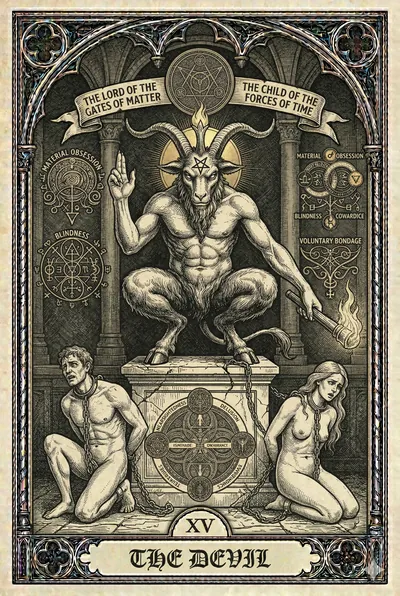
A large, horned satyr, in the neo-mythical figure of Baphomet, the Sabbatic Goat or Horned Goat of Mendes, is squatting on a stone plinth or pedestal, his right hand raised in some wicked benediction mocking the Hierophant’s gesture, his left hand holding a torch pointing downward. He has the obligatory inverted pentagram on his forehead, pointing to his third eye. Chained to the base of his pedestal are a naked man and woman, seeming to suffer greatly, but one notes that the chains around their necks are loose enough to slip off at will. For an alternate image, a mean-looking, goat- foot demon, not Pan, sits atop the far railing of a small wooden pen or corral amidst a pastoral setting, taunting a smaller human couple, naked and cringing against the nearer railing. With one hand the demon entertains a huge erection, leering lecherously at the humans, perhaps about to break out in sadistic laughter, while his captives worry over who will be sodomized next. One may get the idea that they were out here building a pen to contain their goats, and this demon happened by, looking for sport. Out of fear and myopia, the humans accept domestication without contract, trapped in a self- limited reality, rather than simply hopping the fence, for this god has waxed mighty in his role as scapegoat. He has become all of the enemies gods, and all of their enemies guilts and fears. But he’s only a fantasy, not the real evil. The real evil is simply human blindness, obsession, ignorance, delusion, fear, cowardice, and voluntary bondage, having turned pathological and against this life, perhaps all life, and this world.
Interpretation
Along with the Tower card, this was the last card to join the present deck. To begin with, there are a couple of things that this card is not. The Devil is not the evil here, although evil puts down important roots into the pathologies represented here. Nor is the Devil card a depiction of Cernunnos, Faunus, or Pan, the hoofed, satyr god em- bodying the forces of nature and sexuality, the pagan and hairy side of ourselves, the Earth god, groom of the Mother, lord of the world’s libido. However, it may still depict a caricature of Pan made into a scapegoat for our human failures. This is the Devil that’s painted by human immaturity, the Bogeyman conjured to frighten children into obedience. He’s the enemy that leaders like to use to control their subjects. He’s the adversarial attorney who wants us to see only one side of things. He’s our saintly perversion, turning us contra naturam, against our own nature. He’s our demonized flesh and our sensations, our denunciation of the very material that brings us into being. He is Saturn, lord of our limitations, twisted into Satan the liar. He’s mankind’s bedeviling characteristics and influences. Sometimes in doing his worst, he does us great favors. And sometimes a minion, as advocatus diaboli, makes excellent argu- ments against anthropocentric human self-righteousness.
We look at the limits to our vision here. In our ignorance, we act and react on limited information, but do so with an arrogant certainty. It’s not matter that drags the soul down: there is nothing inherently wrong with matter or the material world. But it does have the problem of being opaque. We have a hard time seeing past what’s right in front of us. Our vision is limited by the nearest surface and horizon. All that we see are the limits to our vision, and so what we see is too often all that we get. This is what culture builds on, forgetting the far horizons, so that limited human culture becomes the whole world. We live by fake needs and false assumptions. We live for the latest fashions and fads. We move according to short-term trends. We get bewitched and fascinated by trinkets and baubles. We judge by surface appearances, facades, and hypocrisies. We are glamored. This is the core of the Yijing counterpart, Gua 22, Adornment, showing the light of the flame blocked at the foot of the mountain, lighting up the valley and the local terrain, but nothing else. This leads to the advice to make only small and local decisions, to enjoy the adornments, but to understand their limits. This connection will be more challenging to someone who has understood this as Wilhelm’s weak idea of Grace. But the core problem is nearsightedness, with possible slips into a more pejorative short-sightedness. These goatish images, however, from both this card and Capricorn, suggest that nearsight can still be useful, as the goat must know precisely where he stands, with total concentration, if he is ever to get to the top of the canyon wall, where the big views await. Local activity is only a prison when context, the big picture or far horizon is lost.
In a way, a fearful reaction to this card is itself the core meaning. The self-reflexive and negative emotions like fear, intimidation, guilt, and shame have all cemented a generally appropriate place in primate and human evolution, but they are also easily perverted and subverted. It starts at the edge of self, as fear for the boundary comes with the boundary. Of these, fear may be the most easily played, and enemies most easily painted. Nietzsche suggested that “everywhere that a culture posits evil, it gives expression to a relationship of fear, and thus a weakness” (WTP p. 530). Then, by way of naming these devils, the culture attempts its conquest. Thus, when we want to understand a culture’s weakness, we might first take a look at its devils. In the West of the Abrahamic religions, evil is often the material world, nature, gender differences, the flesh, sensuality, eros, and sexuality, and then secondarily, all of those cultures that disagree with ours, the ones we wish to conquer. An antipathy to life is the first weak- ness here, then our approach to diversity. Our cultural paranoia is playable in both its delusions, of persecution and of grandeur. Our devil is our own shadow, which, as Jung explains, “personifies everything that the subject refuses to acknowledge about himself and yet is always thrusting itself upon him directly or indirectly: for instance inferior traits of character and other incompatible tendencies” (CW 9 i, par. 513). At bottom, the Devil is our cowardice, fear, shame, and delusion, born of our ignorance. Then we can find no better way to excuse our failures to than to simply imprison ourselves and claim helplessness, to blame our compulsions and addictions, temptations and seduc- tions, our fate and circumstances, our puppet masters and upbringing, our victimizers, our diseases, tyrants and devils, as just the way things are. We chain ourselves, but still hold the keys.
Liberation is in large part a question of where new light is shed, and bigger pictures for bigger minds. We get outside the hall of mirrors, we come to understand our projec- tions and reflections on the surfaces of things. We stop running from the material from which we emerge, and understand our problem was not loving matter or life enough. Perhaps we find the courage to confront our demons. Alcoholics might call alcohol called cunning, baffling, and powerful, although it’s none of these. The problems are in us. Neither will their fears let them see that a cold-turkey withdrawal is no worse than the next two scheduled hangovers. Victim and disease mentalities abdicate our power to change, even where they might hold some truth. Remember that the biblical Satan is a lawyer, wanting you to see only his own side of things.
“Get thee behind me Satan” really means that he still has value, but that we are finally ready to lead. Ironically, the Satanists, by taking on the point of view of the adversary or the other, in whatever psychodrama they play with whatever cultural props, wind up with a richer picture of things than the ones who fear their devil out of their fear of a god. It’s really all about exploring and crossing the boundaries set by cultural fears. Even the Catholics employ their Devil’s Advocate. Finally, of course, we need to take a look at the Devil’s playful side, his devilishness, his mischievousness, his eagerness to show us the silliness of our limited ways. The old goat Capricornus is the root of the word caprice, whimsy, even if that dates back to when he was just a kid. To sport with the Devil is educational play. Evil is something else. Evil is dragging your son to the altar to kill him to prove your faith, and then convincing your people that that was a good thing. Did you know that the name Isaac meant laughter?
