The Great One of the Night of Time, The End of the World
Worldliness, Emergence, Homecoming, Wholeness
Image Reference
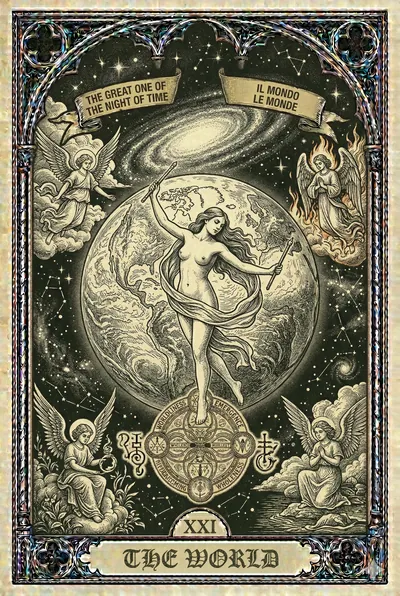
A goddess, who is nude except for a loosely-draped, strategically-placed veil, is shown in mid-dance, weightless, holding a wand in each hand. Behind her is the full Earth, and behind that, the oval form of an elliptical galaxy, like our own Milky Way, all against a background of the Night of Time. Her veil is not worn out of shyness: it’s part of the dance, ‘the only dance there is,’ Lila, a divine playfulness. She is Gaia, the wife of Uranus, or Anima Mundi, the World Soul, Shekinah, the Presence, Malkah the Queen, and Kallah the Bride. This card represents an emphatic denial of dualism, or a recovery from duality through a reunification with reality at large, at really large. In particular, this card denies the idiotic assertions that things worldly, material, and fleshly are profane, unspiritual, or unholy. As with the Wheel, the corners of the card are occupied by the Kerubs of the four elements, showing a full circle of seasons, each in its full glory. The oval of the galaxy, formerly a laurel wreath, carries the golden 1.618 ratio, and it also suggests both the cosmic egg and a vesica piscis. Some commentators wish to call the figure androgynous or hermaphroditic, but despite the overall theme of unity of this card, there is just too much to suggest the goddess Gaia, as a grand, emergent being, created out of the synergetic interaction of the material world and the living biosphere. A woman has all the DNA needed to make a being.
Interpretation
There exists some pressure and valid rationale for renaming this card ‘the Universe,’ to acknowledge the more extended horizons that modern culture has found. This push is in part to accommodate newer associations with Saturn, who needs to be remem- bered as the outermost planet for most of astronomy’s very long history, and therefore symbolic of the outer limits of existence, and human finitude. But there are too many purely local aspects to this card’s meaning to develop such a grandiose concept, beyond reminding us that the larger universe is out there. For now, this card needs to imply that we have a home here, when we are ready to more fully inhabit it. A core idea here is that we need to come to terms with this world, as our reality, to accept and to live within our limits cheerfully, to respect that we already have a great generational ship for exploring the stars, to drop the delusional nonsense about being angels de- scended from elsewhere to walk around in puppets of meat. As cited before in the context of the number Ten, this is Alan Watts’ wisdom, ‘You did not come into this world, you came out of it, like a wave comes out of the ocean. You are not a stranger here.’ Here we affirm our life incarnate, and that we end here where we began. Or, in the words of T.S. Eliot, ‘We shall not cease from exploring, and the end of our exploring will be to arrive where we started, and know the place for the first time.’ This is literally a card for the worldly. However, the world is really big, much bigger than dreamt of in our philosophy, and we only sense a few narrow bands of her much broader spectra. It requires states of mind far more expansive than those we are used to in order to fully appreciate the world we have here. We spend most of our lives with this world at our feet, but seldom really arrive. We take the world for granted, but its ordinariness is just a thin layer of dust that’s hiding the magic of it all. The dullness is in us. The ordinariness just rubs off, and the sacred shines through.
The most mundane interpretations of this card simply suggest that we have completed a task or journey, that something is now attained, that a matter has reached its conclusion, or that a process has culminated. At the least, things are now in their final stages and we make ready to wrap these things up. The prognosis is usually good, ignoring the world’s frequent disobedience to our will, and that our outcomes are sometimes those we deserve instead of the ones we wanted. There is also frequent mention of an ultimate fulfillment, finality, or perfection. This may come from people who live in some world other than this one. Sometimes we just need to find ways to think of things as complete. Sometimes we just have to accept the things we cannot change. The Saturnian element can be useful here to recommend a cheerful realism, acceptance of the limits, the givens and facts, as the most sensible place to begin from, regardless of how high our ambitions may be. We take a comprehensive view, see the things we would rather not see, because care and respect will set us on solid ground. We might, to no ill effect, immerse and involve ourselves in material matters, participate in creation, roll up our sleeves, work hard, sweat and get soiled. We might also learn to acknowledge the damage we do, and that we are not immune to the world’s reactions as consequences of our own. Such a materialistic and worldly view will still admit a number of respectable, human states of mind which might be termed mystical, and yet these particular states remain available to scientists, and philosophers armed with critical thinking skills and Occam’s razor. While often claimed by religions, they belong to human evolution, and may even be better off in the care of neuroscientists. Pantheism describes one such understand- ing, although to call all the world ‘God’ serves only the purpose of making our friends less uneasy about our souls. Panentheism is just that transcendent god trying to weasel his way back in. Emergence might be the most useful idea, the idea that the world can give birth to unexpected things, qualia, like the color blue, or consciousness, and maybe even spirit, things that might still become real, even if not original parts of the world. Einstein famously noted, “The most beautiful thing we can experience is the mysterious. It is the source of all true art and science. He to whom the emotion is a stranger, who can no longer pause to wonder and stand rapt in awe, is as good as dead: his eyes are closed.” Some of us make awe into awful, perhaps wanting a much smaller and more manageable world. But to manage all that we can see, we can also just limit our worlds, lock ourselves up in cabinets, and only claim what little we own.
We want to remember that cosmic consciousness is not the end of the search: it’s only one door to go through, the sooner the better. It’s not the same thing as having arrived. Getting to the ordinary is vital as well, and seeing it as sacred is a bigger step than you’d think. One version of this particular journey was penned by Qingyuan Weixin, “First there is a mountain, then there is no mountain, then there is.” In Zen lore, the Ten Oxherding Pictures depict the ten steps to enlightenment, which culminate ‘back in the world, with gift-giving hands.’ The goal is not ascension into white light, it’s coming home. Of course we should also be thinking in terms of kalpas and light years, and regard these as special as well. The real world must also be a world without you in it, or with an insignificant or long-forgotten you, or a place where you must ask if you still really exist at all. This is unavailable to those who are too big and full of themselves. Humility of scale gives us better horizons, beyond those of our playpens and nations. Reverence requires neither a church nor a deity, and it helps us to remember to care and respect. Albert Schweitzer’s ‘reverence for life’ is a great start, but we should also save some reverence for waterfalls, thunderstorms, and clean air too. Gratitude is a fine state as well, and reminds us to give a little something back, to be more than parasites on this world of wonders. We can be OK with finitude and mortality: it’s really all we born to deserve. As Vonnegut reminds us, we were mud that got to sit up and take a look around. Lucky mud.
Eastern Resonance (Yijing)
Hsiao 1, Yang, the Active, Banners in the Sun. This association was a chal- lenge. Yang’s original meanings concern light, sunlight or energy, and even before there was Yin-Yang theory, it contrasted with Yin, the shade. And here we have the material world, usually thought of as darkness. But even the heaviest matter is just slow, frozen light. And if we could journey to the darkest part of space, our eyes would be filled with the starlight passing through. There is really no escaping the light. This is energy, nature, activity, and life, nearly always in motion in some way or other. Even heavy, old lead is loaded with zippy little electrons.
acceptanceadventureaffirmation of this life incarnateaham brahmasmiappropriate wonderas full as it getsarrivalattainmentbig picturebelonging herebounty beyond any acquisitionbroadened or expanded horizonsclosing the circlecoming full circleconclusioncompletioncomprehensionconsummationcreationculminationecstasy as ‘out of stasis’ elegant solutionsemergenceeternityexplorationextensionfinalityfinding a home herefinitude and system constraintsfully expanded horizonsGenius of the World (Cosmico)globalizationgratitudegreat mandalagreater scheme of thingshaving it allhigher consciousnesshomecominghorizonsimmanenceimmersioninfinityintegrationinvolvementliberation from selflimitationsmicro and macrocosmmaterialismmicrocosm in macrocosmmokshamulti-dimensionallymundane affairsnaturenot man apartPanpantheismreabsorptionrealismrealityrealizationrealmsre-homingreintegrationrejoining the universeresolutionreunificationsacredness of the ordinarysamadhisatisfactionscalesuchnesssum of manifest thingssynthesissystem comprehensionsystems thinkingtat tvam asitiānxiàthinking globallytotalityultimate imperfectionunitive experienceuniversalityvastnesswholenessworld eggworldlinessworldly concernswrapping upyugen
Warnings & Reversals
•cascade failures
•delay
•distraction
•entropy
•fear
•fugue
•greediness
•heaviness
•hostile environment
•ingratitude
•insatiability
•jadedness
•metastasis
•misuse
•narrow horizons
•negligence
•nihilism
•parasitism
•pessimism
•poverty
•quitting midway
•self-limitation
•stagnation
•stasis
•terminal ego
•thoughtlessness
•waste
•weight of the world
•world- weariness
Structural Components
The World is a straightforward symbol. Portmanteaus may be made with its associa- tions to Saturn, Tau, Kether, Daath, and now Yang, but no second-tier astrological associations, except perhaps for the Earth itself. There is a mysterious connection here between Kether and Malkuth as groom and bride, who are reunited through Tikkun Ha'Olam, repairing the world.
Mystic Correspondences
Astrology
Saturn, Shabbetai; Self as the difference or remainder, the universe minus the not-self, defined in terms of the other, in terms of what it is not. Living at the boundary, touch and abrasion, pain as a sign of resistance. Learned limits of self- assertion, the skin and psychological integument, the edge of vulnerability, of self as most narrowly defined. Restraint, discipline, trials. Realistic and even cheerful acceptance of limitations. Saturn in the higher forms as a working interface between self and other. Concentration on the immediate moment. Authenticity, realism, knowing one’s limits. The quality of validity to which one reduces experience. The realm of the search for meaning.
Qabalah
The Double Letter Tau. The Jewish Kabbalists associate Tau with various other Planets, with little agreement. Tau, as a mark or T cross, is a signature or a seal, a mark made by a witness.