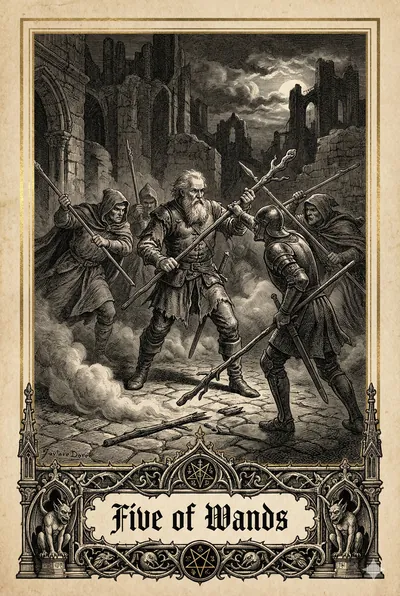
The RWS deck and most of its clones show 5 people armed with staffs and involved in a melee or free-for-all. It’s unclear whether this is in sport or in earnest, but the competition seems fierce. In either case, much of the energy spent here is self- cancelling, and nobody is questioning whether this is worth the effort. A card could also depict a slightly older gentleman defending himself with his staff against four similarly armed assailants, having already disarmed one, and now stepping towards the second while watching a third.
Interpretation
Darwin began: “We will now discuss in a little more detail the Struggle for Existence.” The core meaning of the Five of Wands is as straightforward as the Four was complex, although the Five will tend to make more of a mess of things on the back end. The force for change, or kinetic energy of the Five is expressed here through the element of Fire. Something is likely to get moved around or altered. The basic idea is that change is the rule. It can be temporarily resisted, but often this will makes the needed adjustments more abrupt, radical, and even violent, the longer that change is resisted or stresses allowed to build up. It’s like plate tectonics: better ten little quakes than a major disaster. But the notion of pent-up emotions or hostilities can also offer a false, self-fulfilling, ‘hydraulic’ model of things, demanding a catharsis or venting before more useful solutions are tried. While the Tarot images show interpersonal competitions and conflicts being worked out more violently or aggressively, this will not always be the case. Our worthy opponent could as easily be a disobedient part of ourselves, or anything else that might get us piqued, heated up, riled up, vexed, annoyed, or enraged. Sometimes it’s just an excuse to blow off some steam. It’s a good idea simply to let the images of interpersonal conflict here stand in as a metaphor for energetic divergence in general.
Crowley's account of two ways to view this card, cited earlier, bears repeating: “The Five of Wands is therefore a personality; the nature of this is summed up in the Tarot by calling it Strife. This means that, if used passively in divination, one says, when it turns up, ‘There is going to be a fight.’ If used actively, it means that the proper course of conduct is to contend” (BOT 43).
Although straightforward diplomacy is probably not an option here, there are usually alternatives to violence, even in self-defense. Raging against the rock that jumped out and stubbed your toe is almost always a bad idea. The martial arts can provide a pretty good model for non-violence. The best defensive move might be using your feet to walk away. An Aikido or Jujitsu approach might move directly into the center of the situation’s gravity and take control from there, simply helping the opponent to fall down. The kinetic energy here might be redirected or reapplied. Often aggression is just a substitute for confidence. If clarity and cooler heads can prevail at all, someone might think to ask if there really is a right and wrong here. We can often put cards on table and tell the truth and work it out, or we can resort to law and legal force, and even save ourselves some jail time thereby. Sometimes the exercise of this right to legal recourse is even a duty, even when the police power or system of justice is known to be corrupt. Rashness can be even blinder than this. This situation usually becomes intolerable after a time, and demands satisfaction or resolution, or that an obstacle be removed,
Authors will often suggest that this is only play, or a friendly competition, and this is sometimes the case. Both of these, of course, go way back, beyond even our life in the African trees. Just watch the young cats play-fight. Thought is a latecomer here. And it isn’t always just preparation to battle for mates or territory, or for driving the intoler- able and the insufferable out of our tribe and our niche. The Five of Wands is also vigorous effort for its own sake, for the simple pleasure in exercising power or force, for flexing some muscle, for the dopamine, for good health, and for learning more about life. Whether in sport or in earnest, our mock combat teaches agility, decisiveness, ingenuity, focus, and fair play. These games are analogs of real world affairs that go far beyond the more heated engagements. They even have something to add to quiet walks in the woods.
And, naturally, this can can mean what it seems like it means: a true test and rite of passage, one played for keeps and even for survival, an incident calling for extreme self- assertiveness and exertion, an emphatic contradiction, or non-acceptance, of things as they are. The Yijing counterpart is Gua 21, Biting Through, which describes the use of emphatic, corrective action. Violations of due order, forces at odds and cross-purposes to what we know is a better way, unjust and illegal challenges to our sovereignty or our safety, being put or set upon: all of these might demand emphatic action or force. We know in ourselves that forward motion often has repercussions, especially if we fail to process the feedback we get. But sometimes it falls to us to be the repercussion or be the feedback for others. We may have an opportunity here to offer some good information to bad actors and actions and answer a challenge with appropriate force, asserting what is right. But where it’s information we offer, there are good arguments for starting first with clarity, instead of wrath or rage. Clarity is still the best hope for an effective solution, even if diplomacy is out of the question.
Eastern Resonance (Yijing)
Gua 21, Shi He, Biting Through, Decisive Action. Da Xiang: Zhen (5) below, Li (Wands) above; “Thunder and lightning bite through. The early sovereigns clarified penalties when declaring the laws.” Emphatic judgment, teeth, consequences that bite, culpability, incisiveness, enforcement, eradication, execution, criminal law, termination, trenchancy. “Satisfaction. Worthwhile to execute justice.”
Five plus Wands. Forces for stabilization allow pressure for change to build. The pressure releases suddenly, with force out of proportion to that of steady change, breaking out of the Four's confines. A backlog of change catches up quickly, structures are challenged and defended, the changes test the status quo,
Mystic Correspondences
Astrology
Mars in Fire Signs and Houses. Mars is good with fire, maybe too good. It’s an inclination to act dynamically, with assurance and vigor. Self-assertion does not need to be offensive, aggressive or violent, and the absence of these is often a measure of real assurance and strength, even in a warrior.
Qabalah
Geburah in Atziluth. Breaking out of the stability and confines of the Four and Chesed, the balance swings from peace towards force, from love towards judgment. Stability has led to a backlog of change, now being remedied at a pace faster than gradual change would have moved.