Image Reference
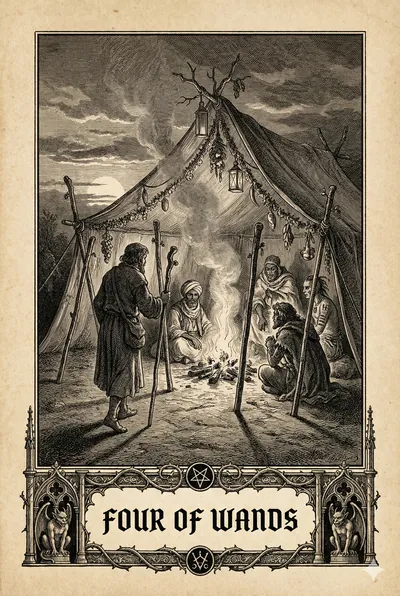
A wayfarer arrives at a place where the wayward can rest, an open-air canopy, a temporary structure, already containing a fire and three other nomads who all seem to hail from different cultures. Four walking staffs are seen. The mood seems celebratory, even with fungible celebrants. The day’s last task is to enter and make himself at home. Many decks feature a celebration of sorts, and perhaps even a marriage, but this is only a moment in time, when things hold relatively still, not a lasting state of affairs like a marriage would be. This a stay at the inn in the midst of a longer journey. The day will pass, but it’s one that may be remembered.
Interpretation
There is an inherent tension between the organizing, constructive, and consolidating processes of the Fours and the disorganizing, restless, and dynamic energy of the fiery Wands. This is resolvable, however, in the idea that stability and structure here are only temporary, dynamic, and ad hoc, or ad interim. This is stability in motion, security on the move, dynamic equilibrium. There is only one provision here: the stability of fire is in its sources of fuel. A self-sustaining system needs only to feed. But if all it does is consume then it cannot maintain its place or its welcome. It takes care to stay longer than this. A home base may also be a formula or standard for living, an ethic, a reliable attitude, or an adaptable sense of identity, in which case the entire journey can be both home and destination. Otherwise, the term completion may simply be ironic, and wherever you go, there you are.
Who we genuinely and fundamentally are can be altered by experience, and we want that if we are living well. Continuity is more important in life than consistency. Stability exists, but in an ever-changing form, and a tolerable continuity is conditional and contingent upon getting along with our context. If we enter this present context correctly, we at least have a place to rest for a while and things might hold fairly still for a time. Identity is constrained for now by place, as the fire is by a pit or a hearth, with a stock of fuel close by. The Wands that form the gate in Smith’s deck signify something more like a party or a weekend event. I would use the term caravansarai, a stable place for the travelers who are constantly streaming through it. Feeling at home here becomes a simple matter of tact and good manners, but better still if you can tell a good story. While we adapt ourselves to our niche here, we still want a niche in which we can be ourselves. Self-management is advised. The sacred fire, the eternal flame, the controlled burn: all of these want to have some maintenance included in their budgets.
The idea of ‘completion’ is frequently mentioned along with this card, but a functional arrangement or working configuration captures the notion much better. This includes having a functional personality and a working identity. We are meeting the conditions of our place, but not assuming that we will remain the same when the context changes. We are only completing what needs to be done for now. We are able to know and respect the place we are in, to know the place on its own terms, to fit in and still be ourselves, to remain self-reliant but tactful, politic, polite, and thankful enough to obtain any help that we need. Nothing is really done or complete here, except that we have now put more days, descansos, and milestones behind us. This may be no more than a state or stage of attainment, prior to moving on.
Also relevant to the card is the stability that we carry with us through the fire and the changes, how we stay recognizable to ourselves while we are evolving and adapting to our circumstances, how well we hold ourselves up and hold ourselves together. This is our integrity. In order to remain both consistent enough and adaptable, we will want to travel lightly, as it’s easier to hold it together when we have less baggage to manage: a little luggage maybe, or a small carry on, or maybe a bug-out bag. Perhaps a tent instead of a building. The corresponding Gua in the Yijing is The Wanderer. One prepares with a few well-chosen and highly portable tools, such as our wits, tact, credit, self-rule, a likable attitude, or a useful one, and working notions of what is necessary and sufficient: just the essentials, a simple standard or formula for living. It’s also easier to get out of tight spots this way. The ease and comfort with which we move through the world, our sense of at-home-ness, is a function of our adaptability, or our nichemanship, our tactics of intrusion, and our capacity for diplomacy. This gives us a more dynamic version of the Four’s stability. The goal is to not be a stranger. For the sake of avoiding unpleasant surprises, we want to be trusted for the reliability of our character. It helps when a good repute or reference precedes us. The presumption of innocence and benefit of the doubt help preserve us. These will make negotiating mutually acceptable arrangements easier, even with strangers. As Bob Dylan put it, “'to live outside the law you must be honest.” This preserves us a more reliable freedom.