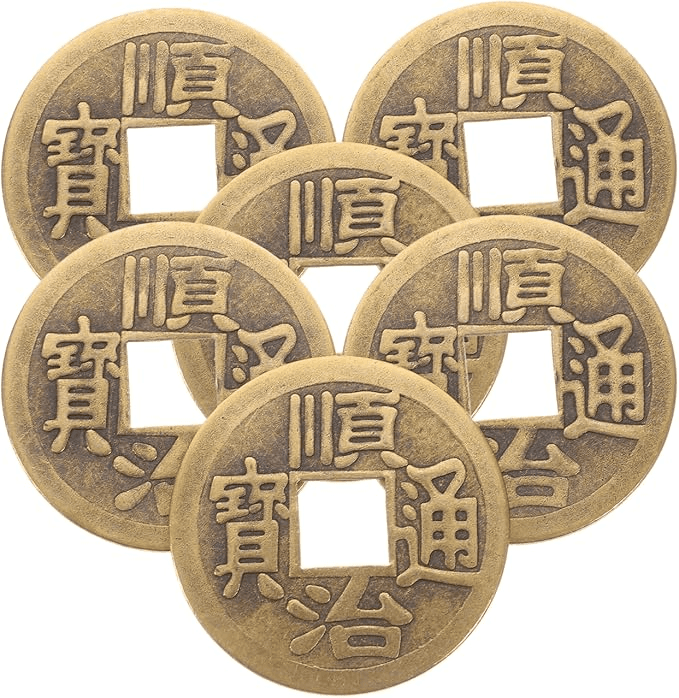
I Ching Coins Meaning: Heads, Tails, 6, 7, 8, and 9
I Ching coins are used to turn a question into a hexagram. Three coins are tossed six times. Each toss becomes one line, and the six lines together form the answer you read in the Book of Changes.
The coins also carry symbolic meaning. Traditional Chinese coins are round with a square hole: the round shape suggests Heaven, while the square center suggests Earth. In a reading, the two sides of the coin become Yang and Yin, activity and receptivity, movement and stillness.
If you are here for the short version:
- The side with Chinese characters is usually Yang and counts as 3
- The blank or simpler side is usually Yin and counts as 2
- Toss three coins together to get 6, 7, 8, or 9
- 6 and 9 are changing lines
- 7 and 8 are stable lines
This article explains what the coins and numbers mean. If you want the full casting sequence, use the companion guide: How to use I Ching coins step by step.
What Do I Ching Coins Mean?
In divination, I Ching coins are not lucky charms first. They are a simple way to create Yin and Yang lines.
Each coin has two possible states:
| Coin side | Line energy | Value | Common meaning |
|---|---|---|---|
| Character side | Yang | 3 | Active, firm, creative |
| Plain side | Yin | 2 | Receptive, open, yielding |
When three coins are tossed together, their values are added. The total tells you which kind of line to draw.
This is why I Ching coins are useful: they translate chance into a structured symbol. Instead of giving a simple yes or no, they create a six-line pattern that can be read as a situation, a warning, or a direction of change.
Which Side Is Heads on I Ching Coins?
Most readers treat the side with four Chinese characters as the Yang side. If you are using modern coins, choose one side before you begin.
A common convention is:
| Modern coin side | I Ching role | Value |
|---|---|---|
| Heads | Yang | 3 |
| Tails | Yin | 2 |
The exact convention matters less than consistency. Decide before the first toss, then keep the same rule for all six lines.
If your traditional coin has one side with four characters and one side with fewer marks, use the character side as Yang. If the coin design is unclear, assign one side as Yang and the other as Yin before asking your question.
The Meaning of 6, 7, 8, and 9
Three coins can only produce four totals. These four totals are the heart of the coin method.
| Total | Combination | Line | Meaning |
|---|---|---|---|
| 6 | Yin + Yin + Yin | Old Yin, changing broken line | Receptive energy at a turning point |
| 7 | Yang + Yin + Yin | Young Yang, stable solid line | Active energy, stable for now |
| 8 | Yang + Yang + Yin | Young Yin, stable broken line | Receptive energy, stable for now |
| 9 | Yang + Yang + Yang | Old Yang, changing solid line | Active energy at a turning point |
In practice:
- 7 is drawn as a solid line
- 8 is drawn as a broken line
- 6 is drawn as a broken line that changes into solid
- 9 is drawn as a solid line that changes into broken
Changing lines are important because they show movement. If your reading has a 6 or 9, the first hexagram describes the current situation, while the changed hexagram shows the direction the situation may be taking.
Read more here: What are moving lines?
Why Are Six Tosses Needed?
A hexagram has six lines. You build it from the bottom upward.
The first toss becomes line 1 at the bottom. The sixth toss becomes line 6 at the top.
This order matters because the I Ching reads change as a layered situation, rising from hidden conditions into visible expression.
For the actual casting ritual, including how to ask your question and record all six tosses, read: How to use I Ching coins.
Can You Use Regular Coins?
Yes. You do not need antique Chinese coins.
You can use three pennies, quarters, euros, or any three matching coins. The important part is that each coin has two clearly different sides and that you assign the values before you start.
For example:
- Heads = Yang = 3
- Tails = Yin = 2
Then toss all three coins together six times.
The coins are not magic by themselves. They create a clear ritual frame: you slow down, focus your question, and let the pattern appear without forcing an answer.
Divination Coins vs Feng Shui Coins
The phrase "I Ching coins" can mean two related but different things.
In I Ching divination, the coins are tools for casting a hexagram. Their main purpose is to generate Yin and Yang lines.
In Feng Shui, Chinese coins are often used as symbols of wealth, protection, and good fortune. They may be tied with red cord, placed near a door, kept in a wallet, or arranged in groups such as three, six, or nine.
These uses overlap historically, but they are not the same practice.
| Use | Main purpose |
|---|---|
| I Ching divination | Cast a hexagram for guidance |
| Feng Shui coins | Symbolize prosperity, protection, or auspicious energy |
If your goal is to consult the Book of Changes, focus on the coin values and the six-line hexagram. If your goal is Feng Shui, the coins are usually treated as symbolic objects rather than a casting method.
A Simple Number Example
Suppose you toss three coins and get:
- Heads + heads + tails
- 3 + 3 + 2
- Total = 8
That line is a stable broken Yin line.
If your next toss gives:
- Heads + heads + heads
- 3 + 3 + 3
- Total = 9
That line is a changing Yang line. It is drawn as solid in the first hexagram, but it changes into broken when forming the relating hexagram.
This example only shows how the number is interpreted. To cast a complete hexagram, you repeat the process six times. You can follow the full method in the 3-coin casting guide, look up your result in the 64 hexagrams, or use the free online tool: Toss I Ching coins online.