Image Reference
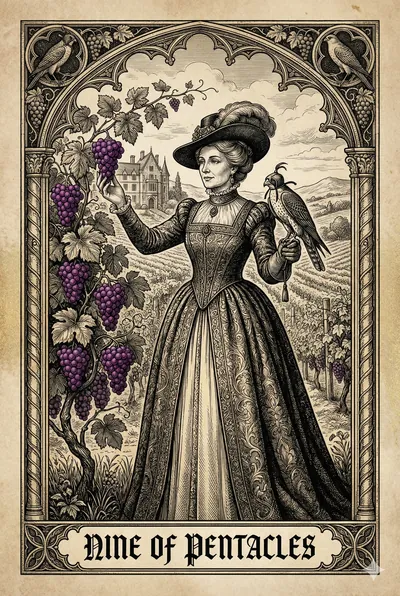
An elegantly dressed, middle-aged woman of means inspects the grapes in her vineyards. Nine full purple clusters hang on one of the vines. Her posh estate lies beyond. A small, hooded falcon accompanies her, possibly symbolizing an ability to rise above or to see past her present boundaries. She is in a position to take care of her higher order needs. This is a point of culmination, not a permanent state. Some degree of readiness for change ought to be seen in the image. If this is going to be sustainable, there will be more resourcefulness here than meets the eye.
Interpretation
Commentators emphasize the encouraging aspects of this card, with interpretations like material gain, stability, accomplishment, favor, plenty, sufficiency, equity, ripeness, being fully funded, comfort, abundance, having means, resources, prosperity, productive living, realized gain, wherewithal, harvest, and a cultivated or cultured life. There is, however, frequent mention of security issues related to the maintenance of such prosperity, a need for good management or administration of capital and property, or needs for discernment, vigilance, circumspection, foresight, and safety provisions. We want to maintain some fluency in our affluence. If we have that in a psychological sense, we can move in any direction we want. It’s the emotional equivalent of material solvency: not being needy or indebted. This is how to keep winning where others would lose.
Well-being and being well, welfare and faring well, are dreams come true, or seem to be. But things are not always what they seem. The Nines still imply all the challenges of building reliable foundations in a world that’s always changing, and so meanings of this card should speak at length to the problems of adaptive resilience in the built and home environments. Yes, the woman here appears to be enjoying a bountiful harvest. At the same time, however, there are reasons why those nasty old bandits don’t raid pretty little farms until after the harvest has been brought in and sold off. There are explanations why systems enjoying vigorous growth resist rot until they stop growing. Anticlimax follows the climb. Rewards and satisfactions, once gained, are subject to change. It’s difficult to ‘have it made’ forever. True fortune is to roll well with fortune: the good life must be dynamic to handle any vicissitudes.
A rigid sense of security is inclined to invest too much in expecting the worst. We get overspecialized and inflexible. We need keys to leave the house. We build Maginot lines that wind up guarding the thieves. Wealth should expand the options, not narrow them. Fixed assists, attitudes, and behavioral responses limit the ways we can move in a crisis. Although we haven’t been truly self-sufficient since we left the trees and the caves, some measure of self-reliance will give us a broader range of responses, as well as a broader perspective. Most items in the first aid kit will hopefully never get used, but we have to admit that it’s worth the investment. The odds are good that we never recover the money we spend on insurance, but this leaves us more ready for our unexpected events, and the sense of assurance and security has some value of its own.
Clearly, having plenty of means and wherewithal affords us a plenum of resource from which to draw. Extra supplies are cached, the granaries and cisterns are full, rainy day savings bring interest. There are pressures in economics-driven societies to spend all we have, and then some, and many simply submit here, then count on help from others when things go wrong. Discipline, character, and maturity resist this with a little restraint. This is like practicing, or having fire drills, or developing an immune response. Values are for practicing. Responsibility is remaining able to respond, having not squandered one’s safety margin or buffer. Maturity looks to what’s truly important, and this is continuity rather than sameness. Things come and go. They are tools, not parts of ourselves or beings with rights. We have a versatility in being able to put one thing down and pick up another, and this includes our attitudes as well as what seem to be lifestyles. Such a stance gives us meetness, the ability to meet the world on its own terms, known to others as fitness. In this way, too, the situation can be more than it seems. We may look like one thing, but we can also be many others. We look like we can survive one kind of hardship, when in fact we can dance around many. We can also note that the strength and resilience of an ecological system is in its depth and diversity, in its depth of field, in its redundancy of functions, and in a broad portfolio of available responses to stressors. This is a much different and longer-lived kind of richness than having static piles of wealth.
The Yijing counterpart is Gua 07, The Militia. Most translators call this the Army, but in doing so they miss more than half of its meaning. The model depicted throughout the lines is that of an ad hoc force, a grassroots militia, that disappears into the populace except when in training or when called up to meet real threats. Other than the Swiss army, and perhaps some guerrilla forces, this has little resemblance to the standing armies we know. The title, Shi, also means teacher, and this speaks to experience, maturity, the discipline of training, and a familiarization with optional responses. And above this too, we have a metaphor for resourcefulness, preparedness, and adaptive resilience in general. The two Bagua or trigram images depict a groundwater resource to be drawn on as needed. It’s a metaphor for mobile responsive- ness, for solvency and liquidity in life, for strategic security, the hedging of our bets, and the diversification of our portfolios.