#12, L'Appeso, L'Impiccato, Le Pendu, Il Traditore (Traitor)
The Hanged Man
The Spirit of the Mighty Waters
Acceptance, Surrender, Letting Go, Samvega
Image Reference
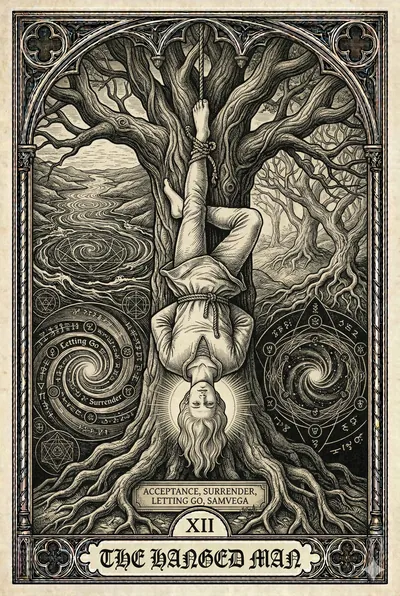
A young, blonde man hangs suspended by his left foot from a living tree, used as a gibbet or gallows. His hands are behind his back, his legs form the same figure four seen in the Emperor, but reversed. He doesn't seem to be suffering, rather, he has an aura of transcendent ecstasy. The tree could be the ‘world tree’ of legend, here in the shape of a Tau cross. The subject has in some way volunteered to undergo a trial, an initiation, or a renunciation. He may have ‘turned himself over’ as if to some higher power, or as though emptying himself to prepare for a major change. He is ‘taking no stand’ of his own, but simply submitting. This could be a dream or vision quest, or a rite of passage. The card demands trust before such an act of surrender. The earlier versions and titles of this card suggest a less voluntary submission to this rite or ordeal, or ‘volunteering’ for it by way of making bad choices. Hanging a debtor by a foot for public disgrace was one of several punishments called baffling. He would be humiliated into better behavior in the future. Others saw a traitor being punished, although back then traitor simply meant one who betrays a trust. Still, most figures, including those receiving some punishment, do not appear to be suffering, and in fact seem to be grateful. Some are even glowing with a nimbus or halo, either for the chance to redeem themselves or for a chance to transcend to a higher state of awareness.
Interpretation
The image of the Hanged Man may imply much from cultural lore, from Buddha and the Bo Tree, to Zhuangzi’s Bao Jiao, Jesus, Judas, Peter, or even Houdini. These are not central to the modern image, although Odin hanging from the world-tree, Yggdrasil, for nine days to discover the runes comes close. This is not a named figure. It’s possibly an act of expiation, someone atoning for a sin or a crime, whether driven to this by contrition or penitence, or involuntarily receiving a punishment. If this is redemption, it would imply a debt to be paid that soon will be. If this is correction, it appears to be welcome, or even a relief. Maybe there is hope that humiliation becomes humility, as dignity and pride are stripped away. It may be time for sober reflection, a time to admit, as is done in 12-step recovery, that ‘my best thinking brought me here,’ and begin the rehabilitation, now that the bottom has been reached, now that how low you can go may be known a bit better.
But atonement is only one account of this image. More centrally, it’s the welcoming of a chance to change our ways, or quite literally, our point of view, as our world is turned upside down. This might also be a voluntary act of sacrifice, though most of our thinking regarding sacrifice is wrong-headed. Giving something up to get something better is not sacrifice at all. Sacrifice as a trading up in value is just buying something cheaply. The word means to make sacred, and it isn’t about getting at all. It’s about saying thank you instead of asking for more. The Hanged Man could be offering himself up for the benefit or use of the others, for some idea of a higher power, or for a higher purpose, something greater or something more long-lived than himself.
This card could also refer to a needed time out, a temporary suspension of our goal- directed activity. This might be a bit extreme without having a higher purpose or end in mind, like Buddha’s vow under the Bo Tree, to not to move again until enlightened. But even simple delays, detours, and changes of plan can provide perfect times to broaden our perspectives. Turning ourselves around, resetting our priorities, reevaluat- ing our values, or checking out surprising new orientations, can be radical, life- changing events. Such tests of our patience and understanding can show us how free our minds can be, and how flexible our directions. We can move ourselves around as if we were water. Central to the attitude needed here is acceptance. Like water, we accept the place we find ourselves in and submit ourselves to its shape. We accept reality as it is, instead of what we wish it to be. This is not the same thing as approving of reality as it is, or wanting things to stay this way. This is merely starting our process of adapting from a place of more perfect realism, so that if we do decide to change things, our efforts are based on the facts of the matter instead of our fantasies and delusions. We may even find unexpected advantage in having our course redirected.
This is also the card of our higher unitive or oceanic states, the mystic’s truth, the great embrace, attunement to cosmic rhythms, an infinite plenum as our source and destination, and together with this, the prerequisite dissolution of our ego, and perhaps even human exceptionalism. The self must stop its endless fussing over itself. The fake mysticism of the new age cannot get over its narcissism. We must lose our self- importance, humble ourselves down to an appropriate size to really get the perspective. There still remains the question of how much reason or logic we’re allowed to pack for the trip. Certainly for the duration we must let go of our baggage and luggage, our burdens and our parcels, our prior beliefs and disbeliefs, in order to get where we’re going. There are goals that require a self, and selflessness costs us these, at least for a time. It doesn’t matter if annihilation of the self is in the beloved divine or in the tortured calculations of astrophysics. At least we get a break from our smallness and may find something great where we might be of some service. The more serious among us can take a shamanic route and break our heads open with elucidogens. Mescalito, Teonanacatl, Mother Aya, Alice D. and the Bwiti all have lessons for us if we have the courage to simply lay back and welcome the learning. We don’t want to try this without some good guidance and reasons to trust the process, but to really know the water we need to melt ourselves down. The Yijing counterpart used here is Bagua 0, Kun, Accepting or The Receptive.
Not all of our surrendering needs be so grandly transpersonal. Sometimes this just means waiting a little longer than you’re prepared to wait. Maybe it’s minor revisions in thinking that cease to be scary. Just a little loss of self, or a little gain in unselfish- ness, can help change a mind going bad, or off in the wrong direction. The search for deeper meanings seems like such a scary thing to those who can only be upright and full of themselves. Sometimes it just helps to turn over and dump this stuff out. Changing our minds, breaking our habits, upending old patterns, reversing our attitudes, flip-flopping our opinions, rethinking all that we are, thinking outside the box, reprogramming our own minds, will no doubt get others to point and wag their fingers and tongues, like they do at that poor guy hung upside down in the plaza. And yet this can get us unstuck. The only real humiliation and shame is when we prefer old errors and faulty perspectives to a little social discomfort.
Eastern Resonance (Yijing)
Bagua 0, Kun, Accepting. Kun comes close to the conception of Earth which we know as Gaia, the great Mother. Since the ocean did not play a very important part in the lives of the ancient Chinese, those aspects of life which in the West accrued oceanic and aquatic symbols were represented in China by symbols of the Earth: these include unity, fecundity, understanding, tolerance, embrace, plenum, capacity, and the mystic’s truth. And of course there are the more “earthy” meanings of basis, ground, substance, support, substratum, accessibility and as many gifts, simply, yet condition- ally, provided, as one is capable of accepting. The dimension is breadth, the range of the possible, or the field of options with an infinite number of paths. The point here is complete acceptance of the world as it is, with what it has to teach.
acceptanceaccounting errorsacquiescenceatonementbetween worldsbreaking habitsbroader perspectivechange of plancircumspectioncomplianceconcessionconversioncooperationcorrective forcecounterintuitive tackdeliverancedetachmentdevotiondissociationemptying the cupenduranceexpiationforbearancegiving without gettinghumilityinevitabilityinterference with plansletting golimbolosing self- importancemalleabilitymetamorphosisnew anglesnew point of viewnew perspectiveoffering upopening upopting outoutside the boxpassivitypatiencepausepenitenceplaces of learningpowerlessnessputting oneself lastquittingrealignmentreconsiderationredemptionreexaminationrehabilitationrelinquishmentrenunciationreorientationreprogrammingresetting prioritiesresignationrespiterestraintrethinkingreversing direction and perspectivere-viewrite of passageritual offeringsacrificesamvegaserviceshamanic journeysobering reflectionsubmissionsubordinationsurrendersuspending beliefsuspending disbeliefsuspensesuspensiontaking another sidetrialturnaroundturning it overuncertaintyundergoingunderstandingupending patternsvision questwaiting is
Warnings & Reversals
•control
•delay
•detention
•empty ritual
•enforced sacrifice
•failure to commit
•fixed points of view
•frustration with progress
•half-heartedness
•helplessness
•humiliation
•impotence
•imprisonment
•inanimacy
•lack of reward for ordeal or trial
•martyr complex
•narcissism
•narrow mindedness
•ordeal
•pride
•punishment
•shame
•shaming
•stagnation
•stripped of dignity
•stubbornness
•suffering
•time out
•uncertainty
•victim mentality
Structural Components
The Hanged Man is a pure conception. Out of his association with Neptune, he might be thought to have some meanings in common with Pisces and the Twelfth House. The new correlation made here between Water and the Yijing Bagua Kun, Accepting, symbolized by the Earth, requires some explanation. The civilization that birthed the Bagua did not live by the sea. The oceanic experiences that are symbolized in the West by big water were symbolized in China by the good Earth. Still, the idea of acceptance or embrace is very much common to the Hanged Man, Mem, and Kun.
Mystic Correspondences
Astrology
Neptune. Self as a wake through chaos, the complex and mysterious universe, a place where impressions are left, writ in water. One’s reference feeling within greater environments, life, region, world. Processes of universalization, embrace, acceptance, dissolution, dreaming. The edge of measurability, the undefin- able, the ineffable, doors of perception, unification, compassion. Failure of definition and fact. Ocean and Gaia in the blood. The Roman god Neptune was pissed off a lot, astrology’s Neptune, not so much.
Qabalah
The Mother Letter Mem, for the element Water as the part of a triad, with Air and Fire. Mem, as representing the sea, works well with the idea of acceptance and embrace.